The Big Island’s Rare Coastal Pools Are Under Siege
Sea level rise is endangering the fragile brackish waters on the Kona Coast, but it’s also creating new ones.
As the sea rises, the coastal brackish pools nestled among the Big Island’s lava beds have also begun to change.
Known as anchialine pools, these brackish ecosystems are distinct from tidepools in that they are connected to the ocean and fed by fresh groundwater from below. They are found in other places around Hawaiʻi, but the vast majority — over 400 — are on the Kona Coast.
Anchialine pools had a wide range of historic purposes. Some were reserved for royalty to bathe in while others were important sources of drinking and agricultural water for Native Hawaiians in an otherwise dry region. They were, and still are, used by fishermen to keep the fish they catch cool on warm days.
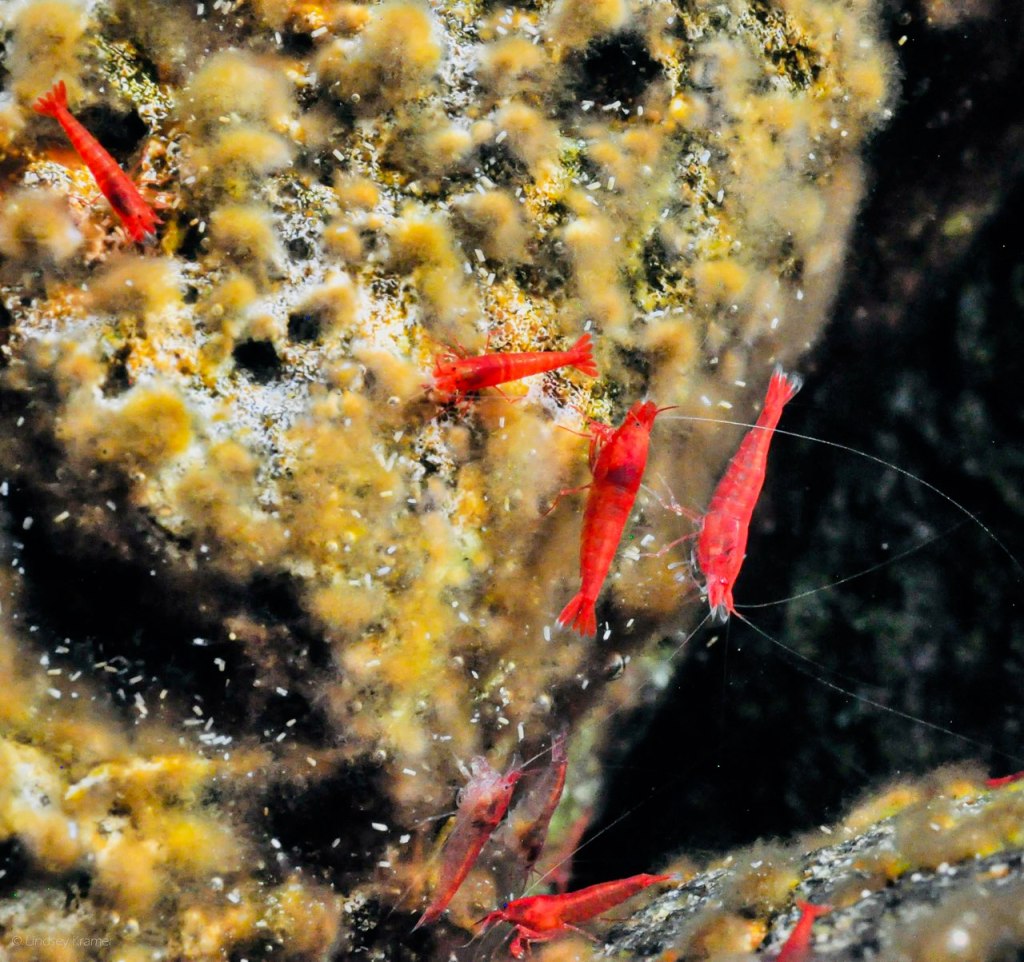
The pools are also home to several rare, endemic species including ʻōpae ‘ula — a tiny, red algae-grazing shrimp and an important form of fishing bait used by Hawaiians to feed ʻōpelu during spawning seasons — as well as a swimming crab, the orangeblack Hawaiian damselfly and the Hawaiian stilt, or ae‘o.
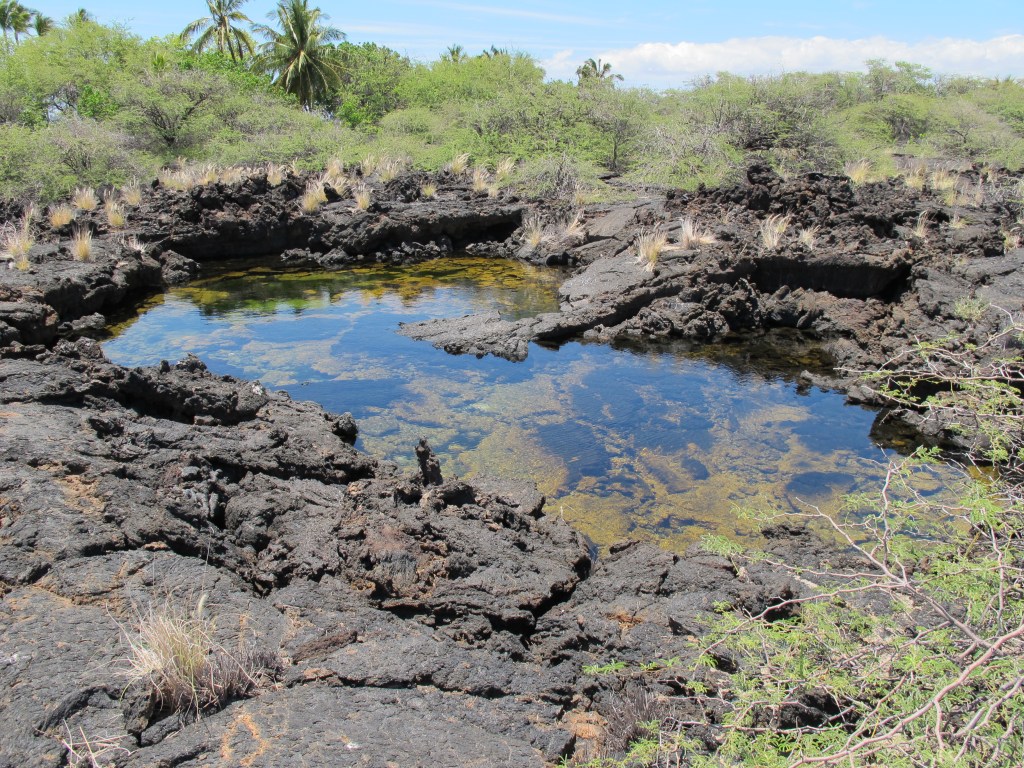
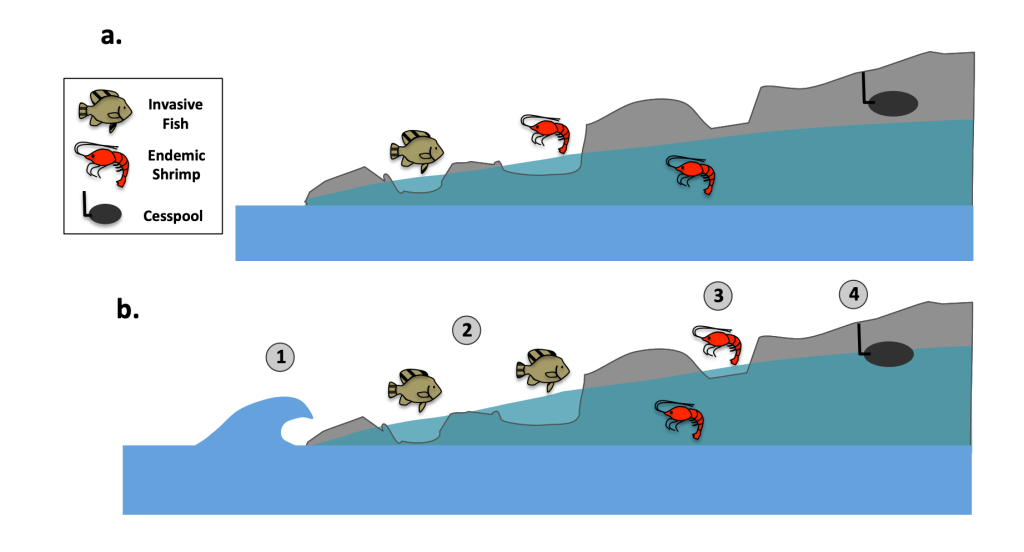
Now, ocean waves are blasting anchialine pools more often and bringing invasive fish that change the nature of the pools. Flooding and big rain events also tend to send wastewater toward the coast, adding nitrogen to the pools, which leads to more algae.
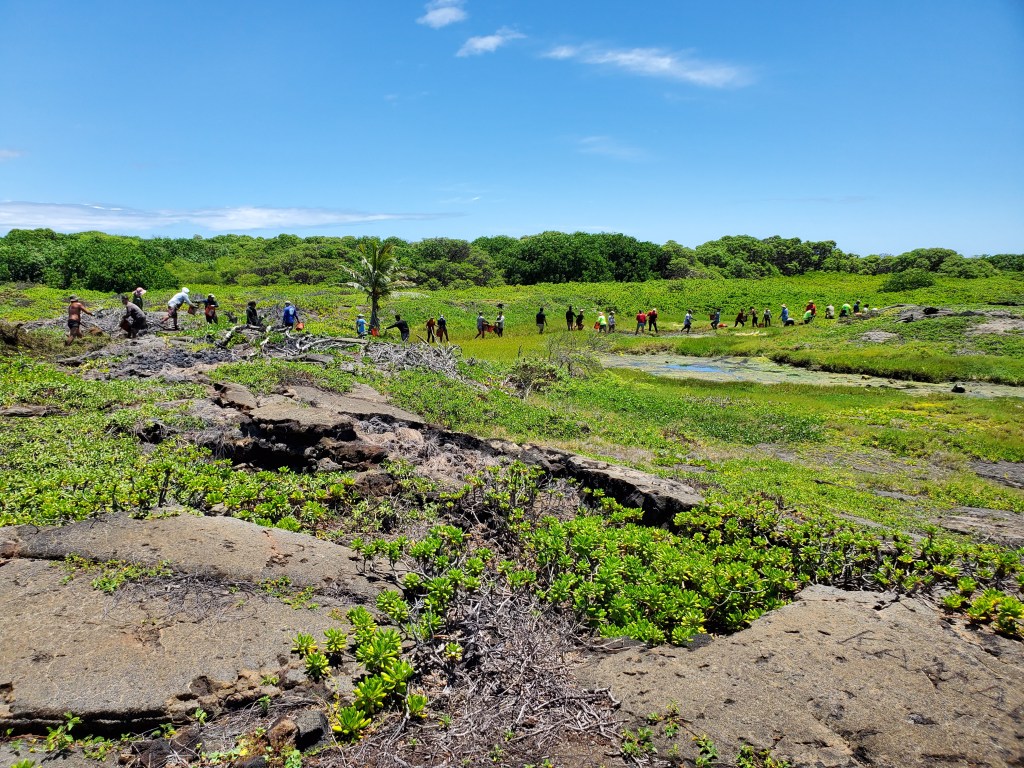
“There’s a very small sample of folks who are even aware of anchialine pools,” said Barbara Seidel, the Hawaiʻi island marine coordinator for The Nature Conservancy. But that group is increasingly committed as it has become clear the pools’ existence can no longer be taken for granted. Seidel leads Hui Loko, a collective of 23 groups working together to restore and protect anchialine pools up and down the island’s western coast. The group’s members meet up to form bucket brigades that remove invading weeds, and fill their nets with tilapia and other invasive fish. And they’re hoping to make more people aware of the value of the need to protect what they see as invaluable cultural and ecological resources.
Mapping And Restoring
Many anchialine pools were lost when the Kona coast was initially developed to make way for tourists. As Hawaiian scholar Hannah Springer wrote in a short essay for the Conservation Council for Hawaiʻi, “Repurposing has been aggressive. While our ancestors valued the pools as family water sources and as habitat for the ‘öpae ‘ula used as chum for ‘öpelu and akule fishing, and to water their plantings of niu and hala, malihini have not always recognized the value of the pools. Wai ‘öpae were covered to create an airport runway and holiday hotels.”
The work to protect the remaining pools picked up speed about a decade ago, when the National Oceanic and Atmospheric Administration led a collective effort by the National Park Service, the University of Hawaiʻi, The Nature Conservancy and other groups to start mapping and planning for the way climate change stood to impact the pools.
Lisa Marrack, an affiliate faculty member at UH Hilo, built a sea level rise model for NOAA that noted the ecosystems in the pools were at risk of changing dramatically. Her maps predicted that many anchialine pools would likely grow, merge, and in some cases become saltwater fishponds. As those ponds filled up with reef fish and invasive fish, the native shrimp tend to would hide in the cracks and in the groundwater below the ponds — surfacing only at night to eat the algae when the fish were asleep.
Marrack’s research also suggested that another phenomena would occur: new pools would start appearing further inland, creating new homes for the shrimp that move back and forth between the surface and subterranean worlds.
Now, seven years after the research was published, Marrack and others are seeing those changes play out. And they want to ensure the new pools can be protected, and that the groundwater flowing through them is as clean as possible.
Marrack and her colleagues studied the algae-grazing shrimp in the large cluster of anchialine pools at Kaloko-Honokōhau National Historical Park, less than a mile away from the Kealakehe Wastewater Treatment Plant, where minimally treated R2 wastewater is being dumped in a lava field and plans to upgrade the facility have been delayed by several months.
They found that the shrimp living in anchialine pools are effective bioindicators for sewage in groundwater flowing through coastal habitats.When they exist without invasive fish, the shrimp are typically able to keep algae levels down. But the research found that “increased groundwater flooding due to sea level rise will increase the interaction between groundwater and sewage infrastructure and potentially increase contamination to pools.”
Protecting Future Pools
Kevin Sullivan, a planner in the Long Range Division of the Hawaiʻi County Planning Department, said in an email recently that anchialine pools should be seen as “visible expressions of a larger underground groundwater system connecting upland recharge, coastal aquifers, wetlands and the ocean.”
He pointed to the county’s effort to create an Integrated Wastewater Management Plan, which could help improve the water quality in the pools, and its intention to use a “One Water” approach, which would treat drinking water, wastewater and stormwater as a single, interconnected resource.
Hawaiʻi County’s new General Plan 2045 also includes language specifying that development should not adversely impact anchialine pools and estuaries, as well as a directive to maintain a program for acquiring and restoring the pools using “collaborative biocultural stewardship.” But, like all general plans, that intention will require legislation to move the vision forward.
“Future anchialine habitat may presently look like undeveloped dry land, Sullivan said. “Once that land is developed, filled or covered with permanent infrastructure, the opportunity for the ecosystem to migrate inland in response to rising groundwater may be permanently lost.”
In the remote and windy Kamilo District of Kaʻū, on the southern side of Hawaiʻi island, Troy Sakihara, an aquatic biologist with the DLNR Division of Aquatic Resources mapped and inventoried a handful of anchialine pools from 2008 to 2010.
“Within the past several years, we’ve seen a lot of those become tide pools,” he told Civil Beat. A number of new pools have also already appeared in the neighboring Manuka Natural Area Reserve.
Sakihara collaborates with Marrack and relies on the mapping she does to help his team of researchers best understand how to prepare for the new pools.
“If we’re anticipating an anchialine pool emerging in an area that’s full of invasive vegetation or invasive species, we can start by clearing those things out, so when the pool does eventually emerge it’s starting off in better conditions,” he said.
There are no explicit buffer zones for the new pools laid out in the county’s general plan, but Sakihara said he’d like to see a clear directive to prevent impacts from development moving forward.
Sakihara has worked with the Hawaiʻi Wildlife Fund and other members of Hui Loko to draft a resolution designed to minimize human-caused impacts to anchialine pools, such as the introduction of tilapia and the harvesting of shrimp for aquariums. If it passes, he said, it could usher in an important set of policies at the state-level. But the resolution would need to work its way through the rulemaking process at DLNR first, Sakihara added.
The same advocates also worked to pass a bill earning ʻōpae ʻula recognition as Hawaiʻi’s official state shrimp in 2025, in an effort to lay more groundwork for protecting the pools.
In the meantime members of Hui Loko will continue to meet up quarterly to help keep them clean and offer mutual support and advice. Seidel, Hui Loko’s coordinator, said it functions a lot like a support group for the few dozen people who care about and tend to the ponds despite their relative obscurity. And the hours of hard work in the hot sun pay off when thousands of tiny red shrimp come creeping back up from the subterranean depths.
Seidel recalled seeing the transformation — which sounded too good to be true — for the first time in 2020. “I’d always been told the ʻōpae ʻula were down in the cracks, hiding. And I was like, ‘they could be. Or they could be gone,’” Seidel said. “And then we eliminated all the fish in a pool, and came back the next week, and there were the shrimp, just waiting for us.”