After Maui Fires, Rents Dropped, But Money Is Tighter
A new report released Tuesday shows a mixed bag for Maui residents who are still reeling from the devastating fires three years ago.
Maui residents affected by the 2023 fires have greater housing stability than they did a year ago, according to a new report released Tuesday by the University of Hawaiʻi Economic Research Organization, but job prospects have not changed much during the same time period and household incomes are still lower than they were pre-fire.
The report, authored by Daniela Bond-Smith, Sophia Davis and Caleb Wood, uses data pulled from an ongoing Maui recovery survey to track the lives of affected residents three years after fires burned parts of Kula and destroyed much of Lahaina, killing 102 people.
Fewer families are displaced from West Maui than was the case a year ago, the report says, but only 7% have been able to return to their homes.
“While these changes point to modest improvements,” the study says, “displacement remains widespread among fire-affected households.”
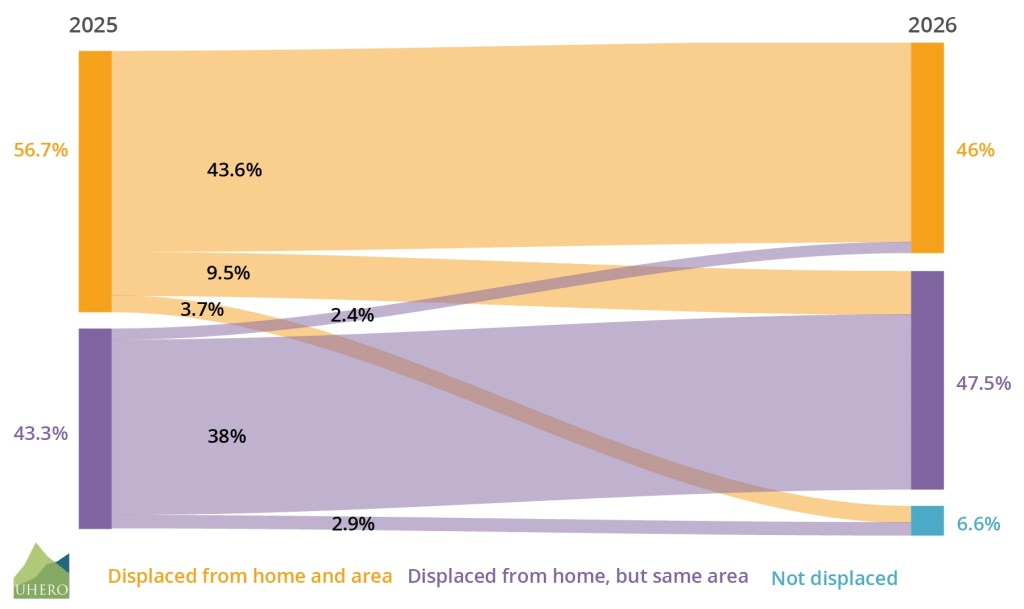
The displacements are likely an underestimate, the report says, because survey outreach is mostly done through Maui-based networks and therefore may have missed people people who have left the island.
More people live in permanent housing and are staying in longer-term temporary housing, according to the report. It says a little over half of respondents lived in permanent housing at the beginning of 2025 compared to roughly two-thirds who are in permanent housing now.

The share of people who have lived at the same address for more than a year has jumped significantly since the beginning of 2025, rising from one in five in January of that year to almost two in three as of May 2026.
“Repeated moves between short-term placements, which characterized much of the first two years after the fires, have become far less common,” the report says, “and some households have had some level of continuity to re-establish routines and community belonging.”
Rents have fallen dramatically for small housing units, meaning studios and one-bedrooms, from roughly $2,000 per month down to $1,200. But while those rents are close to what they were pre-fire, rent prices for bigger units have remained stubbornly high at well over $2,000 compared to the median pre-fire rate of $1,600 for two-bedroom units.
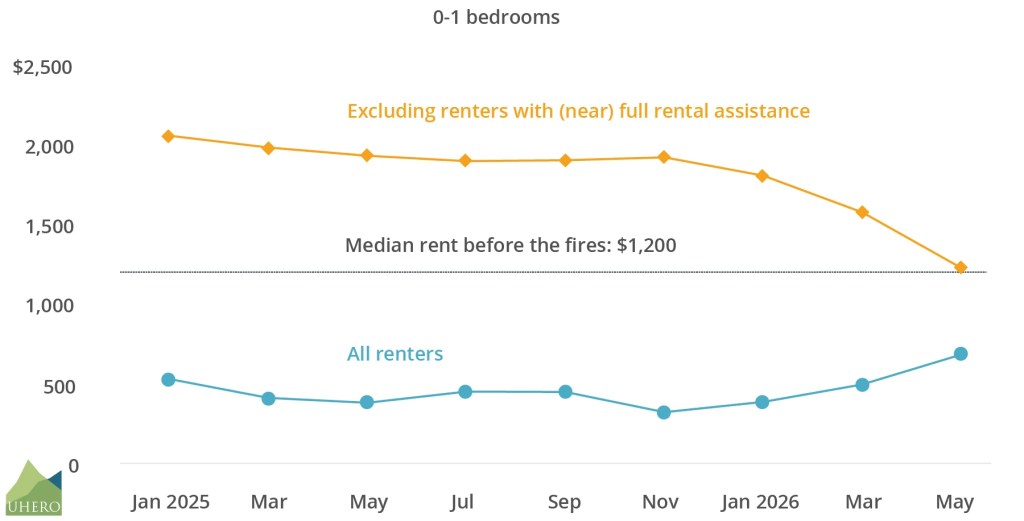
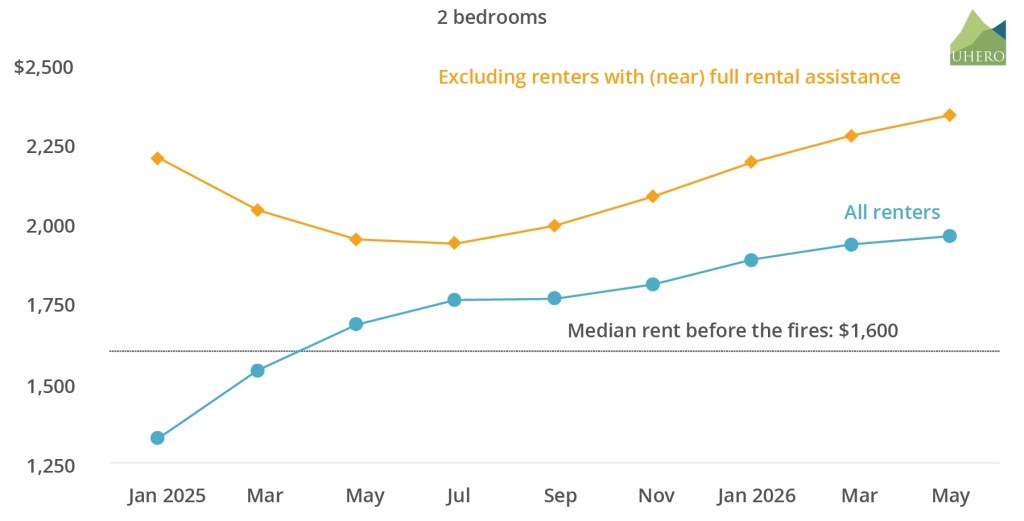
“Families needing more space therefore face a market that has not eased,” the report says, “with rents for larger units still well above pre-fire levels.”
These changes have corresponded with declines in the amount of assistance being offered to fire-affected households. Federal assistance is due to end in February 2027, and starting this September, households currently paying minimal amounts for rent will have to pay 50% of the fair market rent for Maui County based on U.S. Housing and Urban Development guidelines.
Meanwhile, the state’s Ka Laʻi Ola interim housing program, which includes 450 homes for up to 1,500 people, is set to run through August 2029.
“Under current conditions,” the report says, “the assistance that has kept out-of-pocket costs low is being withdrawn faster than market rents are falling.”
FEMA assistance has halved since January 2025, a pattern also seen when looking at assistance from community organizations and friends and family.
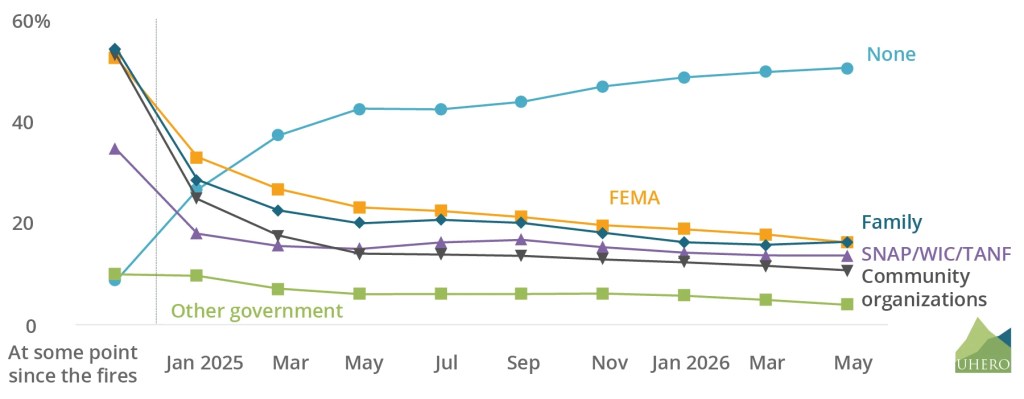
“It is unsurprising that these informal sources of assistance are not sustainable at scale in the longer term, especially given the economy-wide effects of the disaster,” the report says.
Overall, the number of households receiving any assistance at all has halved since January 2025.
“Part of this decline may reflect households regaining stability,” the report says, “but the magnitude of difference suggests that assistance has likely also fallen for households who still need it.”
Financially, some households are better off than they were in January 2025 but most still worse off than they were pre-fire.
While unemployment has somewhat improved since the beginning of 2025, the report says, people are making lower incomes than they did prior to the fires. In addition, it says, today’s lower unemployment rate corresponds with more people opting out of the labor market for good.
Tourism spending is still down roughly 20% compared to before the fires, the report says, and the island’s dominant economic sector is unable to reabsorb all the workers that had to leave it as a result of the disaster. More than 63% of households are poorer than they were before the fires, the report says. While that’s an improvement compared to the 70% figure from the beginning of 2025, the report shows, it still represents a substantial majority of families affected by the fires.

Ready the full study below.