World-Traveling Hawaiʻi Bureaucrat Arranged $30M In Tech Contracts
A Hawaiʻi Department of Law Enforcement official identified tech companies that impressed him at conferences about policing and surveillance. He later got a job with one of them.
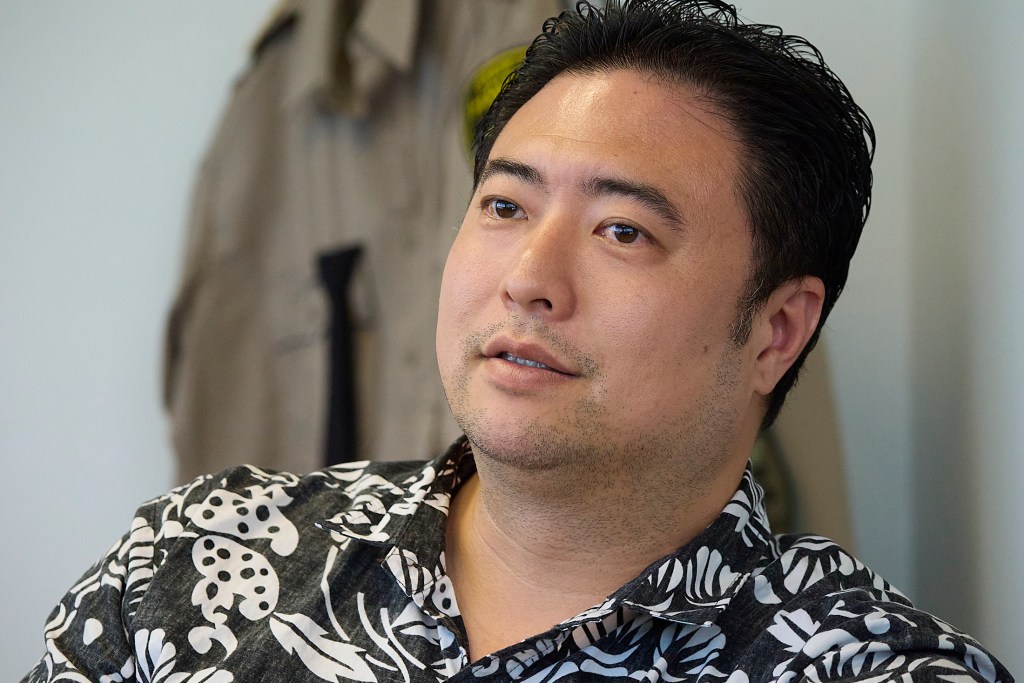
The state Department of Law Enforcement has sent Brandon Asuka to more law enforcement conferences in the last two years than most state workers will go to in a lifetime.
A homeland security meeting in Washington, D.C. A counter-terrorism conference in Dublin, Ireland. The World Police Summit in Dubai.
Department directors sent the high-level official to conferences, site visits and presentations all over the world on the taxpayer’s dime in an effort, they say, to set up the agency with the most advanced law enforcement technology available. These trips, in turn, have translated into multimillion-dollar contracts for tech companies — one of which has hired Asuka as a product developer, even as he continues to work for the state as a contractor.
Over the course of 21 out-of-state trips from 2024 to 2026, taxpayers spent nearly $80,000 for Asuka’s hotels, meals and flights. As a result, the state signed at least 10 contracts worth nearly $30 million with contractors Asuka connected with during his travels. All were procured through an interstate cooperative purchasing program that sidesteps the traditional bidding process.
The total value of the contracts, some of which span multiple years, represents nearly a third of the department’s $100 million annual operating budget. The Hawaiʻi Department of Law Enforcement’s work is distinct from the county police departments. It is responsible for matters within the state’s jurisdiction, including enforcing controlled substances laws, protecting state property like courts and jails, and investigating crimes committed on or against state property, like the Hawaiʻi Capitol.
Department of Law Enforcement officials say the contracts have been essential to the success of the new department, which was launched just two years ago and has set out to embrace technology and save manpower in a short-staffed agency.
The flurry of trips and the flood of new technology contracts that followed, however, are concerning some government observers who say the spending surrounding a single state employee seems excessive, and the worker’s newfound employment with a company that was hired at his recommendation presents an ethical issue.
“It is not doing anything to help the perception of impropriety that we have in our government currently,” said Camron Hurt, executive director of the government accountability nonprofit Common Cause Hawaiʻi.
The department’s heavy focus on new technology, including surveillance tools and license plate readers, is also alarming some critics who say it poses privacy concerns for the public and is out of step with what many residents want.
The purpose of these trips, both the current and former department directors say, has been to expose the state to the latest law enforcement technology and keep Hawaiʻi on the cutting edge.
Asuka, who sometimes accompanied the director or deputy director and on other occasions went in their place, said the contractors will help make Hawaiʻi safer and streamline work for the short-staffed agency.
“I think the creation of DLE gave the department a fresh start,” Asuka said. “We were given a unique opportunity to look globally to bring the best technology to Hawaiʻi to improve public safety.”
Asuka said he was never out for personal gain. He said he had already decided to step down from his position with the Department of Law Enforcement when Cloudwick, which builds AI platforms for public sector agencies, approached him about a role in product development. However, after a 30-day break from state employment, Asuka is now working for the Department of Law Enforcement as a contractor in a division focused on accreditation.
“I think everything that I’ve done for the department, or for the state, has been in their best interest,” he said. “It’s stressful knowing that you’re trying to do best by the state, but at the same time, people see you as selfish for some reason.”
System Architect
Asuka’s official title with the Department of Law Enforcement was program officer, but records show he often referred to himself as the chief executive officer, or CEO, a title that doesn’t actually exist in the agency.
Department Director Mike Lambert said he and the previous director, Jordan Lowe, also referred to Asuka as an executive officer and saw him as a chief of staff figure, someone who reported to them about the latest public safety tech solutions.
“His job is to understand national safety trends,” Lambert told Civil Beat in May, “and then see how we overlay that with our tech.”

The Department of Law Enforcement was officially launched in 2024 and absorbed oversight of the state sheriffs from the Department of Public Safety, which was dissolved in 2022. Oversight of the state’s jails and prisons fell under the newly formed Department of Corrections and Rehabilitation.
Asuka previously worked in professional standards and accreditation for the Department of Public Safety. Before that, he worked as a policy analyst and special assistant in Gov. David Ige’s office.
When DLE launched, Asuka quickly became the face of the agency’s expensive tech initiatives.
“When we started absorbing different law enforcement entities, we found that some of the systems were somewhat antiquated,” said Lowe, the department’s previous director. “So basically, Brandon was our system architect.”
World Traveler
From 2024 through 2026 — when Asuka was working full-time for DLE —the department sent Asuka on a new trip almost every month, and he was gone a total of 127 days, which shakes out to about four months. That includes interisland trips.
Some of Asuka’s first out-of-state trips for the agency were to Miami, Florida, in March 2024, to meet with executives of the emergency communications company, SaferWatch, and to Tallahassee to see how that department used the system. The company later got a $7 million contract to supply elected officials with panic buttons, place them in schools and host statewide tip lines where residents can report illegal firearms and fireworks activity.
The project, though, came under scrutiny because of a yearslong delay launching the technology in schools and a federal corruption investigation. The company’s CEO, Geno Roefaro, is charged with bribing a former commanding officer of the New York City Police Department’s School Safety Division to steer contracts toward his company.
Lambert said the program is now being piloted in Kapolei High School. He said the actions by the CEO are unfortunate, but he still considers SaferWatch a good product.
“If an Apple CEO does something stupid,” he said, “we’re not just going to throw away our iPhones.”
Asuka also accompanied then-director Lowe on a four-day trip to New York City and Los Angeles in September 2024 to tour the NYPD and LAPD’s use of Microsoft data analysis systems.
The following month, DLE announced it had signed a $3 million contract with Microsoft for artificial intelligence.
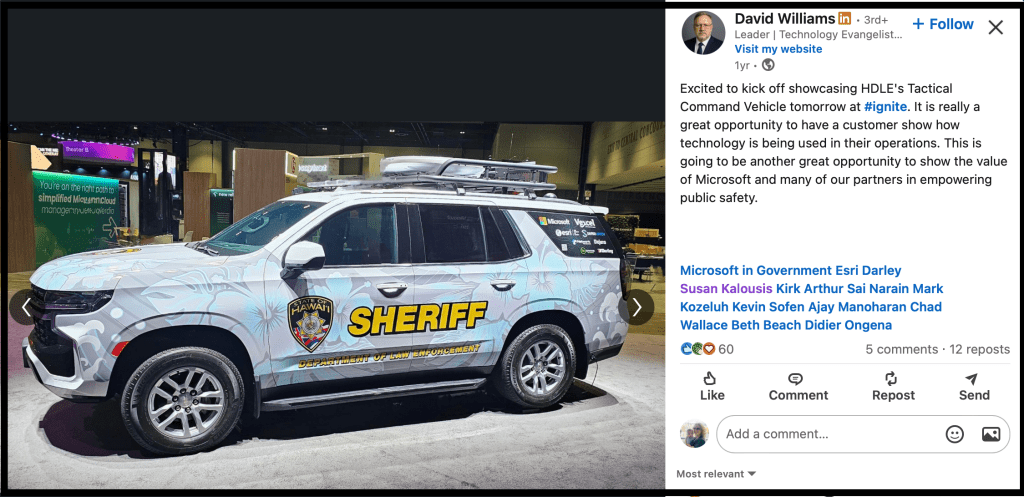
In an effort to increase the new agency’s visibility, the department even paid to have a sheriff command vehicle wrapped in a hibiscus print and shipped to Chicago in November 2024 to be showcased at a Microsoft conference. Lowe said he couldn’t remember how much that cost.
In 2025, Asuka took a 10-day trip to Pahrump, Nevada, with the department’s illegal fireworks task force to see how AI could aid in illegal fireworks investigations, Lambert said. From there, he went with the department’s Deputy Director of Administration Ernest Robello to Dublin, Ireland, for an international counterterrorism conference.
Sending Asuka to both places cost taxpayers nearly $5,000.
Asuka’s farthest journey was to the World Police Summit in Dubai in May 2025, a trip he departed on just three days after returning from Ireland. The trip started with the National Center for State Courts conference in Miami, Florida, where he accompanied Lambert to attend sessions on decriminalizing mental illness and homelessness. Asuka then flew to Dubai with Robello to see the latest in global police technology on display.
The World Police Summit has been known for showcasing some of the world’s most advanced, and intrusive, tech, such as “brain wave” reading headsets that purport to detect when someone is lying, and cameras that can zoom in on a face from more than a kilometer away.
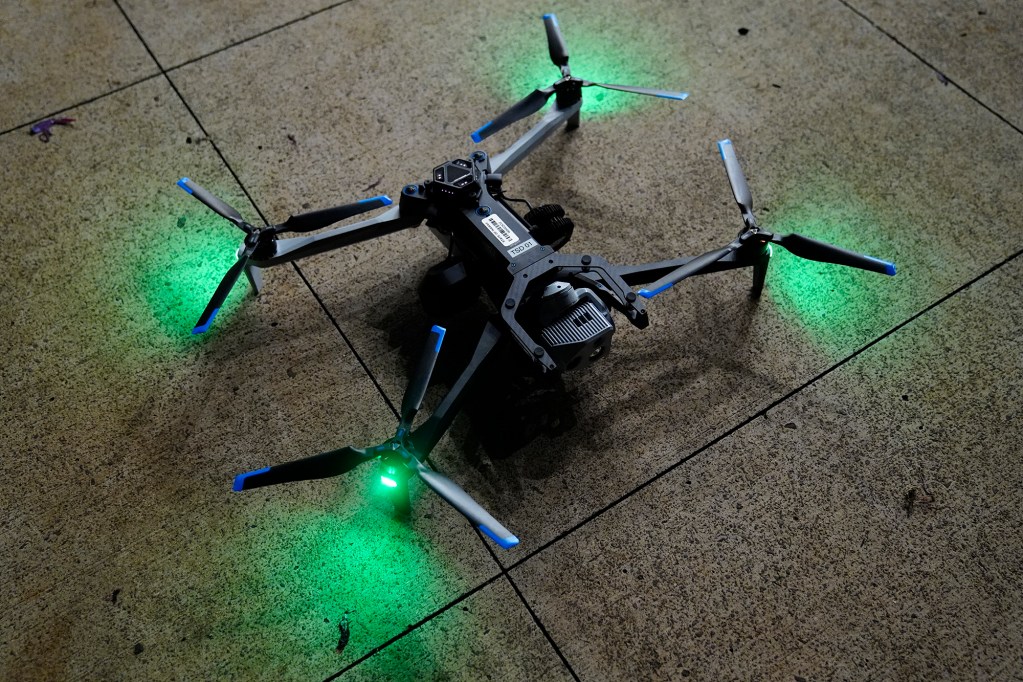
Asuka’s purpose on the trip, he said, was to explore the latest drone technology and get information to help set up the state’s so-called “drone as a first responder” program, which has now launched in partnership with the Honolulu Police Department.
In Dubai, the police department has drones that can deploy anywhere in the city within 40 seconds.
“The biggest example they gave us was somebody got pushed off of a rooftop, and it was a murder,” Asuka said. “And because their surveillance camera network picked up on shouting, a drone was deployed, and they actually saw the person get pushed.”
Dubai places drone docks in strategic places around the city so drones can be more quickly deployed. That’s something Lambert has already started replicating in Waikīkī.
Asuka’s attendance at conferences also resulted in a $5.6 million state contract with Motorola for body cameras, in-car license plate reader cameras and five years of unlimited storage; a $2 million contract with SHI International Corp. for AI-assisted investigations software and a tactical intelligence surveillance platform with video streaming and push-to-talk capabilities; and a $1.8 million contract with Fusus for a real-time crime center dashboard.
“Are we at the cutting edge? Are we behind?” Lambert said. “That’s basically the theme for all of (Asuka’s) attendance.”
As public sentiment becomes more wary of police technology and surveillance, Hurt said, the Department of Law Enforcement should shift its focus to recruitment and retention of officers.
But Lambert has highlighted the difficulty his agency faces hiring new sheriffs, especially given the fact their pay lags about $20,000 behind that of county police officers. Last legislative session, Lambert advocated for a bill that would have created $15,000 retention bonuses for Department of Law Enforcement officers but it stalled in the Senate Public Safety and Military Affairs and Ways and Means committees.
Critics Raise Concerns
Groups like the ACLU of Hawaiʻi have long been concerned about the expansion of police surveillance and say it’s an ineffective way to address public safety.
“I think we can all agree that of course we’d like to make our community safer,” said Wookie Kim, legal director for the ACLU of Hawaiʻi. “But I think it’s really important to challenge the premise that these surveillance technologies are going to get us there, and even if they do get us there to some degree, whether that’s the sort of society or community or environment that we want to live in.”
Other watchdogs said the number of trips the department sent Asuka on was excessive.
“It is important to see what’s going on in the mainland and other areas,” said Will Espero, a retired state lawmaker who previously chaired the Senate’s Public Safety Committee. “But again, we just have to make certain that it’s not wasteful, and the state does benefit in a timely manner.”
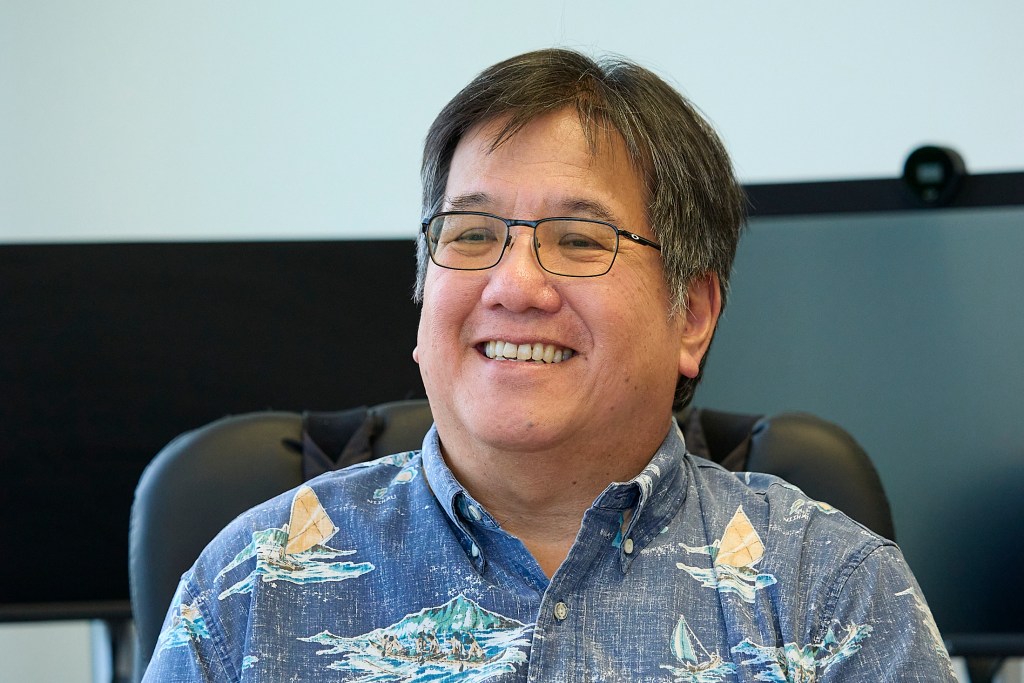
Lambert said other department officials travel frequently as well. Dorothy Booth, the state’s fire marshal who was hired in July 2025 has been to eight out-of-state conferences since she started, according to a document provided by Booth. The trips cost a total of around $17,000 and put her out of the state for 46 days. During the same time period, Asuka took five out-of-state trips, taking up a total of 23 days and costing about $16,000.
Lawmakers have explored limiting state employee travel. Last session, legislators considered a bill that initially proposed limiting state-funded trips to three per employee per year. The limit was removed in a later version and the bill, which proposed requiring agencies to submit detailed annual reports on employee travel, later stalled because the Senate disagreed with amendments the House had made.
State Rep. Della Au Belatti, who chaired the House Public Safety Committee, said she understands a new agency would face high start-up costs. But, she said lawmakers need to look at the Department of Law Enforcement’s expenditures closely, especially because it has gone through two directors in its short life and is about to get a third. Lambert is planning to step down in September to become a chief special investigator, and Deputy Director Jared Redulla will take over.
“I think the next (Public Safety Committee) chair, or whichever committee has jurisdiction over it, needs to make sure it’s meeting its statutory obligations, and then using money wisely,” she said. “What is the mission, and is the department fulfilling the mission with the resources it has?”
State Sen. Carol Fukunaga, who chairs the Senate Public Safety and Military Affairs Committee which oversees the Department of Law Enforcement, declined to comment, referring questions to DLE.
A Contract, Then A Job
The California-based AI company Cloudwick wrote glowingly about its partnership with Asuka and the Department of Law Enforcement on its website in 2024, even quoting Asuka praising the company.
“There’s no amount of dollar savings that can replace trust in an organization,” Asuka said, according to the company, “and Cloudwick continues to deliver time and time again on all of our use cases. So it’s definitely a partnership we’re going to continue.”
That year, the company entered into a $3 million contract with the Department of Law Enforcement. This summer, they offered Asuka a job.
Asuka said he had already decided to step down from his procurement role with the department before Cloudwick approached him about a position. He announced his plans to step down in June, shortly after Civil Beat began inquiring about his travel expenses.
He said he got job offers from multiple private vendors, but decided to go with Cloudwick, which offered him a role in product development where he could help work on a legislative intelligence platform. That’s something he helped build for DLE using Cloudwick. The platform tracks legislation, analyzes public comment and drafts testimony and has reduced the number of staff needed during the legislative session, he says, from more than 20 to three. His job with Cloudwick now is to improve on models of the platform so it can be sold to agencies nationwide. He said he will not communicate with any Hawaiʻi agencies about Cloudwick.
He started a full time role with the company in July, and then on Aug. 18, came back to the Department of Law Enforcement on a temporary-hire contract. He declined to share how much he is earning with Cloudwick.
The fact that Asuka helped direct millions of taxpayers dollars to the company and later took a job with them — while continuing to work for the state — is raising alarm bells for some.
“It’s troubling to see the revolving door between public officials and companies that they have paid money to,” said D Dangaran, an assistant professor of law at the University of Hawaiʻi Mānoa. “On the state level, we should be highly concerned about it, and the warped consequences are impossible to predict, but we know that it could include overspending in terms of what our state actually needs because of this potential conflict of interest.”
Asuka said there isn’t a conflict with his current state role. He now focuses on writing policy to get the department accredited by the Commission on Accreditation for Law Enforcement Agencies, something the Legislature has wanted for the state sheriffs for more than a decade. His current role has nothing to do with the department’s Cloudwick contract, he said.
His state contractor position is paid hourly at just under $43 an hour, he said. That translates to about $89,000 a year, a significant pay cut from the $103,000 to $165,000 he was making as program officer, according to Civil Beat’s salary database.
Asuka insisted he isn’t doing any work for the private company on state time.
“People have two, three jobs in Hawaiʻi,” he said.
There is a state law that restricts state employees from working for their former agency’s contractors within a year of leaving their government service, but it only applies when an ex-state employee works for a contractor on matters they touched as a state worker.
Lambert said a human resources officer spoke with a staff attorney at the Hawaiʻi Ethics Commission who advised Asuka could continue working for the Department of Law Enforcement as long as his role had nothing to do with Cloudwick or its contracts with the state. Lambert said he would provide written documentation of that ethics guidance but did not share it with Civil Beat as of Wednesday.
Other than the legislative tracking platform, DLE investigators also use Cloudwick AI platforms for fireworks investigations, especially to analyze shipping logs of incoming fireworks imports and look for inconsistencies, Lambert said.
“We use them for legislation and fireworks,” Lambert said. “So in the accreditation office, he doesn’t overlap.”
A separate state law prohibits government agencies from granting contracts to companies represented by individuals who worked for that agency within the prior two years. But that wouldn’t seem to apply to Asuka’s case either, because the contract was granted before he took the Cloudwick job.
Hurt, the director of Common Cause Hawaiʻi, said he thinks government employees should not be able to work for a company that has done a procurement bid with the state for at least a year.
“During this time, where there’s such distrust in our government,” he said, “our people in positions of leadership should take extra care of our trust in our government right now.”