

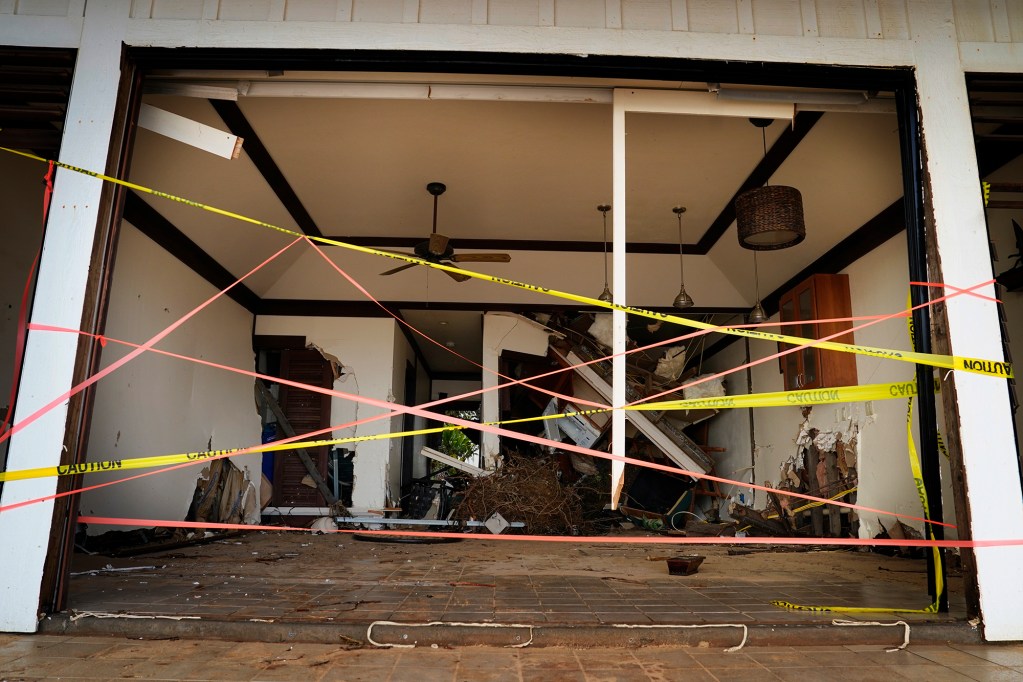
Jon-e Delos Reyes-Olores had decided to weather Hurricane Lowell at her home near the Kekaha Neighborhood Center because she’s “hard headed.”
But outside her house Monday night, as the storm bore down and a parked cop car’s headlights lit the violent sea, she had second thoughts. Water had already reached her backyard and the sound of the wind was deafening.
By morning, the rising waters had pushed the vehicle into a neighbor’s lanai, Delos Reyes-Olores said.
“The wind was ripping, doing all its swirls. It was just scary,” Delos Reyes-Olores said, adding that she would make a different choice in a future storm. “I better go to the shelter next time.”
On Tuesday, her neighbors were “going like madmen” to clear the coastal road and their properties of rocks, sand, trees and debris as a battered Kauaʻi took stock of a storm that revived old memories of devastation from Hurricane ʻIniki more than 30 years ago.
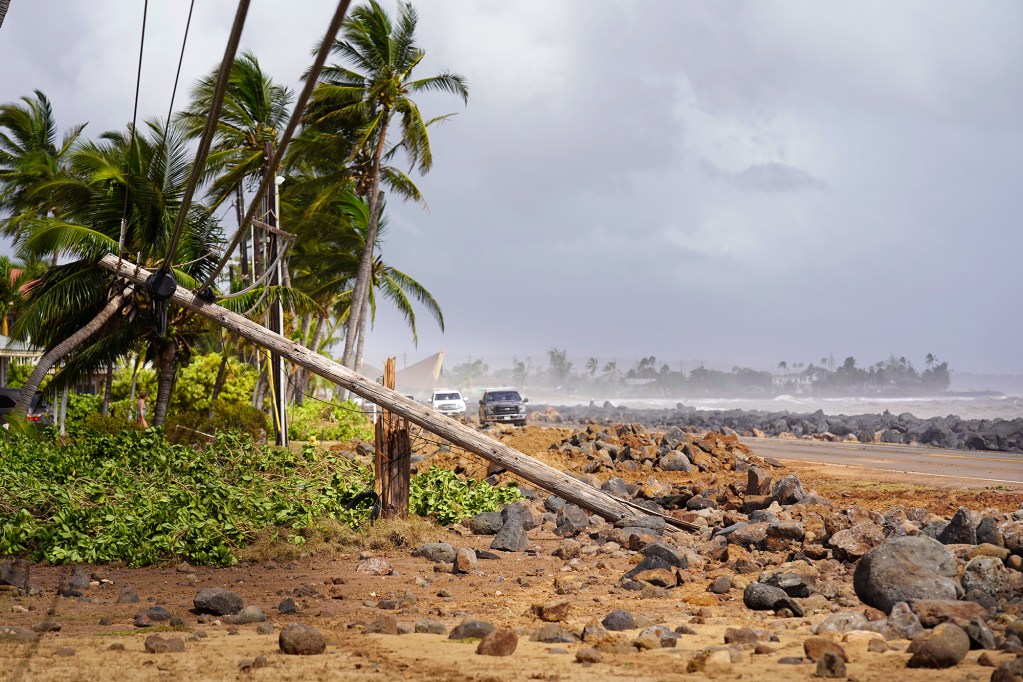
Hurricane Lowell, which spun 90 miles northwest of Līhuʻe at its closest, spared Kaua‘i of the level of destruction ʻIniki wrought with a direct hit as a Category 4 storm. Still, nearly everyone was left without power Tuesday and damage assessments had just begun.
The island saw significant impacts from the triple threat of wind, rain and a coastal storm surge, said Elton Ushio, the Kaua‘i Emergency Management Agency chief.
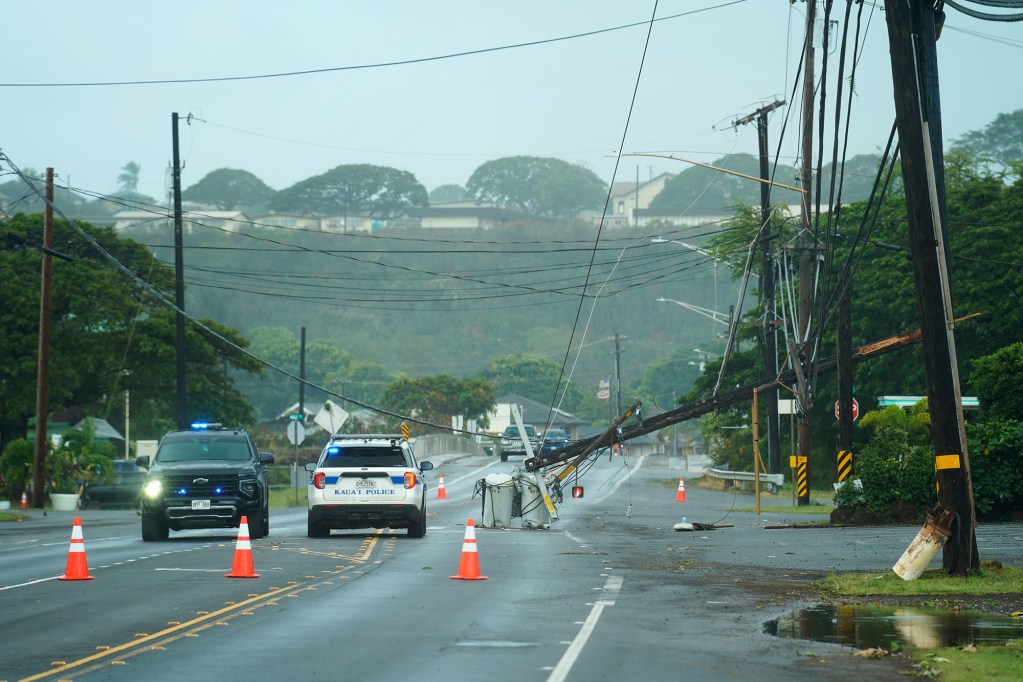
Speaking Tuesday morning, Ushio said the county was tracking 198 active hazard reports, including downed trees, power lines, debris, flooded and cracked roadways, flooded bridges, landslides and broken water pipes. But as the day wore on, scant details were made available about the extent of damage — helicopters took off after sunrise to survey the island, but little to no information about their findings was reported.
Likewise, an unexplained interruption in radio broadcasts left Kauaʻi residents unable to tune into official reports about road closures and other storm updates through much of Tuesday.
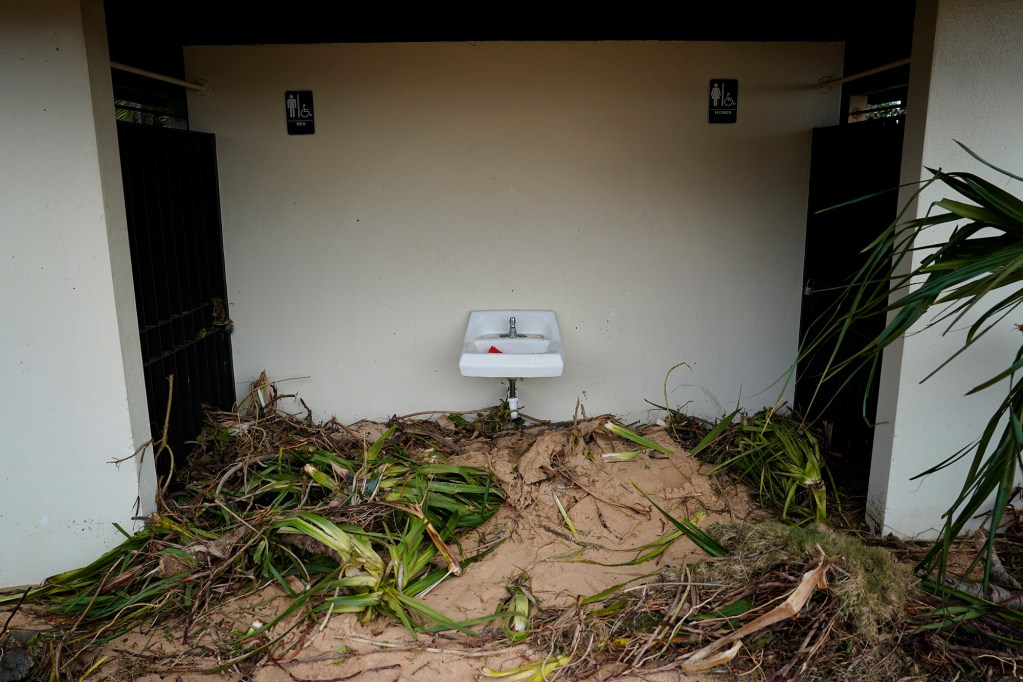
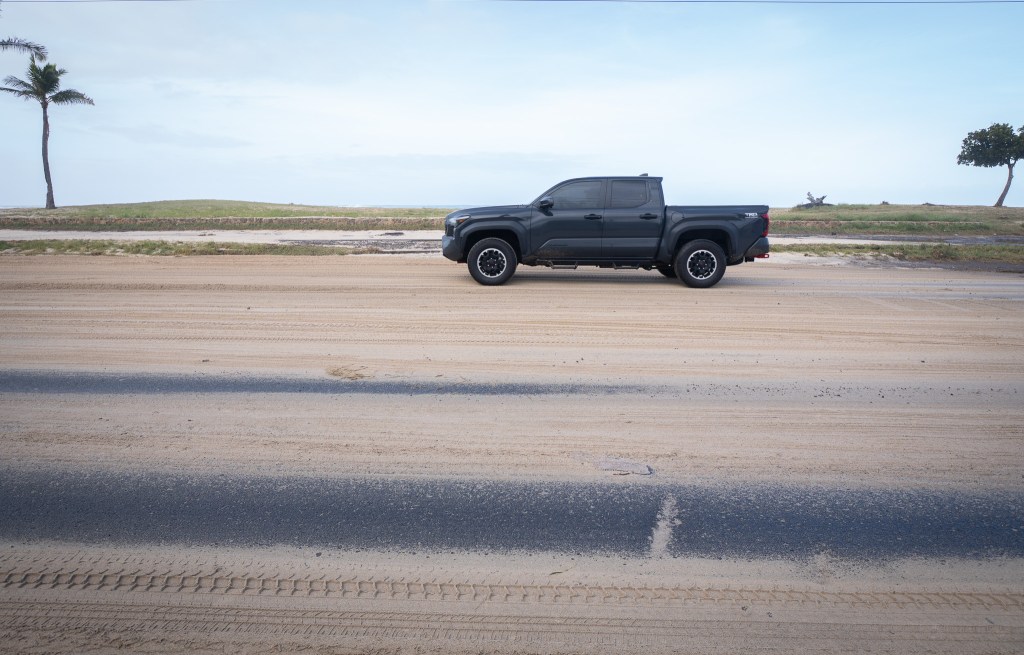
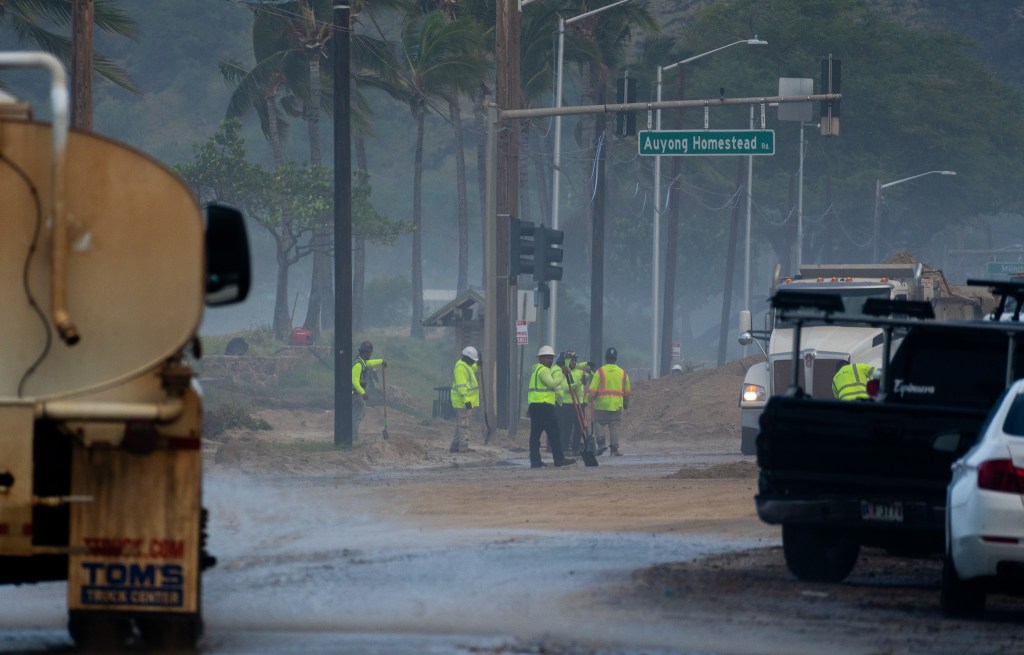
Kaua‘i’s North Shore and Westside highways were impassable due to flooding and debris, with some roads buried in sand and boulders that washed ashore from coastal armoring.
While worst-case scenario fears appear to have been averted, at least one storm-related injury was reported on Kaua‘i, and a man was killed on Oʻahu on Monday evening after a large tree trunk fell on his tent in a Waimānalo park, according to Gov. Josh Green. The hurricane hammered homes, businesses, infrastructure, utilities and government facilities such as the Port Allen small boat harbor, where several vessels sank and piers were destroyed, officials said.
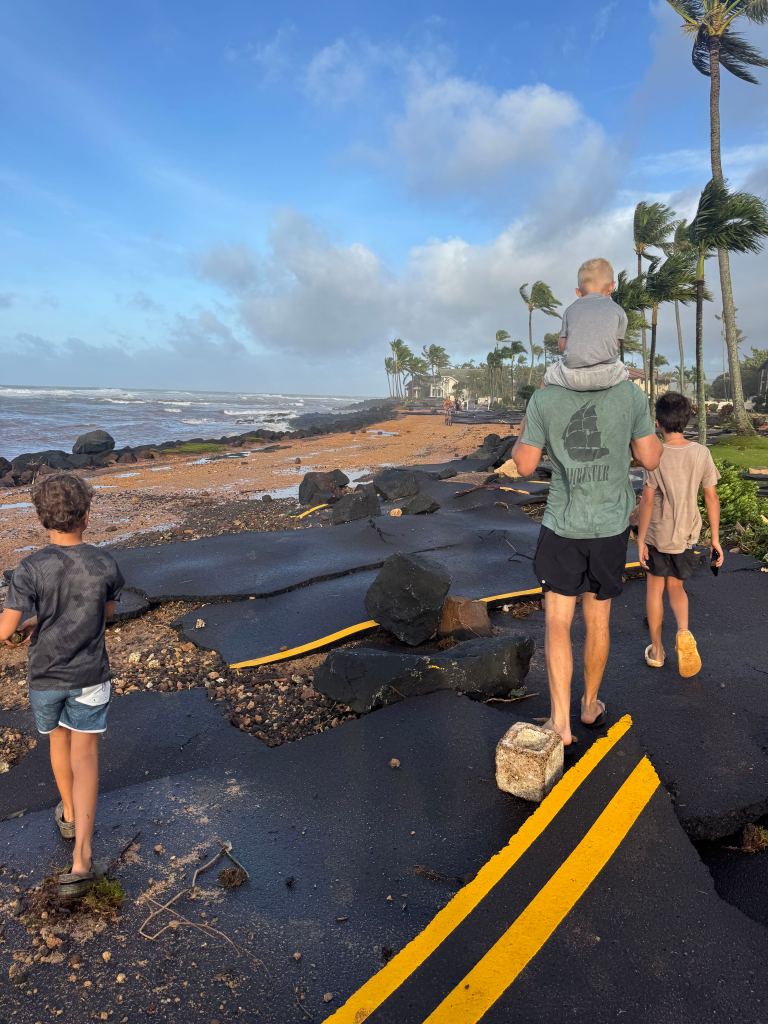
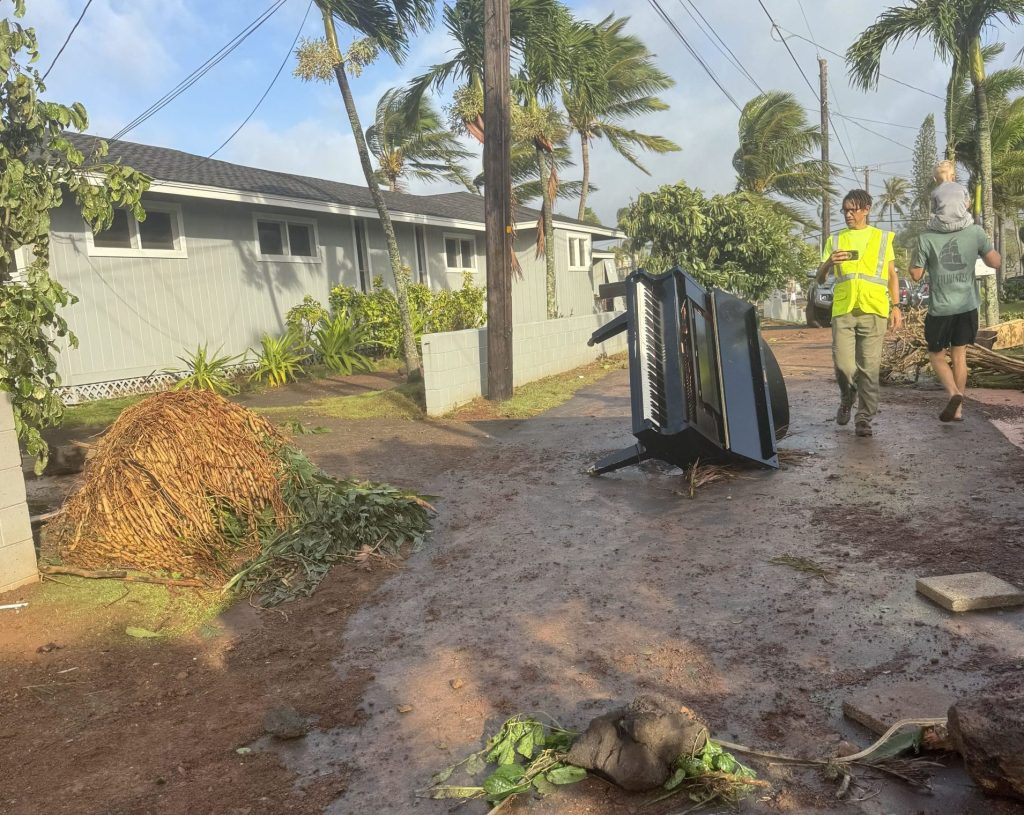
“It looks like a war scene,” said Michael Olivas of Niumalu, where the hurricane had ripped rooftops from buildings at the Nawiliwili small boat harbor.
Part of Olivasʻ own roof was found across his street, where a coconut tree also lay across a power line. Wind had torn apart his sheds. He and his family spent hours Tuesday morning filling a 20-by-8-foot debris container with metal, asphalt shingles, wood and other pieces of roof.
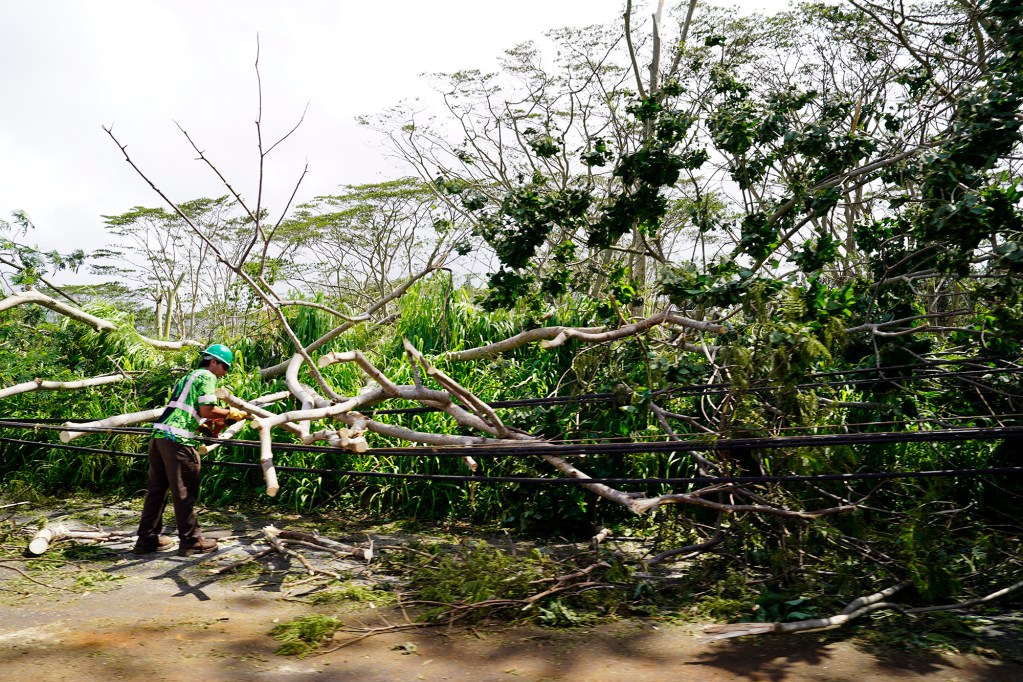
With nearly all the island in the dark — 9 out of 10 residents were initially reported to have lost power — Ushio anticipated it would be a “huge restoration process” for Kauaʻi Island Utility Cooperative and the county to restore infrastructure across the island. KIUC crews were assessing 1,500 miles of transmission and distribution lines as access allowed, but only 486 customers, in ʻEleʻele and Hanapēpē, had their power restored late Tuesday afternoon out of 33,000 customers who lost power.
KIUC’s president and chief executive, David Bissell, said the utility is using all available resources to restore power as quickly as possible and is in talks to bring HECO workers in to help with repairs.
“We know our members want to know when their power will be restored,” Bissell said. “However, this is a significant island-wide restoration effort, and we ask for our members’ patience as our crews work to restore power.”
On Tuesday evening, Mayor Derek Kawakami emphasized the county is still assessing the extent of the damage and urged people to stay off the roads and document damage to their properties. Reports of damage to residents’ homes can help the county direct resources to different communities and make a stronger case for federal aid, he said.
“We’re begging you to seek help,” Kawakami said.
Honolulu Mayor Rick Blangiardi ordered 13 city and county employees to Kauaʻi to assist with recovery efforts. They arrived Tuesday morning, with a seven-person incident team set to follow.
“We are one state,” Blangiardi said, “and when one island needs help, we all step up.”
‘Completely Destroyed’
On the island’s Westside, the road fronting Hanapēpē Bay was completely washed out, with giant boulders scattered across the breakwater, resident Chris Ka‘iakapu said Tuesday morning.
He said it appeared the storm surge came into Hanapēpē Stadium, hitting the county park and the soccer fields and tennis courts that the county was renovating.
“It’s completely destroyed,” Ka‘iakapu said.
Kaumuali‘i Highway along the ocean was also wiped out, said Umi Martin, a Kekaha resident and farmer.
“That road is going to be down for a long time,” he said, adding that multiple kiawe trees in the area were uprooted.
Residents had placed what equipment they had available — skid steers, excavators, backhoes — in front of their homes to prepare for the storm and had been out cleaning since the early morning, so roads are now open for the most part, he said.
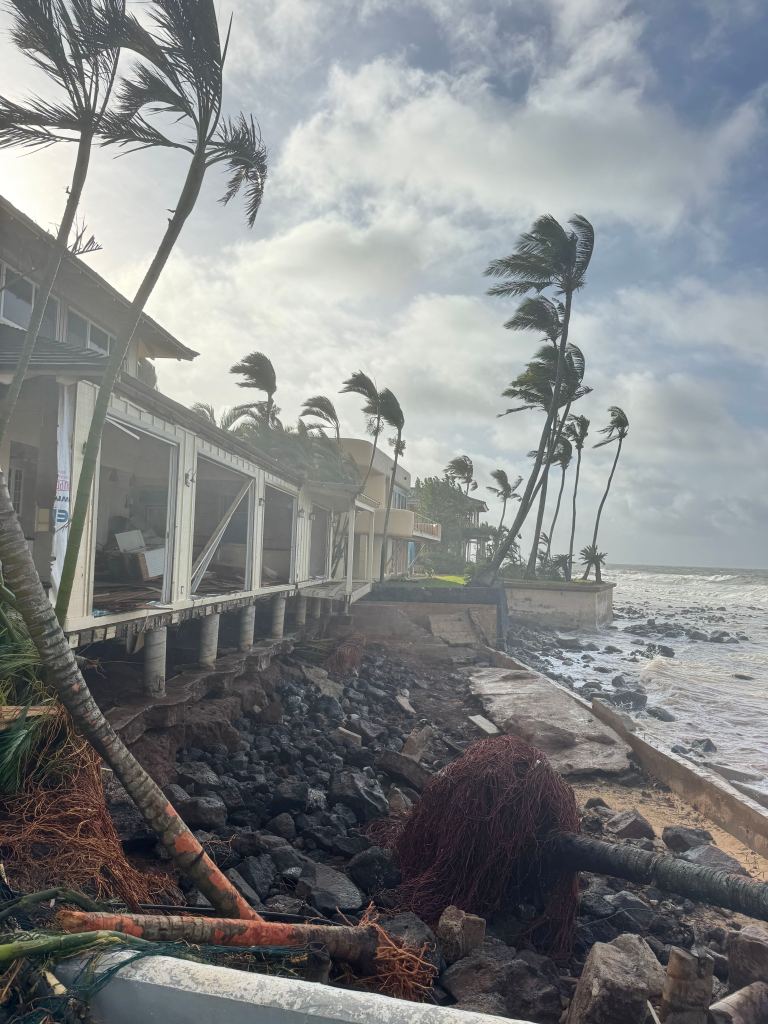
Waimea Pier was ripped apart, Martin said. “The first half of the pier — the wooden part is all gone,” he said. “The hale and cement are still there.”
Farms in Kekaha, including Kauaʻi Shrimp’s operations, “took a beating,” said Mike Faye, manager of Kekaha Agriculture Association.
“We had water come in off the ocean,” he said. “It doesn’t look good.”
On Kauaʻi’s North Shore, Krisy Zietz said she purchased 12 sheets of plywood to board up her house in advance of the hurricane. It wasn’t enough.
The family boarded up the windward side of the house, she said, but some of their other windows began flexing around 10 p.m. Monday as winds picked up. Then a mango tree flew through a tiny house on Zietz’s property, breaking the windows and throwing a television across the home.
Zietz’s sister, who lives in the tiny home, was unharmed, but she was standing only 20 feet away from where the tree crashed into the building. The family stayed up through the night to keep an eye on the situation and make sure the kids were safe, only sleeping for about an hour after the winds died down around 4 a.m., Zietz said.
“We all just hunkered down,” she said. “And the winds just progressively got worse and worse.”
Reminders Of Earlier Destruction
For many, Lowell’s path was a harrowing reminder of Hurricane ʻIniki in 1992 — a Category 4 storm that caused an estimated $3 billion in damage. Like ʻIniki, Lowell had been passing south of Hawaiʻi but took an abrupt northward turn, heading toward the west end of the Main Hawaiian Islands.
Vance Pascua of Lāwaʻi was one who remembered. Both ʻIniki and 1982’s Hurricane Iwa damaged his home. But Lowell spared it and — except for a shredded shed — his Hanapēpē property, too, leaving him feeling fortunate.
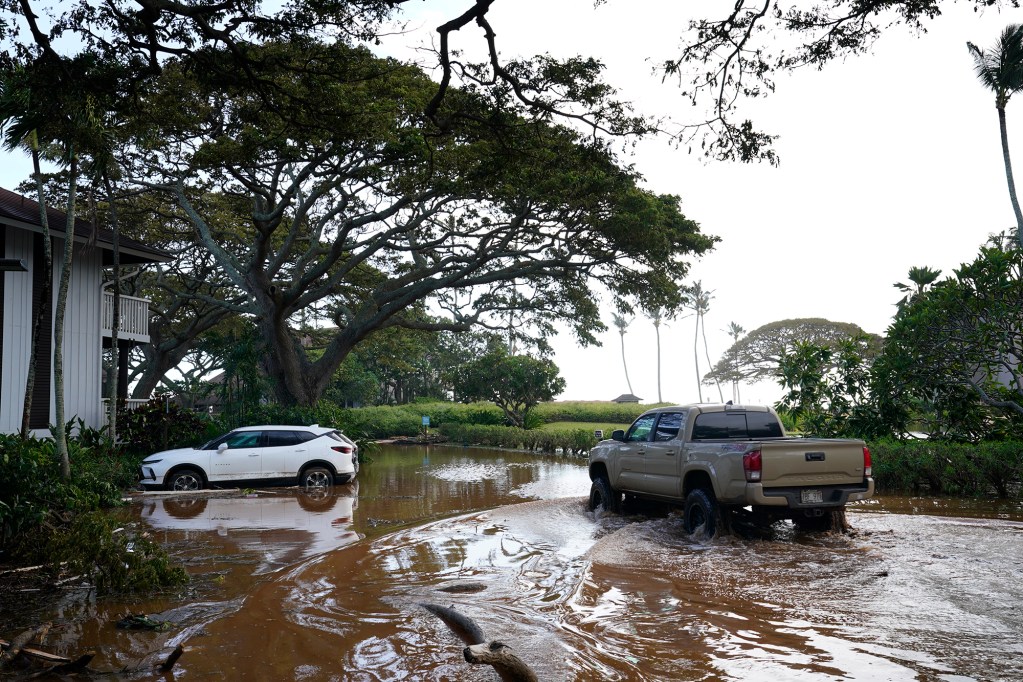
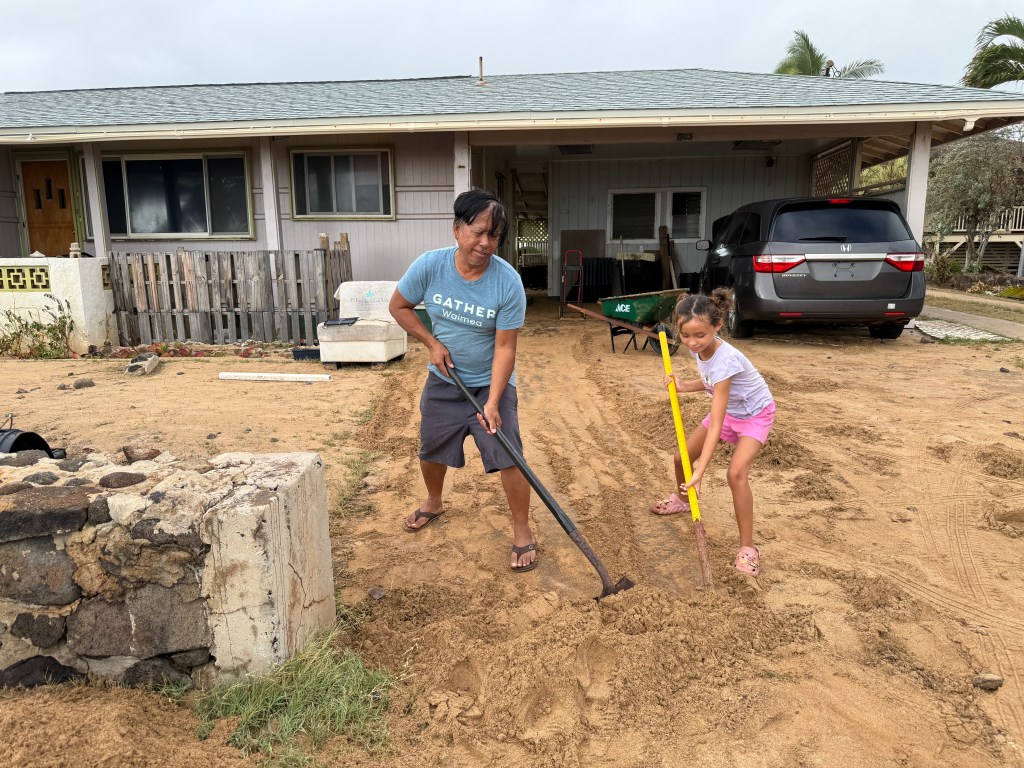
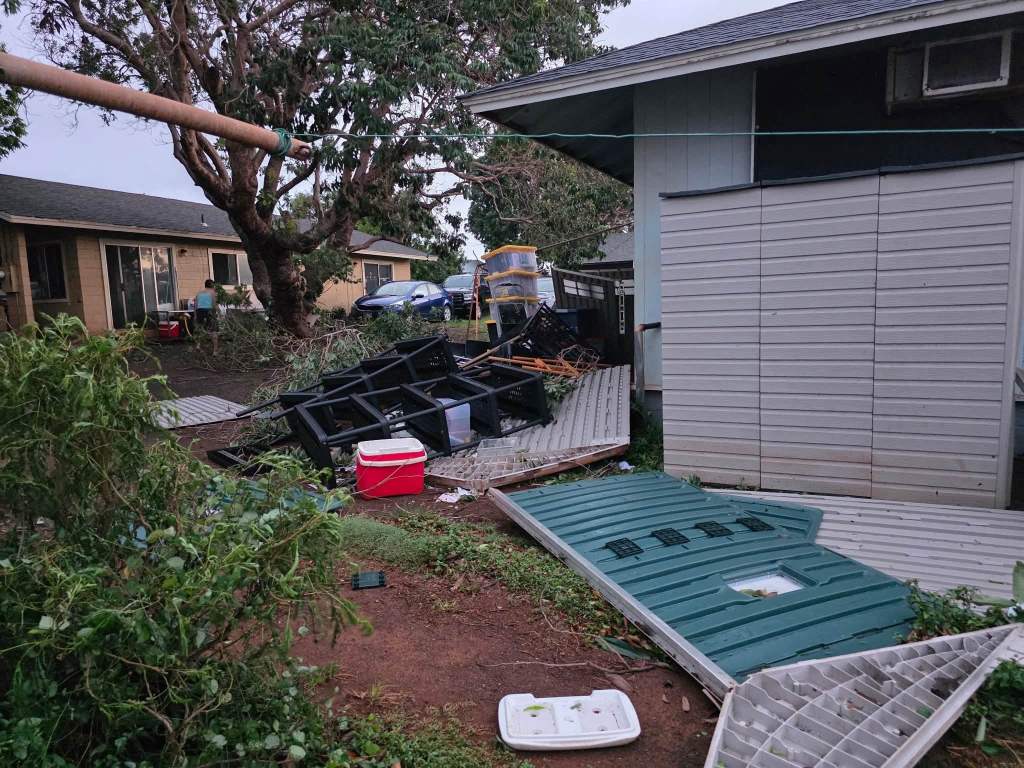
The first thing Pascua did Tuesday morning was call family members who are scattered around the island.
His parents in Poʻipū are safe and he was waiting to hear back from others in Kapaʻa, though “it sounds like everybody weathered the storm,” he said.
Ushio said officials were in regular contact with the Robinson family, which owns Niʻihau, as the hurricane approached and throughout the night. He said the island, home to about 100 Hawaiians, has hardened structures to shelter in, and the county didn’t receive reports of injuries from the island. Neither the Robinsons nor company officials responded Tuesday to Civil Beat’s requests for comment.
A National Weather Service station at Puʻu Lua in Kauaʻi’s western reaches recorded gusts of up to 92 mph, 10 mph more than the strongest felt on the Big Island when Hurricane Lala passed last month. Wind speeds at the site topped out at 41 mph. Closer to the southern coast, in Waimea, winds peaked at 45 mph, gusting up to 79 mph, according to another station in the service’s RAWS network.
On other parts of the island, a different network of weather data stations called Hawaiʻi Mesonet found similar gusts at Waipā in the north. The system, which provides almost real-time data, measured the average sustained winds from 12 a.m. on Monday until 8 a.m. on Tuesday, showing Kīlauea faced peak average sustained winds of 28 mph, the highest for the northern half of the island.
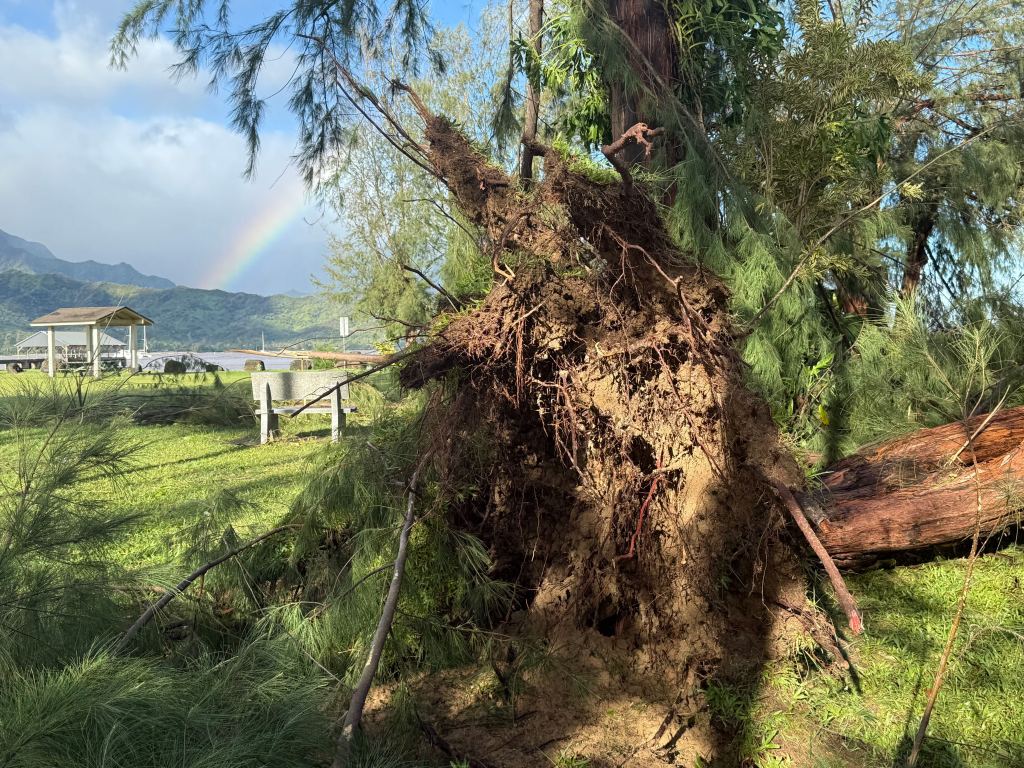
Lower Limahuli, near Hāʻena, took on just shy of 16 inches of rain, the most recorded on the island, while Keālia experienced the least at 3.8 inches, according to Hawaiʻi Mesonet data.
Although several of Kauaʻi’s dams — there are 48 according to a federal inventory of dams — had “elevated water levels, all structures continue performing as expected and are now leveling off or decreasing,” Andrew Laurence, communications director at the state Department of Land and Natural Resources, said in an email Tuesday afternoon.
The mesonet, a University of Hawaiʻi initiative, is still being built out across the state and does not have a station on the Westside of Kauaʻi yet. The initiative is still compiling a full set of data from the storm, which will include data from the National Weather Service.
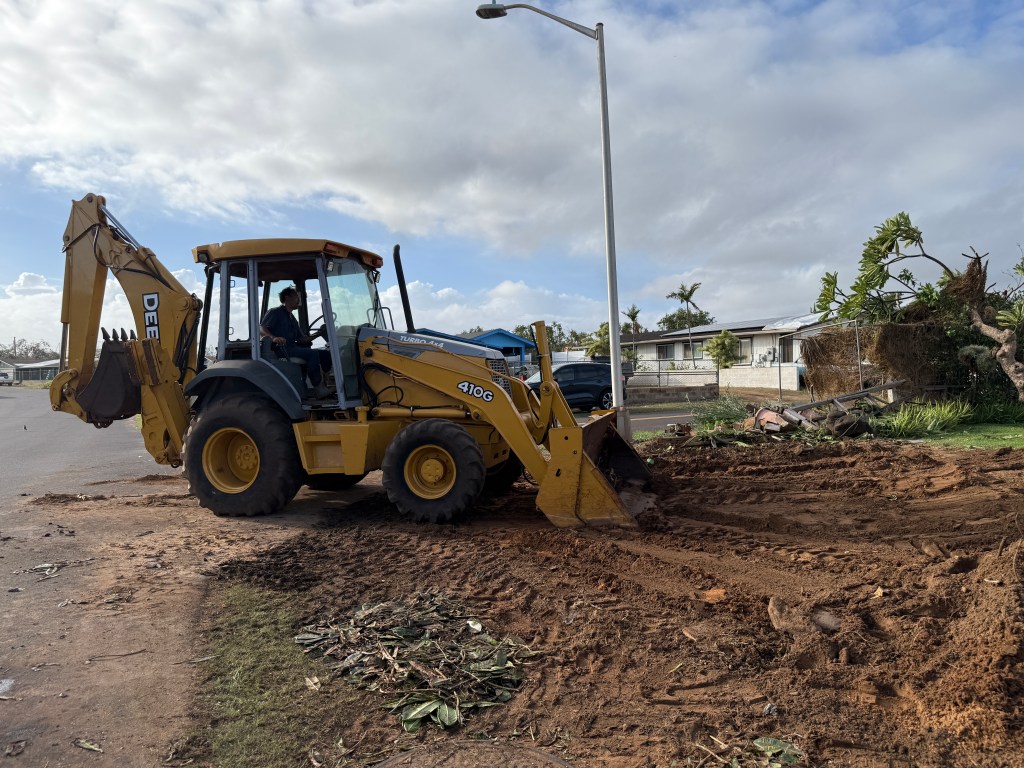
At about 5 p.m., Kelsey Hesapene, Kekaha resident and farmer, was still cleaning up his property. A plumeria tree had fallen on his old wooden fence. He had removed the remains of the fence and was leveling dirt.
Hesapene and his family had stayed at Waimea Canyon Middle School because their Kekaha home is single-wall construction and they also wanted to be near Hesapene’s extended family of about 50 to 60, all of whom stayed at the school, he said.
Hesapene drove his backhoe to the highway in the morning to help others clear the road. He’d recently bought it for his farm; now it was perfect for post-hurricane work. It also proved handy on Tuesday for clearing sand and rocks from the properties of friends and neighbors.
Work to restore electricity to the island was focused on inspections of large transmission lines, which must be repaired before the company can try to repair individual distribution circuits. KIUC was able to complete the transmission line inspection Tuesday, the company said.
Preliminary inspections show the distribution system took the biggest hit, while KIUC’s generation units suffered no significant damage.
“Our efforts the next two days will focus on completing these transmission system repairs,” KIUC Chief of Operations Brad Rockwell said. “If all goes well, we can complete that work and shift to repairing distribution circuits by the end of this week, if not earlier.”
Waves On Highways
On Oʻahu’s Westside, sections of Farrington Highway were closed as waves crashed across the highway.
The closure cut off Māʻili, Waiʻanae and Mākaha from the main thoroughfare that connects the rest of the island.
More: Hawaiʻi Knew Neglected Streams Could Wreak Havoc For 60 Years
Parts of Kamehameha Highway in Windward Oʻahu flooded Sunday afternoon after water jumped over the banks of the Waiāhole and Waikāne Streams, closing the highway for several hours.
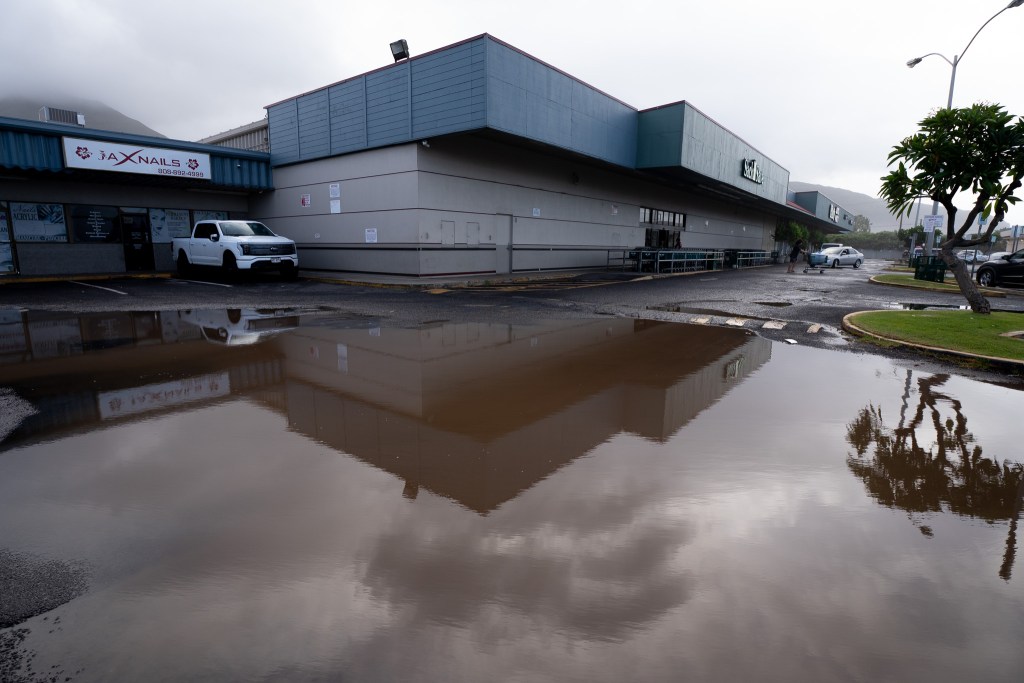
Several factors impact coastal flooding, Liam Tsamous, a meteorologist with the National Weather Service, told Civil Beat. Storm surge — which causes the overall sea level to rise — combines with both tidal shifts and waves to send damaging quantities of water inland.
In the case of Hurricane Lowell, Tsamous said, there was a high tide Monday afternoon that played a role, but “the heavy lifting was done by the surf,” as wave heights were in excess of 25 feet.
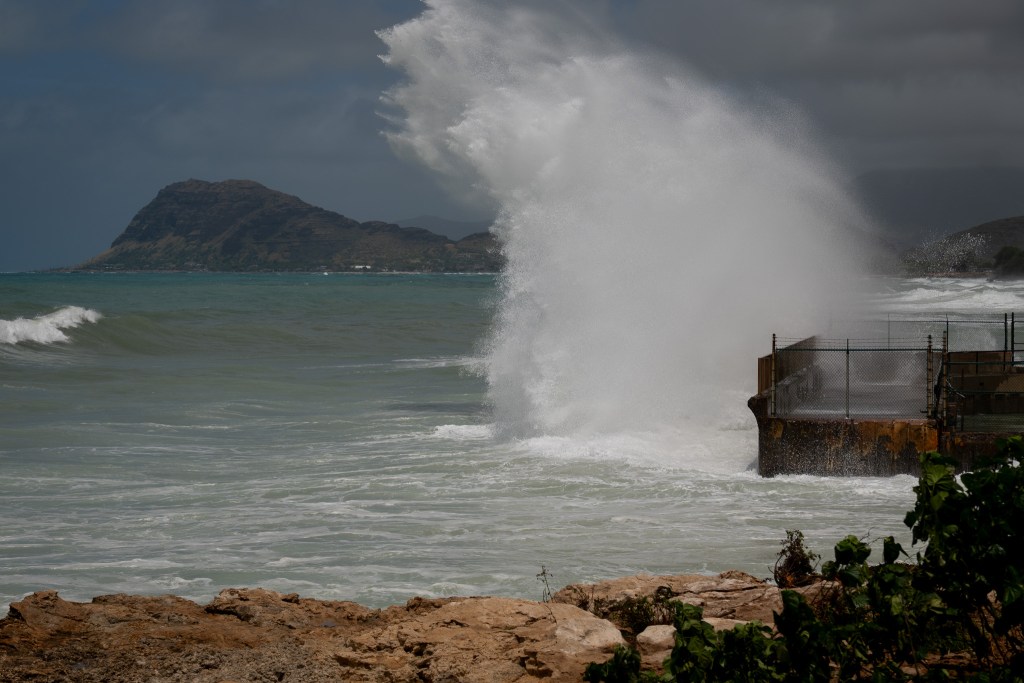
“If you have really powerful winds over the ocean blowing over a long distance, that’s called fetch,” Tsamous added. “There was a good wide fetch for the hurricane to consistently blow over a long period of time, which allowed the wave heights to get so large.”
For Hawaiʻi island, swaths of which were ravaged by Hurricane Lala in August, high surf warnings were in place for all south- and west-facing shores and a high surf advisory was up for east-facing shores through Tuesday.
In Maui County, multiple roads, particularly around Kīhei in South Maui, were closed due to debris and flooding.
State and local government offices and schools were set to reopen Wednesday on Oʻahu, Hawaiʻi island and Maui. Schools on Niʻihau and Kauaʻi will remain closed until at least Friday, officials said.
Peter Harp and his wife Janet were visiting Kauaʻi from Maui when the storm hit. They said Tuesday that security and maintenance were on site all night at the Sheraton Villas where they were staying, and that the hotel staff did an excellent job communicating updates through the PA system in each room as they sheltered in place.
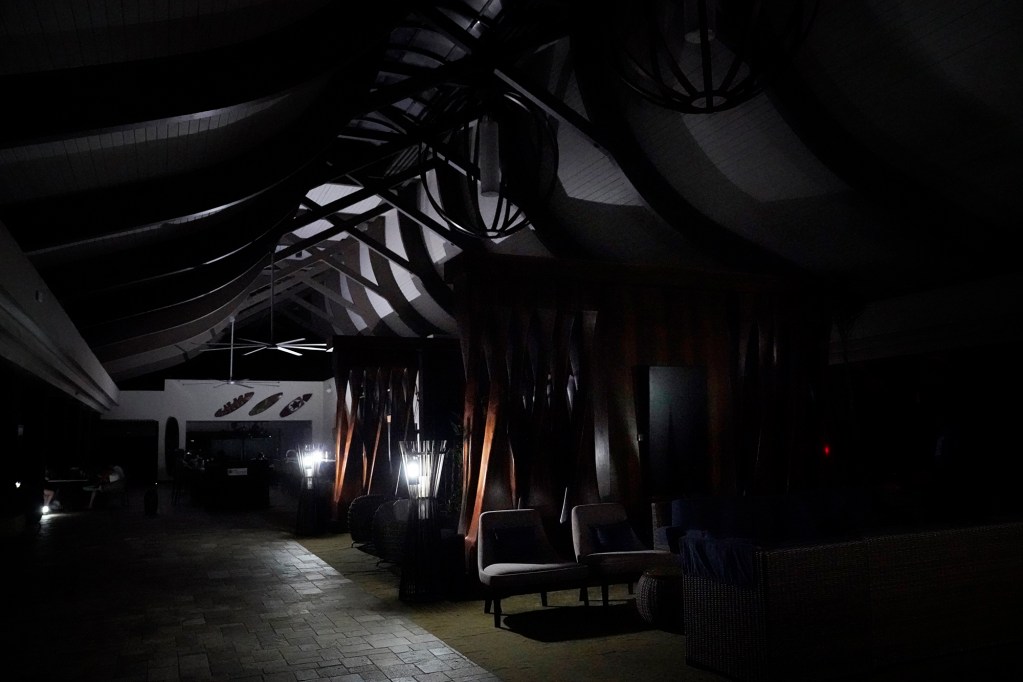
“My first thought was, ‘Holy moly this is bad,’” Janet Harp recalled thinking when she first looked outside Tuesday morning. “They did everything they could do to make sure we were safe.”
The hotel made sure guests were fed Tuesday as Poʻipū was basically shut down due to the storm damage, the Harps said. The only power in the hotel was in the lobby through a generator, so they planned to rely on candles Tuesday night.
Tourism executives on Tuesday were still assessing the storm’s impact, said Lei-Ann Field, senior director of public relations and communications with the Hawaiʻi Visitors and Convention Bureau. Airlines had allowed passengers to change flights without additional charges before the storm, she said, and there were enough hotel rooms up and running to accommodate visitors who didn’t leave.
The tourism authority advised travelers planning to visit Kauaʻi in the next few days to confirm their accommodations are available and, if not, consider visiting another island until conditions on Kauaʻi improve.
But the bureau didn’t yet have a comprehensive picture of the damage Lowell inflicted on one of the island’s main economic engines. The bureau sent out a survey to member companies on Monday, Field said, but received only one response.
“Everyone’s just overwhelmed right now,” she said.
Civil Beat reporters Megan Tagami and Stewart Yerton contributed from Oʻahu and Twilight Greenaway reported from Hawaiʻi island.
About the Authors
Noelle Fujii-Oride is a Kaua‘i reporter for Civil Beat. You can reach her at nfujiioride@civilbeat.org.
Thomas Heaton is a reporter for Civil Beat. You can reach him by email at theaton@civilbeat.org.
Help power essential news and information