

Storms Shut Down Elevators Indefinitely For Hundreds In Honolulu
This year’s storms have been disastrous for some Oʻahu residents immobilized by their building’s broken elevators. Restoration could take weeks or months.
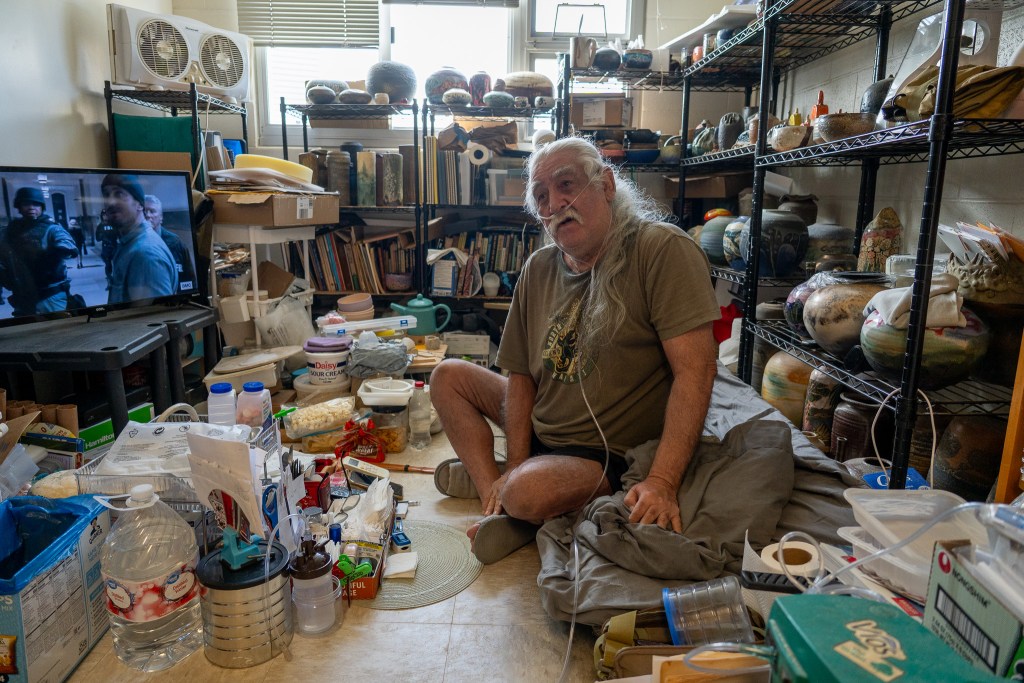
Steve Shoemaker, a 75-year-old resident of a McCully senior housing complex, is essentially trapped in his seventh-floor apartment.
The building’s single elevator has been down since Hurricane Lala. And Shoemaker depends on around-the-clock oxygen supplied by two heavy, waist-high cylinders on a trolley that he can’t haul down the stairs without assistance.
The last time he left the apartment was for a hospital emergency room visit Aug. 17, two days after Lala unleashed torrents of rain across the islands.
“It’s frustrating, especially since I am trying to get myself more mobile,” he said, “and it’s just one setback after another.”
Shoemaker is one of hundreds of Honolulu’s high-rise residents living in the fallout of widespread elevator outages that have exposed vulnerabilities in the city’s aging housing stock this year. Civil Beat has identified more than 10 residential buildings that have experienced weeks-long outages — some that predate Lala — and all remained without some service as of Thursday.
Making matters worse, there is no timeline for repairs for many buildings. Elevator repair companies, limited in their capacity, are trying to triage some jobs with overstretched staff who often face long delays to get the parts they need. Some building associations are experiencing sticker shock as they fork out for unavoidable repairs. And even when those repairs are complete, restoring service requires a state inspection from an understaffed and backlogged agency whose delays, according to one national expert, are among the worst in the country.
Residents, many of whom have already gone weeks without service, could have to go without a lift for weeks more, or even months.
The loss of elevator service has hit elderly and disabled residents particularly hard. And it threatens to disrupt housing stability for tenants who rely on government assistance programs that require buildings to have working elevators.
While there is no central database of elevator outages, a picture of widespread disruption to service in urban Honolulu has emerged from information gathered from elevator service providers, property management companies, managers and residents. The impacted buildings include three state-owned senior housing complexes, one of which is Shoemaker’s building at 1628 Kalākaua Ave., and privately owned buildings such as 2215 Aloha Drive in Waikīkī. Both of the elevators there are out until further notice, according to signage.
The impact is especially evident in older multistory buildings in Waikīkī, McCully and Makiki – remnants of a post-statehood building boom that still make up close to half of the residential buildings on Oʻahu. Those buildings, constructed in the 1960s and ’70s, were prone to damage from the Kona low storms and Hurricane Lala.
Many residents are mobilizing resources and assisting each other if possible, but others who spoke with Civil Beat are saying their property managers and city services could be providing more assistance.
Shoemaker said his daughter and a care attendant are keeping him stocked, and Meals on Wheels volunteers are willing to make the trek up. But the outage is taking a toll on Shoemaker’s helpers too. During his recent emergency visit, his daughter and her partner took half an hour to make it back up to his apartment.
“By the time we got up to my floor, we were soaked in sweat,” he said.
An Otis elevator technician was on the property on Tuesday, but a sign on the elevator didn’t say when service was likely to be restored.
Elevator Repair Services Swamped
Half of the buildings identified by Civil Beat lost service due to weather generated by Hurricane Lala, but it was already an unusual year for elevator repairs starting with the Kona low storms in March, said Matt Verhun of Vertical Rise Solutions, a Honolulu elevator service, repair and installation company.
“When the Kona lows came through, there were so many electrical motors in motor shops, they had backlogs for weeks,” Verhun said. He said his company was shipping elevator motors to shops on the mainland to try and keep up with the need.
Elevator systems have become heavily reliant on circuit control boards that literally go up in flames if they come into contact with water, Verhun said. That’s what happened to the single elevator in the pink stucco Waikīkī Cove apartments at 2118 Kūhiō Ave., resident Pat Glaser said.
Just before Lala hit on Aug. 15, the elevator was parked on the top floor with Do Not Use signs posted on each floor, Glaser said. The practice of parking elevators is meant to stop passengers from being trapped during power outages. But after the storm passed, a resident used the elevator without permission and got stuck in it.
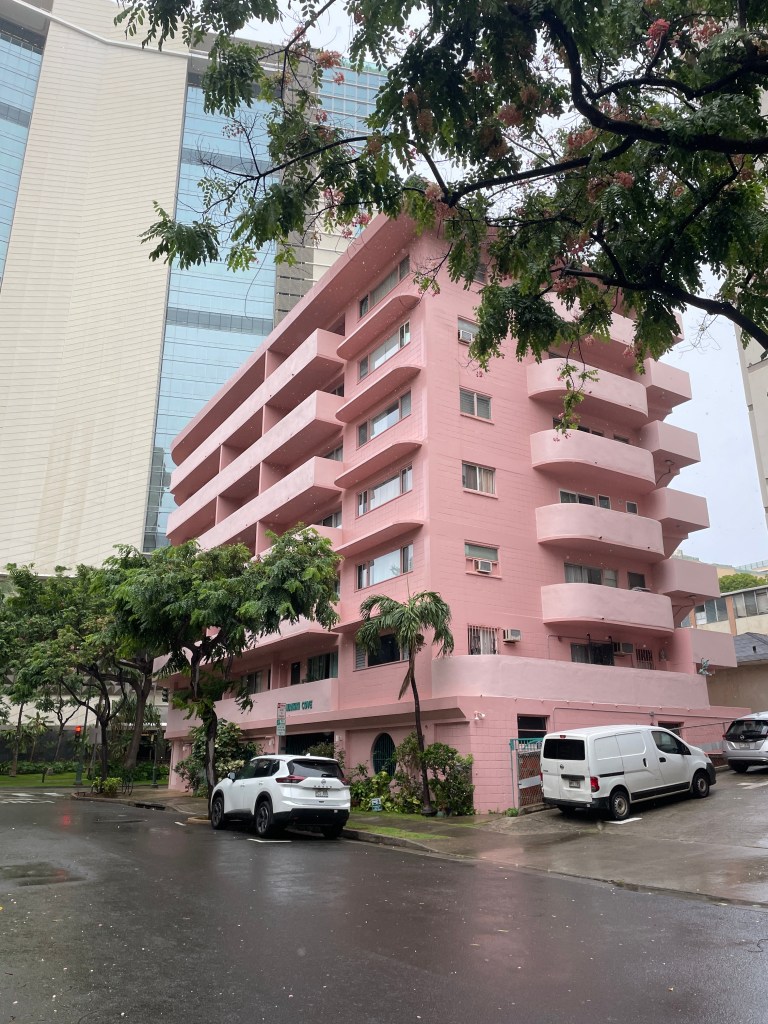
A technician arrived within two hours, Glaser said, but he told her that parts were blowing up in front of him as he checked them. The problem was likely caused by water that managed to infiltrate vents to the electrical system, Glaser said. A repair proposal was signed a few days after the storm, and the parts will have to be flown in from Tennessee.
The repairs will cost $58,000, a hardship for a small building with limited reserves still reeling from recent insurance increases. The board is hoping its hurricane insurance will cover part of the cost, Glaser said.
Other outages occurred after the March Kona low storms, including the 25-story Makiki Plaza on Pensacola Avenue. Service has since been restored.
But the wind-propelled rain from Hurricane Lala that passed south of Oʻahu in mid-August added to the current toll. A succession of surges and blackouts combined with directional rain was an unwelcome recipe for many buildings, Verhun said.
And the hurricane season is still highly active, as Category 5 Hurricane Lowell tracked south of the islands Wednesday.
Meanwhile, residents of Waikīkī Cove are taking things in stride, slogging up and down stairs with their trash and groceries, Glaser said. One woman, a former Lahaina resident, has been schlepping down the stairs with her large dog, which has an injured leg, so the pet can relieve itself outside.
Many buildings are not equipped with power filters that can handle power surges, brownouts or blackouts from the grid, and those events can trigger elevator systems to shut off as a safety mechanism.
Even if there is no serious damage, a service technician usually needs to get on site before they can restart.
“These resets can’t be done remotely,” Verhun said. “A lot of time they require a human touch to assess the components.”
The spate of outages shows that many buildings remain vulnerable to shifting or unusual weather patterns, like the conditions the islands are seeing this year from the super El Niño.
Verhun, who worked as a technician for different service companies, now advises building associations on how to modernize their elevator systems. They need to do some serious capital planning, he said, if they aren’t already.
Condo associations without reserves can end up delaying upgrades, Verhun said, and buildings with a single elevator are particularly vulnerable to storm impacts.
State Inspections Can Slow Down Process
Even if building repairs can be completed efficiently, getting an elevator back online could be delayed by the state’s inspection progress. Major elevator repairs need to be certified by the Boiler and Elevator branch of the Department of Labor and Industrial Relations.
If parts are swapped like-for-like, they may not require an inspector’s sign-off. But new installations usually require a half-day of load and speed testing from a DLIR inspector.
The division has previously been overwhelmed by its workload of routine inspections, its own data shows. And its backlogs are among the worst in the nation, according to Billy Taylor of the National Elevator Industry, the leading trade organization.

Of the 10,000 elevators in the state that required inspection in 2024, only 2,600 were serviced by state inspectors by the end of that year, according to testimony in the House Labor Committee last year. The agency left behind a backlog of 7,400.
The current backlog is a bit less, more like 60%, DLIR Director Jade Butay said Wednesday, with 3,421 out of 8,924 elevators requiring inspection.
That’s a problem, Taylor said. “You’re going to have more and more residents who are living in these aging buildings,” he said. “Many of these buildings only have one elevator unit and as it ages, it’s going to have more issues. So the ability to repair or modernize that unit and get it back into service will rest on the ability to have timely inspections.”
So far, the department had not seen a major uptick in demand for inspections after the storms, Butay said.
The department has been making headway with its hiring, Butay said. Recent growth to its administrative staff and the addition of two inspectors would leave only one vacancy, the best tally since 2013.
DLIR inspections are not needed in every instance of repair, but they are necessary for major repairs, modernization projects and new builds. Butay said that his inspectors would prioritize certification inspections for buildings where vulnerable residents are being inconvenienced.
“We don’t want to be the reason for elevators not getting back up and running,” he said.
But Hawaiʻi still suffers from an overall shortage of qualified elevator inspectors, said Taylor, who was in Honolulu Wednesday to meet with Butay about the backlog.
Last year Taylor told the House Labor Committee that the shortage in the inspection branch resulted in inspections needing to be booked months in advance and that the department had adopted a triage-style approach that prioritized inspection of new installations over modernization and routine inspections.
Management Obligations
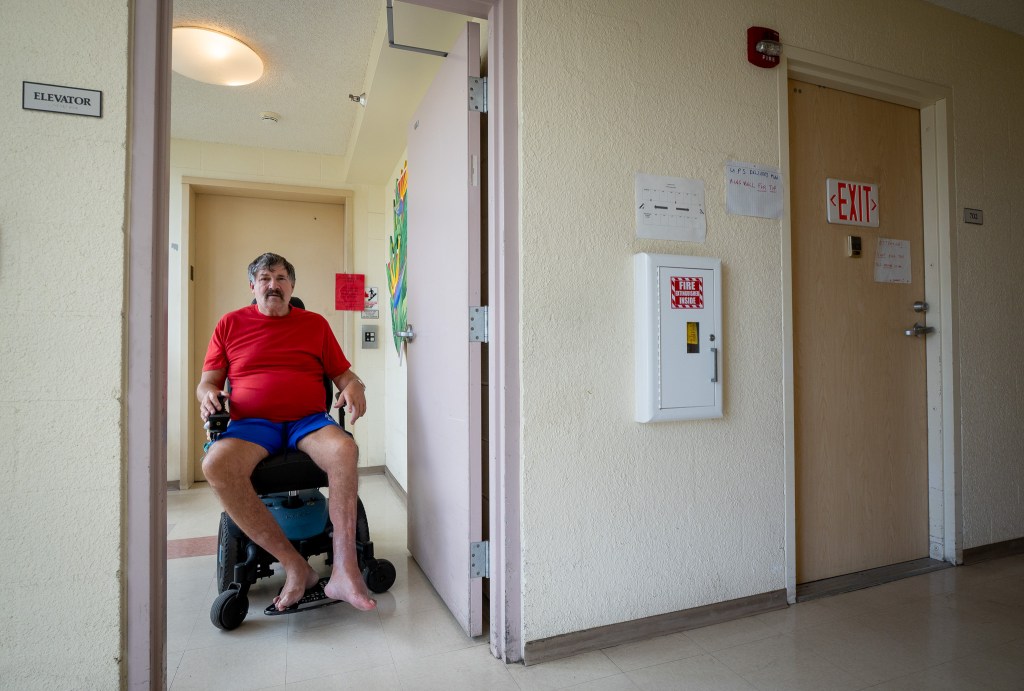
Closer to downtown, Roland Manuel, 74, lives on the fourth floor of Honuakaha at 545 Queen Street, but he can only move with the assistance of a four-wheeled walker. The three elevators at the seven-story building, which is primarily senior housing, have been out for three weeks.
The loss of service predated Hurricane Lala, with outages in some form going back six weeks. Manuel would normally do his own food shopping when the elevators are working, but he said this week he was starting to run low on supplies.
“The personnel here cannot assist us going down the stairs, and a lot of my friends here are handicapped too,” he said, noting other residents rely on wheelchairs. “They can’t help.”
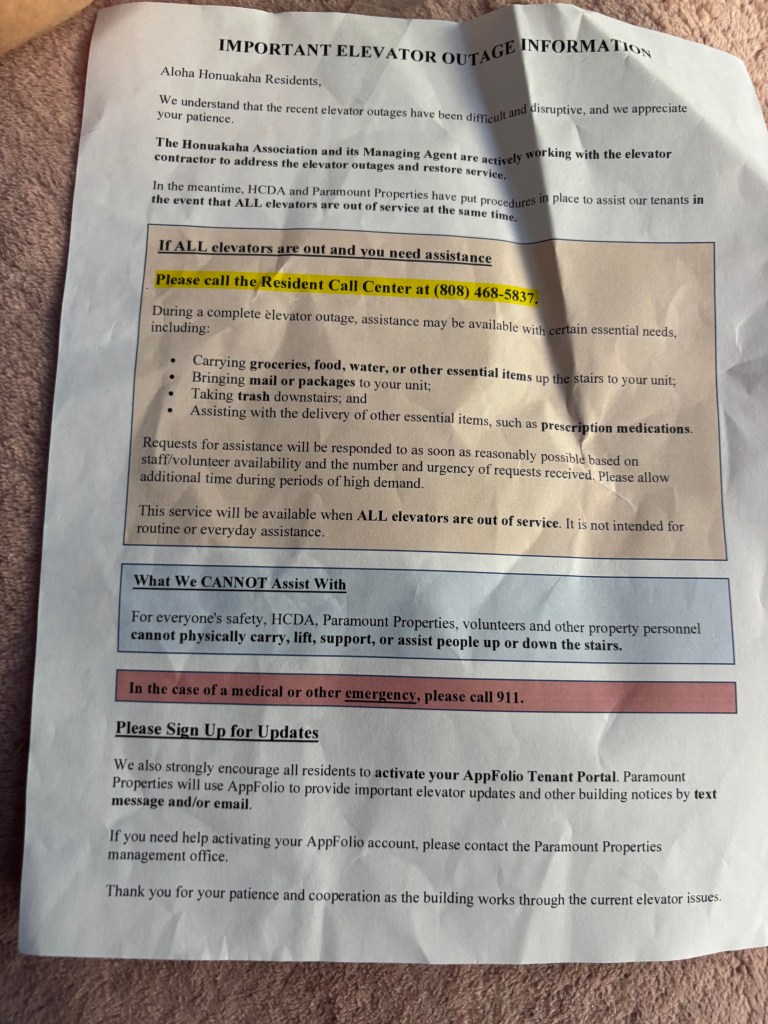
Patricia Shields also lives in Honuakaha, which has 141 studio units and nine one-bedroom units. She said management company Paramount Properties Hawaiʻi distributed a flyer on Monday offering some assistance with delivery of groceries and medications.
According to the flyer, residents and staff cannot provide any physical assistance to another resident because of the potential liability.
Property manager Margaret Walker referred questions about the property to the Hawaiʻi Community Development Authority, which own the building.
Francine Murray from HCDA said Wednesday afternoon that a contractor had managed to get one of the elevators operating and that it had been working so far without incident for two hours. The agency will continue to monitor it, she said, and replacement parts have been ordered for the elevators still out of service.
It is foreseeable that many residents of a building designated for seniors and the disabled would rely on elevators for their mobility, said Alicia Pitts, a Honolulu housing attorney for the Legal Aid Society of Hawaiʻi.
But when the outages are widespread, or associated with events like a disaster, there needs to be a sense of “reasonableness” about both the timeline for repairs and what landlords and property managers are expected to provide.
Individuals who use wheelchairs will obviously need assistance with grocery shopping if they are confined to their apartment, she said.
“I do think that there is an obligation on property management or a building to try to alleviate those needs in some ways, whether that means assisting with picking up medications or dropping off necessary food or water,” Pitts said.
But tenants will also need to recognize there is a limit to what property managers and landlords can control, especially if the issue is widespread.
There could be broader complications brewing if service disruptions drag on, particularly for tenants of buildings that use housing vouchers or Section 8 to help pay their rent.
They will start failing their Section 8 housing inspections.
That’s already happened to Sandee Johnson, a second-floor tenant at 1628 Kalākaua Vista who said that her apartment failed an inspection visit from the City and County of Honolulu on Monday because the whole building has lost elevator service.
Two other tenants in the same building also failed the inspection because of the inoperable elevator, spokesman Scott Humber said.
The city can eventually withhold the rent it pays to the landlords of buildings that fail Section 8 inspections. Likewise, tenants can withhold their own rent portion or terminate their leases early, if they have somewhere else to go.
The city will be reaching out to the landlords about this to avoid jeopardizing any current voucher holder’s housing, and the city can grant extensions to the normal 30-day deadline if the landlord is making a good faith effort to make the repairs, Humber said.
Pitts said her concern would be ensuring that the outcome of the inspections does not result in adverse impact for the tenants. Fixing the problem is the responsibility of the landlord or the property management company.

