This Farmer-Artist Questions Hawaiʻi’s Statehood. He Wants To Be LG
GOP lieutenant governor candidate Daniel Anthony says he’s tired of fighting against the government, and wants to help lead the way to “generational change.”
The Republican nominee for lieutenant governor this year is an activist, artist and farmer who preaches the gospel of food sustainability. In an unusual twist for a candidate for a top-level state office, he also questions the legitimacy of the state of Hawaiʻi itself.
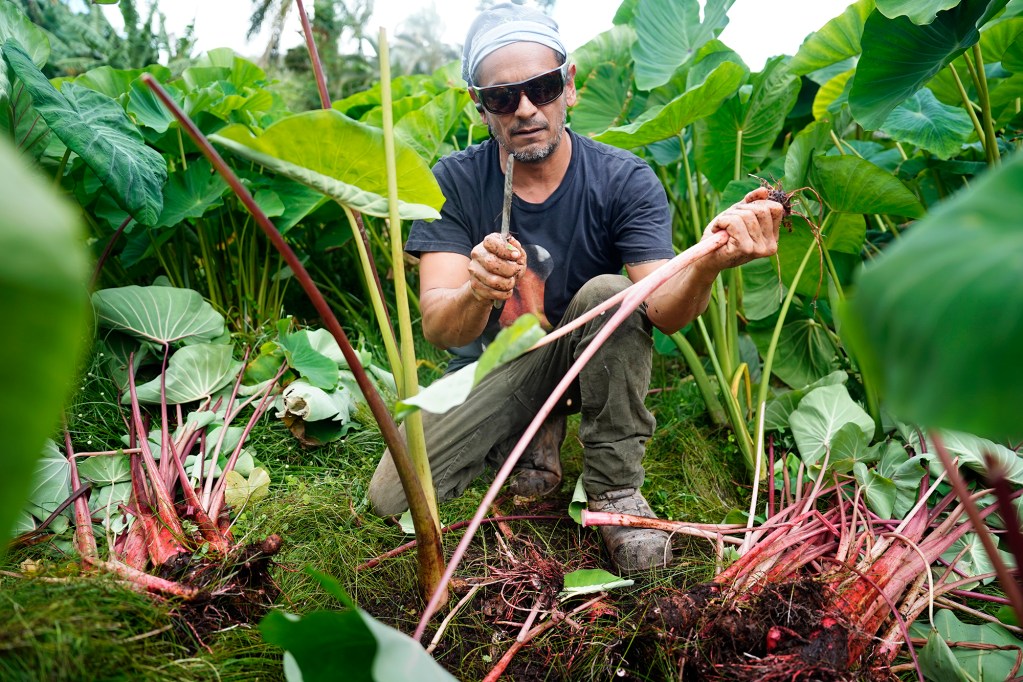
Daniel Anthony, 48, works farmland in Kahana, Waimānalo and Kahaluʻu — growing coconuts, taro, lychee and breadfruit, and also raises sheep and pigs. He has teamed up with Republican candidate for governor Gary Cordery on a long-shot ticket for governor and lieutenant governor this year.
In his Facebook post explaining why he is running, Anthony said: “The reality is, I’m running because I’m tired of fighting against the government to do what is right, and I don’t want to say ‘If you can’t beat ’em, join ’em,’ but the way to make generational changes in our community is by leading the government, not fighting with them.”
He initially pulled papers to run for governor as a Green Party candidate this year, but said Cordery encouraged him to jump into the Republican primary for lieutenant governor instead. Anthony raised little money for this year’s campaign and spent even less, but won the statewide, four-way GOP primary on Aug. 8 with 16,982 votes.
Cordery and Anthony now top the Republican ticket in Hawaiʻi, and are running against better-known Democrats Gov. Josh Green and Kauaʻi Mayor Derek Kawakami. Kawakami is running for lieutenant governor, and received 140,247 votes to prevail in the five-way Democratic primary.
Anthony describes himself as “an open book,” and his sometimes free-wheeling commentary on social media is attracting attention in political circles.
Earlier this month he opined on Facebook that Hurricane Lowell’s abrupt turn to the north before it clobbered Niʻihau and Kauaʻi has “gotta be weather manipulation.” He re-posted another Facebook item in January asserting that “Rigged elections in Hawaiʻi has been a thing since 1893,” adding his own one-word agreement: “Yup.”
Another example was a post in 2022 referring to Hawaiʻi as a “fake state” on the social media platform then known as Twitter. The “fake state” label is commonplace among Hawaiian sovereignty advocates, but is curious coming from a candidate for the state’s second-highest office.
Anthony did not disavow those posts during an interview with Civil Beat. He said people must decide for themselves “what level of corruption” is involved in Hawaiʻi’s elections, and said the state “needs to take a very strong look at its legal standing in regards to the independent kingdom of Hawaiʻi.”
“This is like the emperor-has-no-clothes kind of story,” he said of Hawaiʻi statehood. “If we do not deal with the issue of Native Hawaiian independence, it’s not going to go away. It’s not, and there’s going to be a bigger rift in our community. If we’re trying to bring our people together, we cannot continue to lie to them about our standing. And if we are not in good standing, how do we fix it?”
A Presence At The Capitol
Anthony was born and raised in Waiʻanae, and said some of his earliest memories were of selling fish from a cooler with his father on the side of the road. He recalls he was “raised in a taro patch” worked by his stepmother’s family in the Waiʻanae Valley, and as an adult became deeply involved in the Hawaiian renaissance and independence movement.
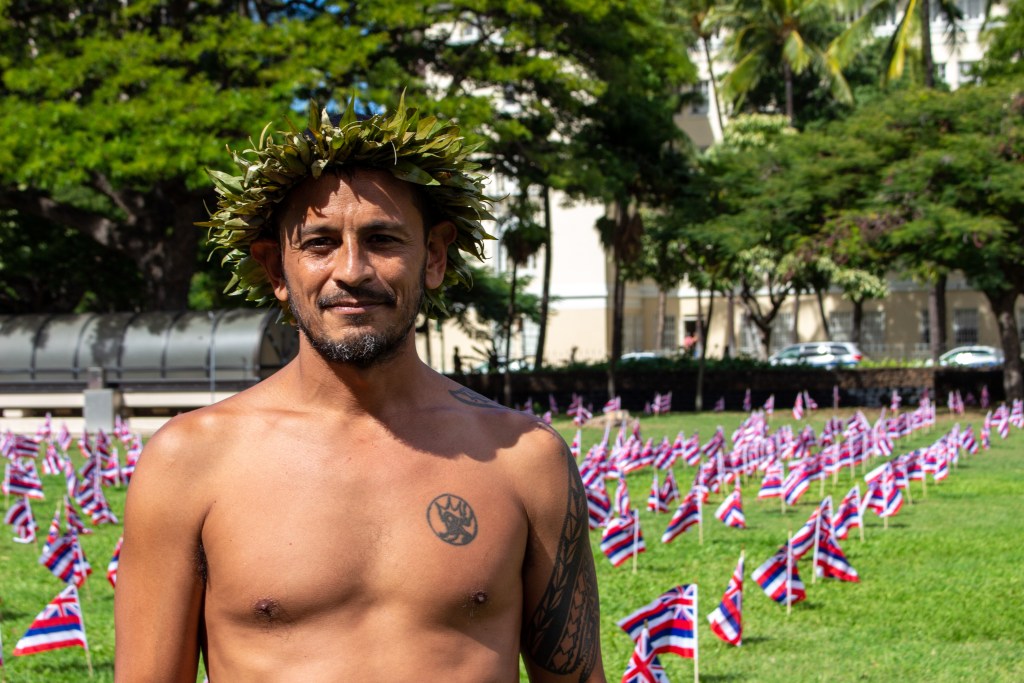
He has been involved for decades in Hawaiʻi politics as an organizer and activist. Years ago he joined the effort to impose a moratorium on genetically modified taro farming and breeding, he said, and was also was a primary organizer of the annual Kuʻi at the Capitol. Those events were festival-like gatherings held on opening days of the Legislature to ensure policymakers heard the voices of Hawaiians.
In 2021, Anthony said he teamed up with Cordery and the Aloha Freedom Coalition for a July 4 land rights demonstration, during which protesters in a car caravan clogged traffic at Honolulu’s airport.
“The idea was to make the visitors feel a little uncomfortable, maybe delay them a little bit,” he said, “in hopes that our political leadership would start to see the needs of our people at least as equal to the needs of our tourists.”
Anthony said he has been farming and helping other farmers for the past 20 years, and also earns money producing wood and stone carvings. He offers workshops on making poi and Korean natural farming, and has a non-profit fertilizer operation called Aloha Organic.
Most recently he has joined the fight to limit or stop the spread of the coconut rhinoceros beetle, and said the government response to that problem has been “super disappointing” and ineffective. It helped convince him to run for office this year.
“We are in a place where we desperately need change — desperately,” he said. Anthony said he hears the same concerns everywhere he goes — people are worried about the cost of living and housing, about food security, and about a younger generation being forced to leave Hawaiʻi.
“We’ve had the same problems, and it hasn’t gotten better. We keep electing the same people,” he said. “When I really looked at where we’re headed, we need some balance. We need some unconventional thinkers, people who are willing to stand up when it matters.”
Anthony readily admits he is not a traditional Republican. He considers Hawaiʻi’s high cost of living the most important issue in the race this year — which is unsurprising — but his strategy to cope with that problem is expanding agriculture to reduce the state’s dependence on imported food. He suggests that could create 15,000 to 20,000 new jobs.
On the subject of the recent public corruption investigation that entangled several prominent Democrats, including Lt. Gov. Sylvia Luke, Anthony said: “You don’t get corruption with aloha. You get corruption because you took advantage of aloha, and we have this identity crisis where we talk about cultural things, but actually those things are not a part of the culture of our government.” That has to change, he said.
On some hot-button social issues, Anthony said he believes people “should have body autonomy for vaccinations” — meaning the right to make their own medical choices. “I also believe that people should have body autonomy in deciding whether or not they want to have an abortion,” he added.
“I’m coming to the Republican Party as me,” he remarked during a recent radio appearance. “The party isn’t going to change me, I’m going to help change the party to participate more heavily in proper stewardship of our land.”
Campaigning Against The Odds
There are no independent public polls that could show whether the Republican Cordery-Anthony ticket is gaining any traction, but history and campaign finance records strongly suggest their campaign will be an uphill climb all the way.
The last time Hawaiʻi elected Republicans to the offices of governor and lieutenant governor was two decades ago, when the team of Gov. Linda Lingle and Lt. Gov. James “Duke” Aiona were re-elected.
The Republicans this year are also at a huge financial disadvantage. As of early last month Gov. Green had raised more than $3.9 million in campaign cash, while Kawakami raised more than $1.18 million. Kawakami has also benefited from lavish spending by the independent political action committee For A Better Tomorrow, which committed more than $2 million to support Kawakami in last month’s Democratic primary.
By contrast, Cordery reported raising only about $347,000, while Anthony raised about $18,800.
Anthony has used social media to try to call out Kawakami to get him to debate, but Kawakami campaign spokesperson Sarah Blane said this week that “at this time Mayor Kawakami does not have any planned forums or debates.” The two have never appeared together at a forum, Anthony said.
Someone recently told Anthony that mathematically he has already lost the Nov. 3 general election, but Anthony said he replied this way: “Well, that’s the same math that ensures that our children will never be able to afford to live here.”
“It’s really going to be up to the people,” Anthony said. Of the Democratic candidates, he said, “these are the guys who depend on 30% to 40% of our community participating in an election. If that many people show up, we’re probably going to lose.”
But he added: “Miracles happen. I’ve been a part of more than a few of them in my life.”