

Dead Pigs, Stripped Cars: Kauaʻi’s Scary Public Housing Conditions
Kawailehua residents say they’re tired of the Hawai‘i Public Housing Authority ignoring their complaints and are organizing to improve the situation.
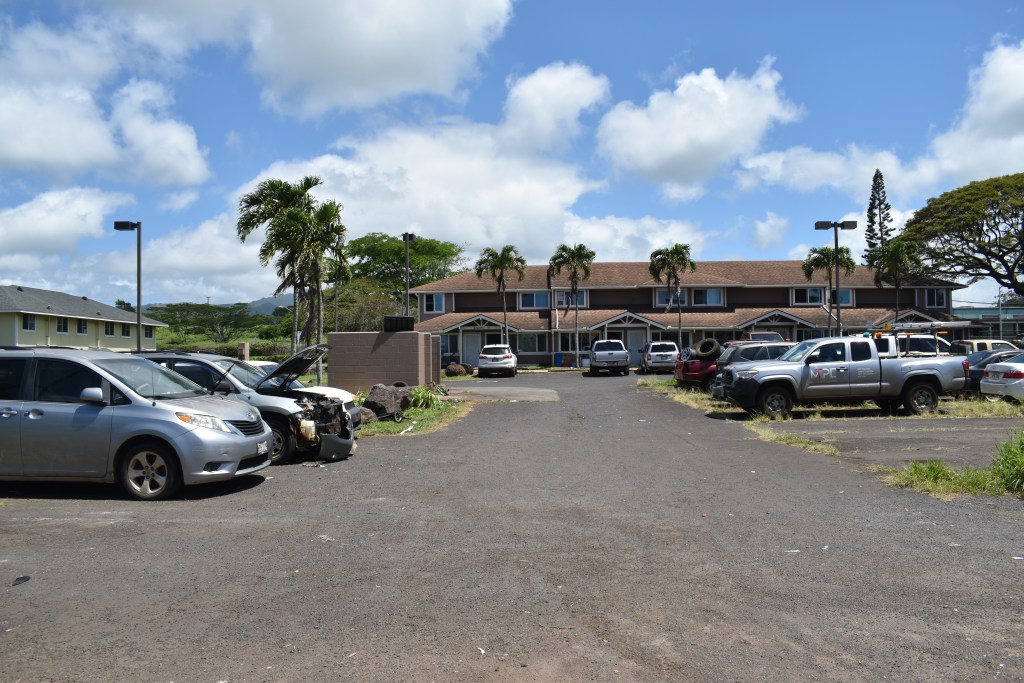
Tenants living at a public housing complex on Kaua‘i’s South Shore knew they’d have to make some trade-offs living in low-income housing, but they never imagined they’d be dealing with years of the place being a dumping ground for trash and abandoned cars, drug use, violence, trespassing and other issues.
Residents at the Kawailehua Public Housing Complex say pleas to their landlord, the Hawai‘i Public Housing Authority, to fix these issues have largely gone ignored or weren’t fully addressed. Some say they continue to feel unsafe on the property.
Residents are taking matters into their own hands. For the last year, a small group has been working to establish a tenants council that would create programs to connect residents with each other and community resources and work with the housing authority to help residents follow the property’s rules.
In other places in the U.S., public housing tenants have formed such councils to improve the conditions of their properties, address tenant concerns and get residents involved in decision-making that impacts their quality of life.
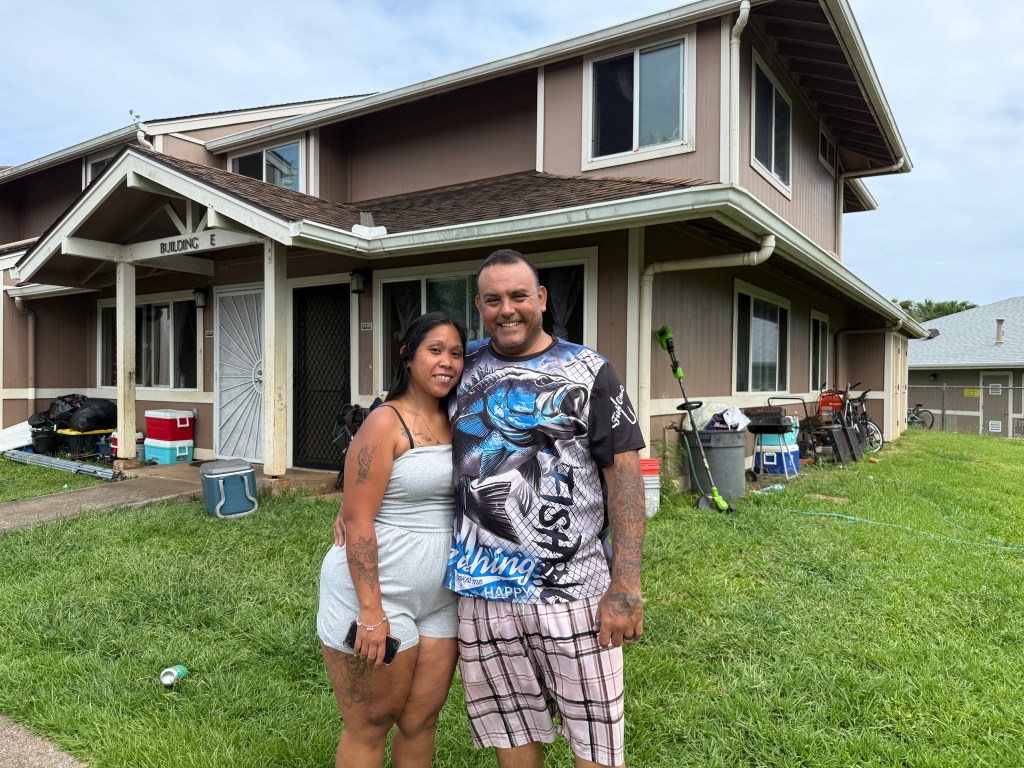
Nivian Kraft, a Kawailehua resident who has been organizing her neighbors for the last year, said she wants to see the 51-unit Kōloa property become a safe and stable place that helps tenants improve other aspects of their lives.
“You can’t do anything without housing — can’t leave the abuser, can’t go to school, you can’t keep the job, can’t get sober without housing,” said Kraft, who has lived at the property for four years.
The group still has a way to go before a council can be established, but it hopes to get underway soon.
The housing authority shares residents’ desires for a safe, clean and respectful living environment and has been working to address them even as some challenges have been difficult to solve, the authority said in an emailed statement sent by housing information officer Dallis Ontiveros.
Tenants Don’t Feel Safe
Several residents say drug use, domestic fights, rooster keeping, violence, random people coming into the complex at odd hours, tenants not following property rules, abandoned cars and other issues have frustrated them for years.
Cheryllynn Kaneholani, who has lived at Kawailehua for five years with her grandchildren, said she’d see needles and empty meth packets on the grounds and has seen people who appear high fight in the middle of the road. In one instance, a tenant used a sword to slice up the inside of an apartment. Some of the people using drugs are tenants, she said, but others are not.
Michelle Gushiken, who has lived at the property for 10 years, said it is stressful to see and hear couples fighting, and it’s made her want to move out.
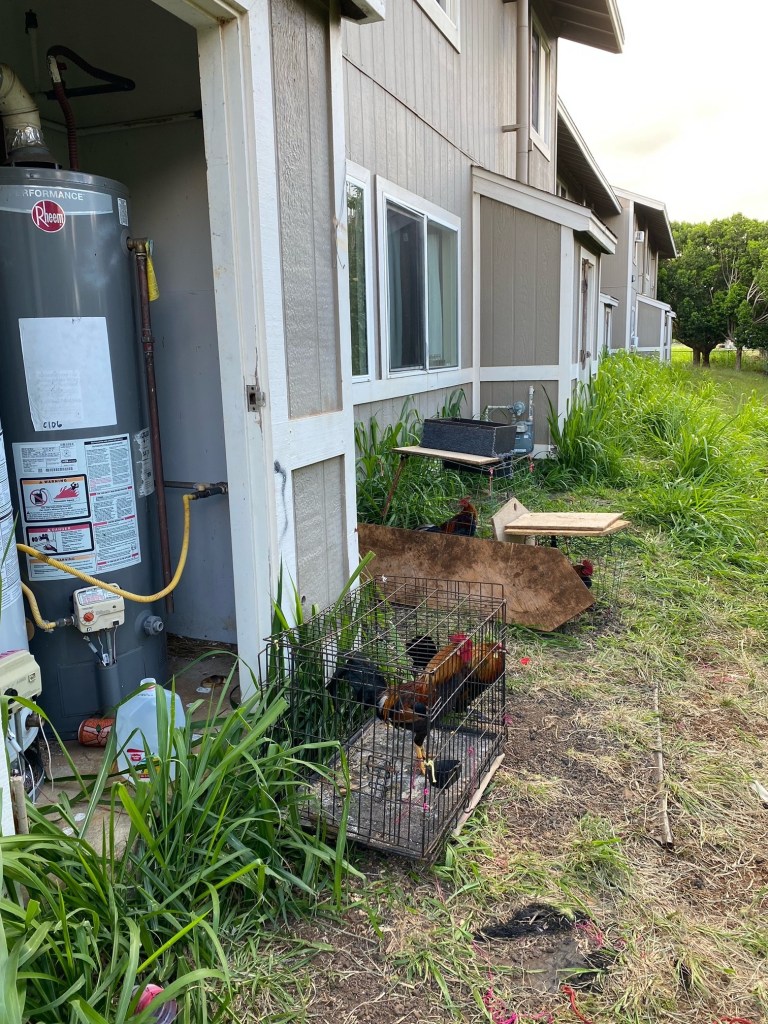
The last two years have been difficult for Katrina Martinez, who has lived at Kawailehua for 13 years. At one point, nearly 30 rooster cages lined her building’s stairwell and the balcony above her unit, she said. The crowing and smells made her feel like a hostage because she kept her windows and doors shut and fans running for the sake of her daughter, who has Down syndrome.
She said she repeatedly complained to the housing authority. She reached out to the County Council, which got the Planning Department involved. The department issued a violation notice in May 2025 and then a dissolution of violation a little over a month later because the activity ceased, said county spokesperson Alden Alayvilla. Martinez said a smaller number of roosters were brought back but the practice stopped entirely when one of the main tenants with roosters was evicted at the end of last year.
She said she’s also dealt with harassment from other tenants and is frustrated by the housing authority not enforcing its parking rules. Some units have multiple cars that take other units’ stalls or park in areas that block her daughter’s paratransit bus from coming into the complex.
Martinez and several other tenants say they don’t always feel safe living there. Kraft even carries pepper spray when she walks around the property.
In the last three years, Kaua‘i police have responded to 20 calls of family abuse, assault, harassment, disorderly conduct or other arguments at Kawailehua, according to police reports. In most cases, arrests weren’t made because the parties agreed to separate to cool off or no injuries were reported. In the family abuse incidents, suspects were arrested on existing warrants.
Rudy Tai, Kaua‘i police chief, said in an email that officers respond to abuse calls also connect victims with domestic violence services and notify Child Welfare Services when a child is present.
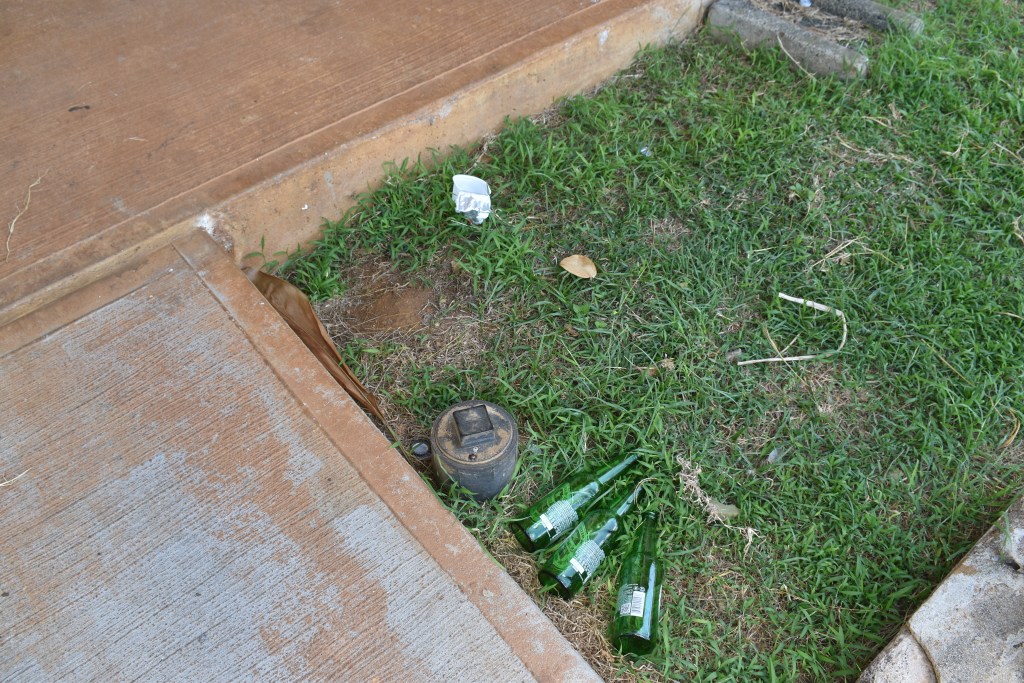
Some tenants feel that the property’s poor upkeep invites further bad behavior. They say the property has enough abandoned and stripped vehicles that they could build a new car from all the parts. This summer, crumpled cans, bits of glass, beer bottles, socks and even a couple of bike tires lay discarded on the ground — some nowhere near the property’s dumpsters.
“There’s doo doo diapers and shishi (urine-filled) diapers, you know, on the ground, and you know, and there’s discarded foods, cartons,” said Christy Fujimori, who has lived at the complex for over 25 years and is helping Kraft organize neighbors.
She and Tyson Iida, who has lived at Kawailehua for 27 years, said tenants used to take better care of the property by cleaning the parking lot, dumpster areas and lawns. Iida said that stopped as other long-time tenants who took pride in the property moved away and as they felt the housing authority seemed to stop caring, too.
The property has also become a dumping ground for people who don’t live there.
“We have people pulling into our project and stripping cars in the middle of the night,” Kraft said. “We have people pulling into our project and dropping whole pigs in our dumpsters.”
She and others have repeatedly complained to the housing authority about these issues but say their concerns don’t get addressed. Those who continuously violate their leases still live there and crime and dumping persist. She and other tenants want the property to have an on-site manager to help enforce its rules.
“The same behaviors just continue,” Kraft said. “It’s not like they fixed stuff.”
Getting a towing contractor has been challenging, the authority’s statement to Civil Beat said. Two companies responded to the authority’s latest request for bids, but one said rates were too low and the other said it didn’t have an appropriate storage yard to accommodate towed vehicles.
The authority issued violation notices to tenants identified as responsible for parking violations and distributed general notices to the tenant community of the complex’s parking rules.
To improve illegal dumping and general accountability, the authority plans on getting surveillance cameras. It takes reports of unauthorized occupancy and other lease violations seriously and investigates credible complaints through established procedures, the agency’s statement said.
The authority also recognizes there’s room for improvement in the areas of parking enforcement, property maintenance and communication, and it’s committed to making those improvements.
‘See Things Change’
Federal law allows tenants at public housing complexes to organize and requires that housing authorities officially recognize duly elected tenant councils and work with them. When requested, housing authorities are also required to provide guidance on establishing and maintaining councils and provide a recognized council with free office and meeting space.
Kraft has been trying to get that recognition and space for a year. With tenant organizing so uncommon on Kauaʻi, she needs the Hawai‘i Public Housing Authority to affirm to inquiring tenants that their efforts to establish a council are a protected activity. She also wants to ensure the council election and formation is compliant with federal rules so that the council has more credibility and pull to meaningfully impact residents’ quality of life.
Housing authority staff have bounced her to different people who sometimes took weeks or months to respond. Other times her inquiries went unanswered.
At the beginning of this year, she filed a grievance with the authority for obstructing tenant organizing efforts. She later filed two others relating to the safety issues and cars blocking paratransit access for disabled tenants. Her grievances have yet to be resolved. She and other residents have also reached out to county, state and federal representatives for assistance.
Rep. Dee Morikawa, whose district includes Kawailehua, said she’s shared tenants’ concerns with the authority. She added she’s not sure if funding challenges have prevented the authority from addressing tenants’ concerns sooner. The authority relies on some federal money, but she said the Legislature will scrutinize its funding request next session.
Most recently, Kraft is worried that recent staff turnover at the authority will further hinder tenants’ efforts because she has to explain to each new worker what she went through with their predecessors and what her group is trying to do now. Over the summer, staff finally provided feedback on the group’s draft bylaws and planned election process.
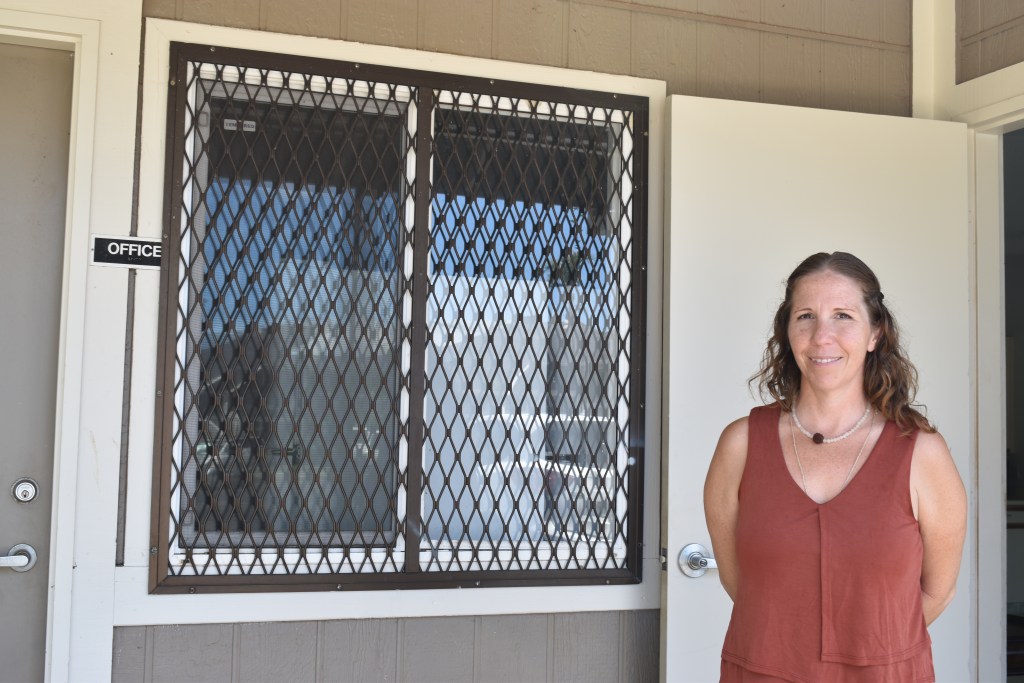
The tenant group still has a way to go to establish its council, and it needs the housing authority’s continued collaboration to do so.
In its statement, the authority said it fully supports Kawailehua residents’ rights to organize. It also met with interested residents to provide clarification, answer questions, and offer guidance.
The tenants have big plans for their council. They want to turn the property’s community room into a permanent resource center where residents can connect with and get help from groups like the YWCA, food bank and Marshallese Association of Kaua‘i. Tenants created a resource center in a community room at the property this spring, but the space was taken over and turned into a storage room by maintenance crews six weeks later.
The center would also be a place to host community gatherings, children’s activities and a neighborhood watch.
Kraft has been talking with the housing authority on potential new systems for granting resident access to the property’s community room and for keeping track of authorized cars in Kawailehua’s parking lots. The tenant council would aim to sustain such systems and help create a process so there’s regular communication between police, Child Welfare Services and the housing authority when lease or safety violations occur.
A Model For Other Public Housing
Many tenants support what Kraft, Fujimori and others are trying to do.
Monica Lojan, who has lived at Kawailehua for about eight months and is bothered by the crime she’s seen there, said she’d like to see the complex become more family-friendly.
“I want to see things change in our community,” she said.
The tenants at Kawailehua are a mix of individuals living with disabilities, seniors on limited income, families, trauma survivors, and Compacts of Free Association migrants from Micronesia, Kraft said.
Jeff Thomas, president of the Marshallese Association of Kaua‘i and a former Kawailehua resident, said the resource center could help families strengthen their relationships. Some parents, for example, have strained relationships with their children who skip school so much that they must go to family court.
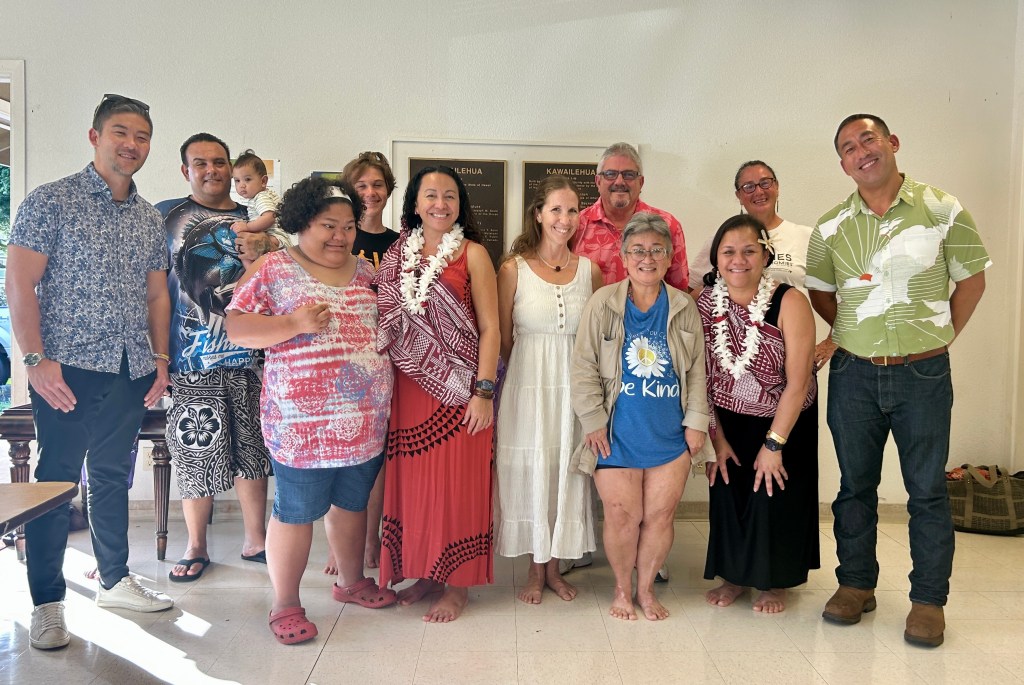
State Rep. Tina Grandinetti of O‘ahu said tenants at other housing authority properties, such as Kūhiō Park Terrace and Mayor Wright Homes, have come together to advocate for themselves amid the properties’ redevelopment plans, but she’s unsure if they’ve formed formal tenant councils.
Read More: Oʻahu Public Housing Tenants Promised Relocation Help Hit Dead-Ends
Grandinetti commends the Kawailehua tenants for trying to build a stronger community and for taking advantage of their explicit right to organize under HUD rules. Those rules also enable the housing authority to give duly elected tenant councils $15 per unit a year of HUD money for tenant participation activities.
She said the HUD rules are robust, but she’d be willing to look at ways to hold the Hawai‘i Public Housing Authority accountable in enabling tenant organizing. Part of the challenge might be that Hawai‘i hasn’t had a lot of tenant organizing compared with other places, so housing providers find it unfamiliar.
“It is scary for people to come together and advocate for themselves because there is always the fear of losing your shelter, your home,” Grandinetti said. “I really hope we start to recognize that and see it as something that we should support because it’s a good thing when people advocate for their community.”

