

Housing Shortage Driving Poverty In Hawaiʻi More Than Anywhere
A new study says lowering rents could substantially cut poverty in the Aloha State.
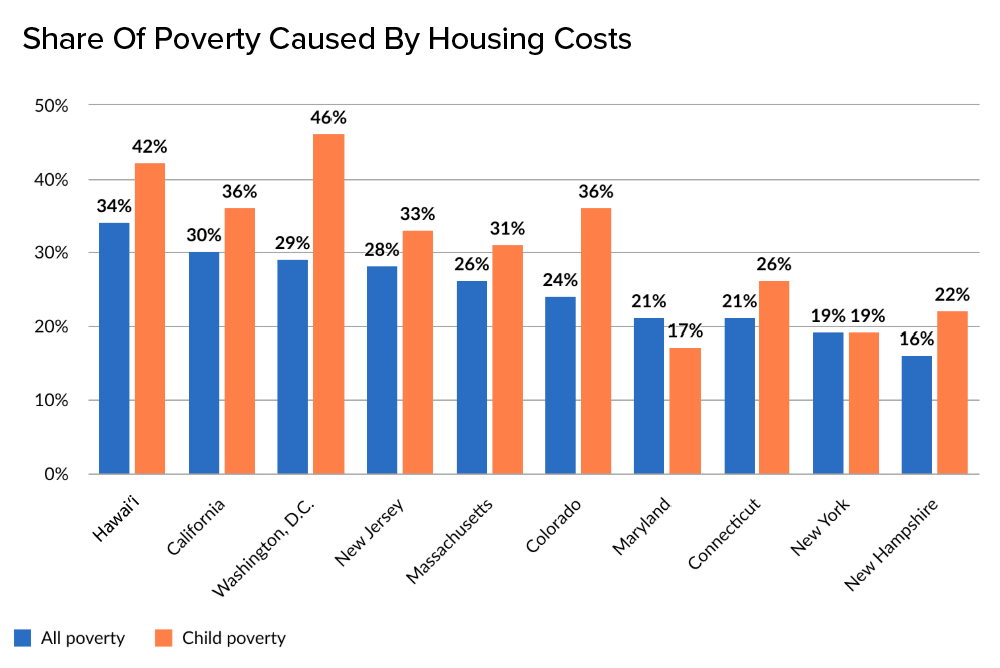
Hawaiʻi has a lower poverty rate than the national average but more poverty in Hawaiʻi is driven by housing costs than any other state in the nation plus Washington D.C., according to a new study.
The study found that as of three years ago, 34% of the state’s poverty was due to housing costs.
That means that of the approximately 150,000 people who lived below the poverty threshold in 2023, according to the American Community Survey, more than a third landed there because of how much they pay for housing.
That compares to California, which has the country’s highest poverty level but where 30% of that is due to housing costs. And for child poverty driven by housing costs, Hawaiʻi was second only to D.C., at 42%.
“Hawaiʻi’s poverty rate goes way up once you account for the fact that its housing costs are so high because more income is needed for a household just to meet its basic needs,” said Alex Horowitz, director of the housing policy initiative at The Pew Charitable Trusts.
Pew, a nonprofit public policy research organization, commissioned the study to find out where housing costs caused the biggest share of poverty. The study based its findings on the U.S. Census Bureau’s supplemental poverty measure, which factors in income, including state and federal benefits, as well as variations in local housing costs to determine how much someone needs to survive. The Census Bureau’s official poverty measure only factors in food costs and how much people earn before taxes.
The study, by University of Oxford professor Zach Parolin — and Pew’s analysis of it — proposed a way to address the problem of housing cost-driven poverty: Make it easier through zoning and building codes and the permitting process to build more housing. That would increase housing supply and put downward pressure on rents.
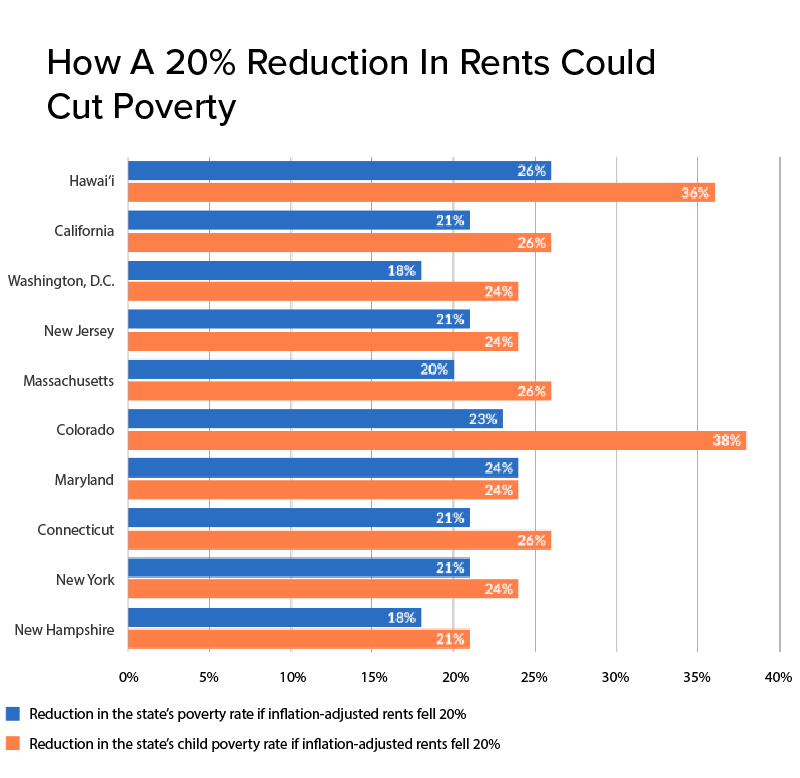
Lowering rents by 20% would cut Hawaiʻi’s overall poverty rate by a quarter and its childhood poverty rate by just over a third, the Pew analysis said.
That approach differs from anti-poverty programs such as food stamps and child tax credits which are used to bolster incomes, Horowitz said, and it would be more cost effective.
“The point of this is not that income supports aren’t important; they are clearly important for reducing poverty,” he said. “But this analysis is drawing attention to the expense side of the balance sheet because we can lower people’s housing costs for free.”
If rents were lowered 20%, about 39,000 residents would be lifted out of poverty as their housing expenses dropped, the Pew analysis said.
The average rent for a two-bedroom unit in 2023 was $2,050, the study notes. According to the 2026 Hawaiʻi Housing Factbook, 57% of renters in Hawaii pay more than 30% of their income in rent. Slightly more than a quarter of renters pay more than half their income toward housing.
The U.S. Department of Housing and Urban Development defines housing as affordable if it consumes 30% or less of income. Those who pay more than that are categorized by the federal government as “rent-burdened” people and families.
The Pew analysis pointed to policy changes in cities including Austin, Houston and Minneapolis that led to more housing construction, especially of multifamily buildings. That, the analysis said, has benefited renters in those and other cities that have made similar adjustments, because they spend less on housing, saving more than $4,000 annually on average.
Some of those changes included eliminating most requirements for minimum amounts of parking at housing developments, allowing multi-unit buildings on lots previously zoned for single-family homes and streamlining permit approvals for certain types of projects.
The example set by those cities illustrates that “state and local governments have a lot of control over housing costs,” Horowitz said, which makes it easier to tackle poverty driven by the cost of housing.
Recent efforts in Hawaiʻi to address the housing crisis have made only small dents, Horowitz said, highlighting 2024 laws that allowed accessory dwelling units on residential lots occupied by single-family homes and required counties to implement rules to convert empty office space into apartments.
“More steps will be needed to dig out of it, because addressing zoning is helpful, but there’s still permitting and building codes as well” that act as barriers, Horowitz said. “Also, the steps that Hawai‘i has taken so far in zoning are partial steps. They’re not all the way there.”

