

Gov. Green’s Mark On Hawaiʻi Supreme Court Set To Grow Even Larger
The governor will soon pick his third justice to the high court, and another vacancy is expected next year.
Gov. Josh Green has already placed two justices on the Hawaiʻi Supreme Court. He will soon pick another to the five-member bench, and could select another in 2027 if he’s reelected governor next month, as is expected.
Taken together, these picks and others mean that Green’s impact on the judicial system could last long after he leaves office.
The state’s Judicial Selection Commission is expected to send a list of Hawaiʻi Supreme Court associate justice nominees to Green in the coming months.
Green’s selection will fill the vacancy created by his elevation of Vladimir Devens to the chief justice position in April. Devens, a labor attorney, was previously appointed associate justice by Green in November 2023.
In addition, Green will likely be able to choose a fourth associate justice, assuming voters grant him four more years. Sabrina McKenna must retire by early October 2027 when she turns 70, the mandatory retirement age for Hawaiʻi judges and justices.
Given the recent history of both the Judicial Selection Commission and the executive branch, two of the 12 applicants for the position are favored to be on the short list of four to six names that will be forwarded to Green. The Intermediate Court of Appeals is the court immediately below the Hawaiʻi Supreme Court and a natural stepping stone to the higher bench, which is also an appellate court.
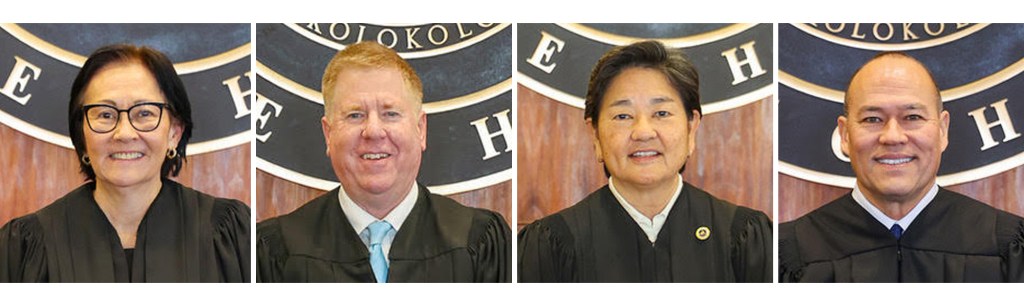
The two applicants are Sonja McCullen, who has served on the ICA since October 2021, and Karen Nakasone, who was appointed by Gov. David Ige to the intermediate court in November 2020. Nominated by Green in April, Nakasone was sworn in as chief judge of the ICA in July.
But recent history also illustrates more unconventional routes to the high court. Devens, for example, came from the private sector and Associate Justice Todd Eddins, who Ige selected in late 2020, was a Circuit Court judge.
Still, Green may also be looking to name another woman to the high court, which would also favor Nakasone and McCullen. At the time of Nakasone’s designation the governor publicly emphasized his priority to achieve a “male and female balance on the bench.”
“Hawai‘i can be proud that we have so many well-qualified female judges,” he said in a press release. “Young women who aspire to legal careers can see clearly in our courts, the heights that can be attained.”
Nakasone’s appointment, along with that of three other judicial picks, resulted in 41 women and 38 men seated in the judiciary.
“It’s a common belief, whether true or not, that judges on the ICA have an upper hand in being elevated,” said Jeff Portnoy, a longtime partner with Honolulu law firm Cades Schutte and a former member of the Judicial Selection Commission. “I think there are some very capable private lawyers on the list, but it always comes down to the governor and his judicial advisers. It really is the bottom line.”
Who Else Applied
The other applicants for associate justice are private attorneys Lance Collins, Ben Lowenthal, Brian Black and Nickolas Kacprowski; Circuit Court Judges James Kawashima, Shirley Kawamura, Catherine Remigio and Rebecca Copeland; Deputy Honolulu Prosecuting Attorney Robert T. Nakatsuji; and David Forman, a legal scholar at the William S. Richardson School of Law, University of Hawaiʻi Mānoa.
Several of the applicants, including Collins, Lowenthal, Remigio and Forman, have previously applied for a Supreme Court seat, and two have ties to Civil Beat. Black is executive director of the Public First Law Center and has represented the news site in litigation. Lowenthal was previously a columnist for Civil Beat.
The commission is reviewing public comments on the applicants that were due Oct. 5. Its nine members are each selected or appointed by the governor, the House speaker, the Senate president, the chief justice and the Hawaiʻi State Bar Association.

Nakasone is a graduate of the Boston University School of Law and Bryn Mawr College who later served as a law clerk to then-ICA Judge Simeon R. Acoba Jr. Acoba, who later served as an associate justice, is one of the nine members of the Judicial Selection Commission.
Nakasone was on the short list for associate justice in 2023 when Green picked Devens and Lisa Ginoza, who was chief judge of the ICA for five of her 13 years with the court.
McCullen trained at Richardson law school, served as a deputy prosecuting attorney and clerked for former Associate Justice Paula Nakayama.
Another factor in selecting the short list and the ultimate nominee is race and ethnicity. Two of the female applicants — McCullen and Remigio — are Native Hawaiian and, if one of them were confirmed, would represent the first Native Hawaiian woman on the high court.
But Green has also said that his court nominations should ensure diversity “beyond just gender and race,” he said when selecting Devens and Ginoza in 2023.
“It’s also background and experience that I was looking for to balance the court carefully this time. These two nominees have very different legal backgrounds, and it was their diversity and depth of experience that served as the most compelling reasons to select them.”
It’s not clear when the commission, whose deliberations are confidential and votes are done in secret ballot, will send its list of nominees to the governor. But when it does, Green will have 30 days to make his appointment. All nominations are subject to state Senate confirmation.
The terms for the justices are 10 years, and the salary has recently increased to $290,000.
It is likely the Senate Judiciary Committee would not take up the governor’s nomination until well into the next legislative session, which begins in January.
By that time there will be a new chair of the committee and several new senators. The Senate will announce any reorganization after the Nov. 3 election.
A Liberal And Righteous History
How Nakasone and McCullen may opine if appointed to the high court is not known.
But the Democratic Party has historically dominated Hawaiʻi politics, and all but two of its governors since statehood in 1959 were Republicans. Not surprisingly, the high court leans ideologically to the left just as the current U.S. Supreme Court leans in the opposite direction.
The opinions of the Hawai’i Supreme Court are shaped by the state constitution itself, which was described as “rooted” in culture and ʻāina (land) in a recent article in State Court Report because of its unique history as a sovereign nation with its own legal traditions.
“Hawaiʻi’s public trust doctrine has enabled extensive protections for natural resources, including water flows, shorelines and beaches, public lands, and marine ecosystems that form the backbone and lifeblood for perpetuating Native Hawaiian culture,” Kylie Wager Cruz wrote in April. Cruz is a senior attorney practicing environmental law with Earthjustice’s Mid-Pacific Office in Honolulu.
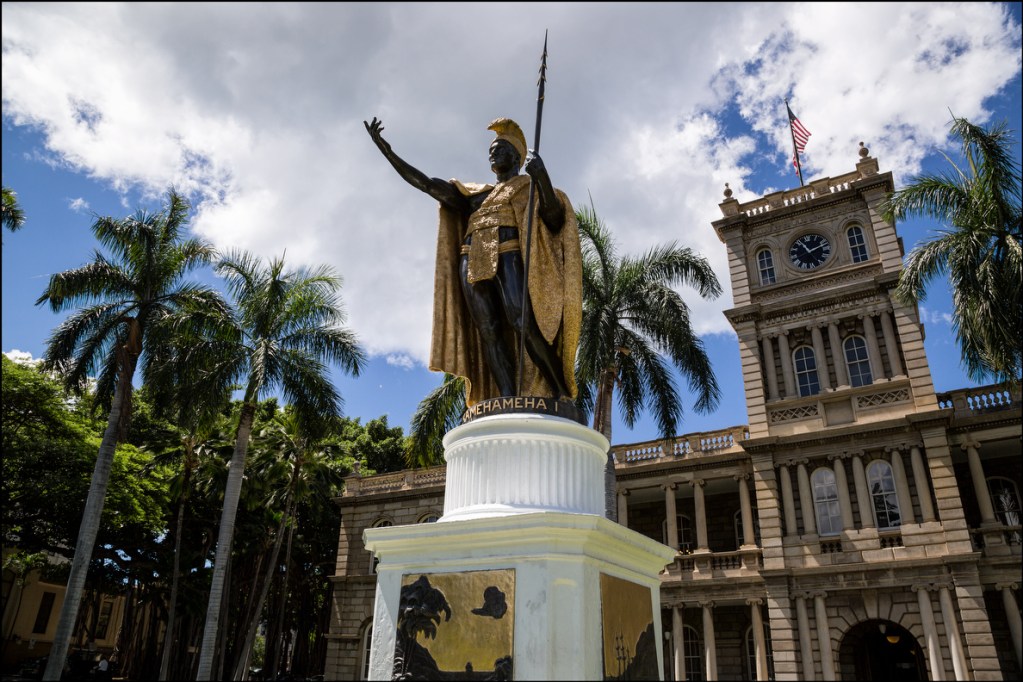
In recent years, the court has clearly favored more progressive views in a number of decisions regarding Native Hawaiian rights, Second Amendment rights, climate change and environmental protection, due process, criminal defense and personal injury.
The last Hawaiʻi governor to appoint three justices was Neil Abercrombie. A liberal Democrat who spent 20 years in Congress, Abercrombie’s appointments included two of the most liberal justices, McKenna and Mike Wilson, who is now retired from the bench. McKenna and Eddins are viewed as the most liberal of the current four justices.
In an interview with Eddins published just this week, Erin Geiger Smith noted how the associate justice has made national news for his “biting criticism” of the U.S. Supreme Court under Chief Justice John Roberts.
“State judges do not need to live in a never-never land of imagined historical consensus where the federal Constitution refuses to grow up and the country never grew up,” said Eddins. “We don’t need to time travel and cherry-pick history from an era when women, people of color, native peoples had no say. Federal judges have no control over the outlook of the Hawaiʻi Constitution and the statutes that we interpret.”
“We do not have to play on the artificial turf that the Roberts Court has patched together,” he added. “Hawaiʻi can plant its own real grass.”

