

Water Safety Lessons Coming To Hawaiʻi Schools. Swimming Isn’t Required
For the first time, Hawaiʻi schools may require water safety lessons. But swimming lessons will only be available to some.
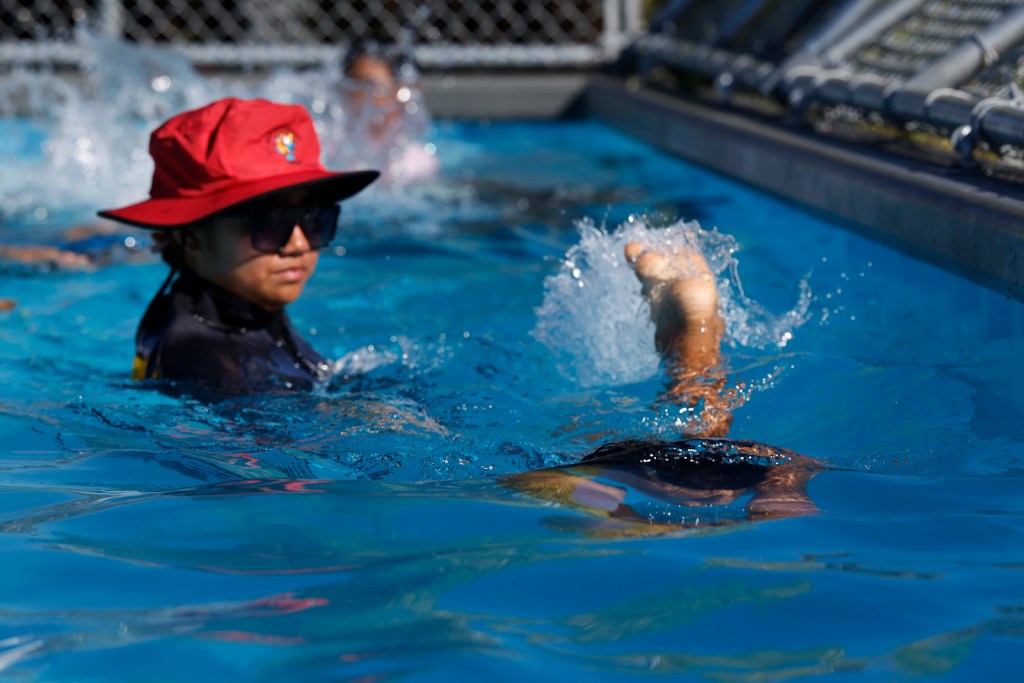
On a recent Monday morning, a Mākaha Elementary student stood waist-deep in the pool, arms stretched above his head as he waited for instructions. At his teacher’s call, he launched forward, kicking his legs to propel himself a few feet before coming up for air.
“Great job!” the teacher cheered, offering the student a high-five.
The lessons took place in Hawaiʻi’s first mobile pool owned by the water safety nonprofit Nā Kama Kai, which is offering swimming classes this fall to elementary students in Nānākuli and Waiʻanae. Similar lessons may be coming to more Hawaiʻi students under the proposed physical education standards recently presented by the state education department.
For the first time, the standards mandate water safety education for students across all grade levels. If the state education board OKs the plan, students will receive instruction on common water hazards, proper rescue techniques, signs of drowning and more.
But for some schools, instruction will likely amount to a lesson in a classroom, far from the water.
Hawaiʻi won’t require schools to offer swim classes unless they have access to a pool or calm stretch of ocean. For most island schools, that’s not a guarantee.
Only six Hawaiʻi schools have pools. Four of them are located in Honolulu. Maui County schools have none. While some campuses are within walking distance to community pools, others may face high transportation costs or other logistical challenges to getting kids to the water. The Westside of Oʻahu has no public pools, although discussions are in progress to build one in Kahuku.
Water safety advocates still say the new standards can play a key role in preventing youth drownings, which is the leading cause of death for kids ages 1 to 15 in Hawaiʻi. A 2019 report estimated that only half of Hawaiʻi kids know how to swim.
“Being an island state with our high drowning rates, ideally we want to have every kid get swimming lessons in the water and learn dry-land ocean safety skills,” said Sarah Fairchild, executive director of the Outrigger Duke Kahanamoku Foundation, which advocates for water safety and drowning prevention efforts. “So I think any movement towards that is good movement.”
Community organizations like Nā Kama Kai are working to improve students’ access to the water through solutions like the mobile pool, which could be transported to schools to offer swimming lessons on campus. Nonprofit leaders say the state needs to significantly invest in their partnerships with schools to ensure all students have the opportunity to learn swimming under the new standards.
“The first step is that you put these requirements in,” Nā Kama Kai chief operations officer Matt Kauwe said. “But it’s going to take a lot of time and effort and support from organizations like us, organizations like the DOE, the state, everyone that’s involved to make it happen.”
Water Safety Without Water?
At Pililaau Army Recreation Center, a Nā Kama Kai staff member challenged a group of Mākaha Elementary students to identify common warning signs at the beach and recall the seven-step protocol for helping someone at risk of drowning.
“What do you eat in your poke, in your sushi?” she asked a student struggling to identify a “Slippery Rocks” sign. Seaweed makes the rocks slippery, she explained, meaning that kids need to be extra careful when these signs are posted.
Under the proposed physical education standards, water safety rules and drowning precautions would be common knowledge for kids across the state. The education department hopes the state education board will approve the standards this school year.
By high school, teens should understand local hazards, recognize signs of drowning and plan safe water activities. If their school has access to the proper facilities, students should be able to float, tread and propel themselves through the water.
Right now, many Hawaiʻi kids lack these skills, even as they grow up surrounded by water. A 2019 assessment of second graders on Maui, Kauaʻi and Oʻahu found that only 2% of students could satisfactorily demonstrate fundamental skills like floating, treading water and swimming 25 yards.
Elementary schools are currently required to cover water safety in at least one grade level, but lessons can be brief. The proposed standards require schools to continuously cover water safety across all grade levels.
The new standards include multiple components that can be taught on dry land, said George Centeio, an educational specialist in the Department of Education. Even taught alone, these skills can still improve student safety, he said.
“It wouldn’t be equitable if only the kids in town got to receive water safety education.”
Parent Myriam Saboui
But some parents would like swimming lessons to be guaranteed in schools. Parent Myriam Saboui said she supports the new standards, but she would like the education department to invest in the transportation needed to ensure all kids can access the water during physical education class.
While her daughter learned how to swim through free lessons offered at city pools and attends school in urban Honolulu, not all kids have access to the same resources.
“I think it should be equitable,” she said. “It wouldn’t be equitable if only the kids in town got to receive water safety education.”
Expanding Access
The challenge of getting kids to the water isn’t new. In the past, the state education department has pushed back against potential legislation mandating water safety education in schools, citing the time and costs of transporting students to pools and hiring instructors. The Legislature proposed a $1 million program to provide instruction to elementary schools in 2023, but the bill failed to pass.
But some nonprofits have found solutions they hope to scale up.
The water safety nonprofit No More Under partnered with two Mānoa elementary schools and the University of Hawaiʻi swim team to offer lessons at the university’s pool this fall, serving around 70 kids. The two schools are within walking distance of UH, making it easy for kids to attend the lessons, said program manager Catalina Ainsworth.
Other organizations have invested in the transportation needed to bring kids to nearby pools. The nonprofit Palekana Aquatics Academy plans to partner with six Oʻahu elementary schools this year, walking or bussing kids to pools at community centers and public parks for water safety lessons, said executive director Dan Worden. The YMCA of Honolulu is taking a similar approach, transporting students at four schools to nearby branches this fall.
But many of these initiatives rely on limited grant funding, and nonprofit leaders say they need more investment from the state to expand their reach and teach swimming to more kids. They’re also hopeful that new solutions, like Nā Kama Kai’s mobile pool, could help reduce transportation costs by bringing necessary facilities to schools.
“It is a costly expense, especially with the transportation aspect,” said Kilohana Moa, associate branch executive director for the Windward YMCA. “We’re hoping, if it becomes part of a requirement, that there would be other funding resources available.”
Even with the uncertainty about implementation, advocates say Hawaiʻi is leading the way in water safety with its new standards. While some states have passed legislation requiring schools to provide families with information around water safety and swimming lesson options, it’s difficult for districts to mandate in-water instruction because of a lack of facilities, said Alissa Magrum, executive director of the National Drowning Prevention Alliance.
Worden said local nonprofits will need time to expand their reach. But if the standards go into effect, he said, it’s an important move to ensure all kids learn water safety.
“This is a really great first step to getting there,” he said, “with the understanding that our long-term goal needs to be making this equitable and accessible to all students, no matter where they are.”
Read the proposed physical education standards here:

