100 Roosters Are Driving These Oʻahu Neighbors Nuts
Residents in Kahaluʻu are mad that their neighbor is keeping more than 100 noisy chickens – and that the city is doing nothing about it.
Every day at 4 a.m., Joel Miranda wakes up to the cacophonous crowing of his next-door neighbor’s roosters.
“Like clockwork,” he said. “I only get four hours of sleep, and it’s causing me health issues.”
The bedroom of his Kahaluʻu home faces his next-door neighbor’s property, where the roosters live in a grid of roughly 100 enclosures scattered across the yard like tombstones. Miranda said he has called the city to complain, but police and permitting inspectors who have visited the property say they can’t help.

City law says households can’t have more than two chickens and that too much noise constitutes an animal nuisance. Violations can come with an initial fine of $250 that can ramp up to $1,000 and up to 30 days in prison for additional offenses. The sentence may also include mandatory animal training.
But officials say those rules may not apply because the neighborhood, in a rural area of Oʻahu, is zoned country. Miranda, however, said that shouldn’t prevent the city’s animal nuisance law from being enforced. Without enforcement of the existing law, he said, anybody on Oʻahu under country zoning can do what they please.
“You cannot stop them from raising as many chickens as they want,” he said. “The city won’t stop it.”
At issue is which of Oʻahu’s laws takes precedence: a zoning law meant to preserve agriculture, or an animal nuisance law meant to protect neighbors’ eardrums.
Miranda’s neighbor, Cherie Young, makes no apologies. She said her property has had chickens for decades, and she said the repeated complaints from Miranda and other neighbors amount to harassment. Inspections by city officials lead nowhere, she said, because the land is zoned for agriculture and therefore has no limit to the number of chickens on it.
The issue has come up at the neighborhood board, she said, and inspectors have visited her property.
“I thought this was already squashed in August,” she said.
Is This Legal?
Young said her roosters are allowed under the city’s zoning law, which the Department of Planning and Permitting confirmed in a written statement. But neighbors say that amount of chickens is not allowed under the separate animal nuisance law, which falls under the Honolulu Police Department’s enforcement power.
HPD did not respond to multiple requests for comment.
Council member Matt Weyer, an attorney who represents the district, said this overlap of conflicting laws is the real issue and that there needs to be clarity.
“It’s going to be dependent on how DPP or HPD’s interpreting and applying the law,” he said. I’m more than happy to have a conversation with the land owner about their needing to comply with the nuisance ordinance.”
The city’s animal nuisance law says no more than two chickens can live at the same household, and that owners cannot allow their animals to continuously make loud noises. The caveat, however, is that the law doesn’t apply if animals are kept for a commercial purpose.
Is Young’s rooster collection part of a commercial enterprise?
“Nope,” Young said. “No commercial enterprise in any way.”
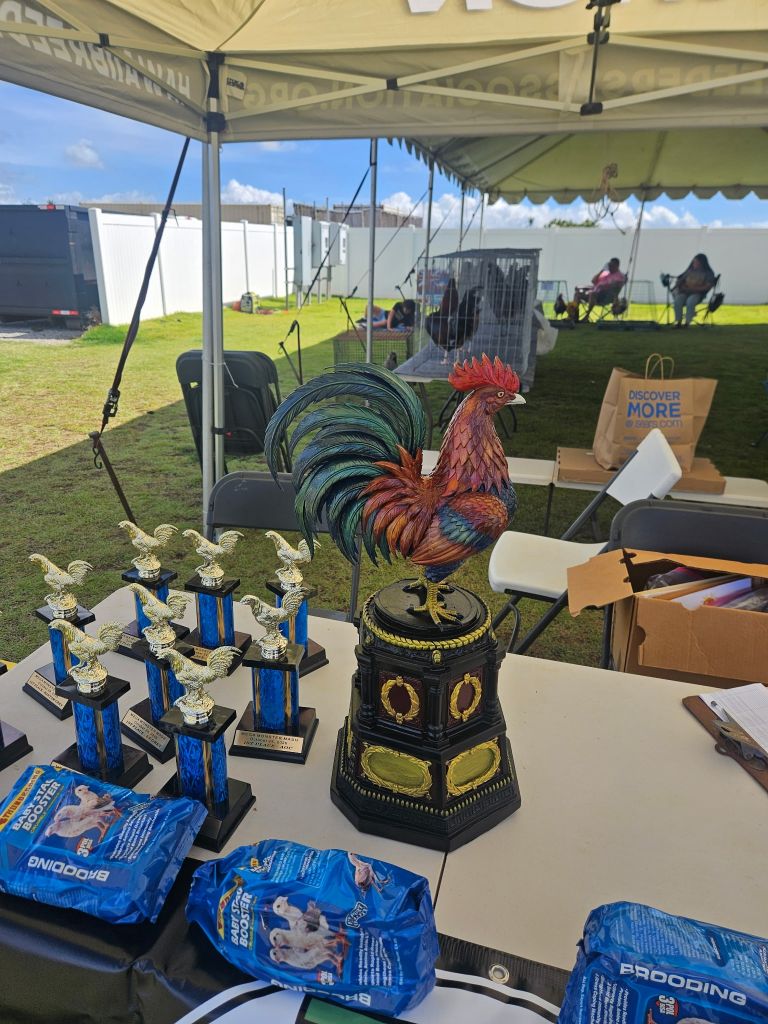
Young’s nephews enter the roosters into shows, she said, such as the recent Mega Monster Mash at Wai Kai in ʻEwa, where a bird competition was part of the mix.
She said she’s new to the world of chicken shows – her nephews take care of the chickens, while she just provides the land – but that she has been attending events and enjoys watching the judges evaluate the birds based on how they stand and how their feathers lay.
“It’s just a little thing that brings the community together,” she said.
‘I’m Not Here To Please Anybody’
Young’s property has been in her family for decades. She grew up there, she said, and her grandma and uncle still lived there until they died last year. She said she remained close with them as they grew older.
Both relatives died within a few months of each other, she said, prompting her to move into the house.
When she moved in, the house already had chickens, which Young said her uncle used for cockfighting. She’s confused why Miranda, who has lived next door for decades, didn’t complain then but is complaining now.
Miranda said that’s because he moved in after the roosters were already there, and that he was on good terms with Young’s uncle.
“I kind of looked the other way,” he said, “even though it was irritating. And then I figured once he passed away that we’d be done with the chickens.”
“I don’t get why people are ignoring the two-chicken rule.”
Neighbor Daniel Ringkamp
Instead, Miranda and other frustrated neighbors say the number of chickens has increased since Young’s arrival, which she denies. Historical overhead satellite images from Google Earth suggest the number of chickens 20 years ago was comparable to today’s total, but their numbers had dwindled by 2024.
Now, Young estimates she has just over 100 chickens, the vast majority of which are roosters.
“I’m not here to please anybody,” she said, arguing that she can do what she wants on her property.
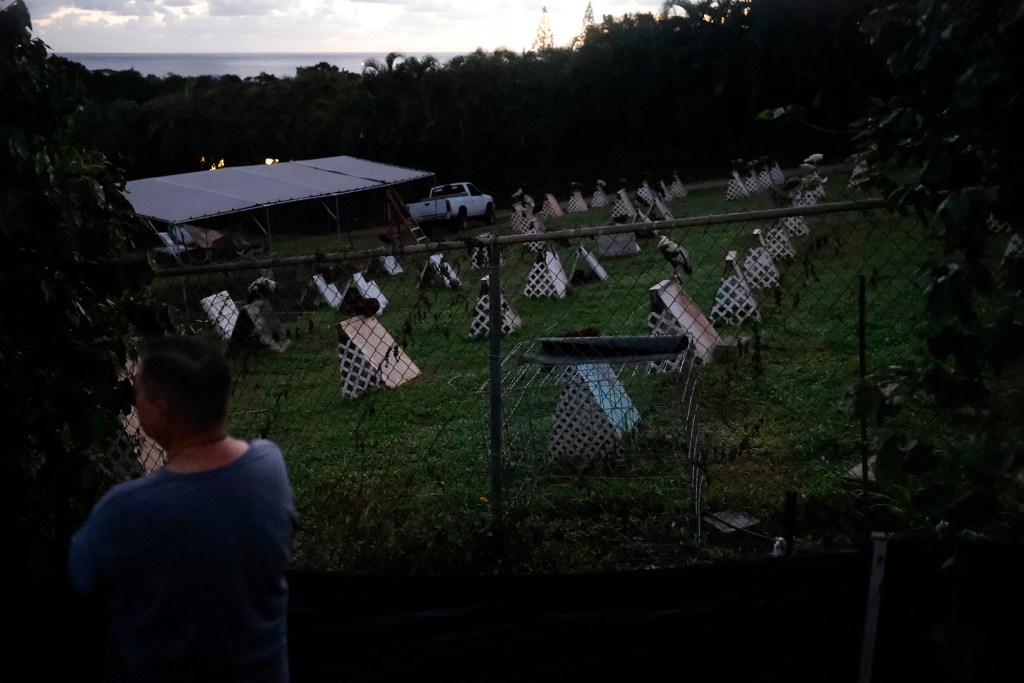
“Although she feels that she’s grandfathered in because the uncle was doing it,” Miranda said early one morning as roosters screamed beside him, “she’s new to the neighborhood as far as I’m concerned.”
Other nearby neighbors complain too. Mary Chang, who lives on the other side of Young, said she planted areca palm trees around the perimeter to muffle the sound. Daniel Ringkamp, who lives across the street, said he doesn’t think the legality is a gray area – just that people haven’t objected in the past and now “it’s created an illusion of grayness.”
“I don’t get why people are ignoring the two-chicken rule,” he said, referencing the city’s animal nuisance law.
Spokesperson Brandi Higa said in an emailed statement that the animal nuisance law doesn’t apply to every scenario on Oʻahu. She referenced the law’s exemption for commercial properties, which Young’s property is not.
Regardless, Young said the noise doesn’t irritate her since she grew up with all the chickens, and she’s frustrated herself that her neighbors continue to complain.
“Animals make noise,” she said. “How do they not make noise? I don’t get that.”