

Oʻahu Jail Killing Shines A Light On Prison Gang Mayhem
Grand jury testimony in a 2023 killing details the power and violence of an organization known as Murder Inc.
Four inmates were packed into Cell 201 in the gang module of Hawaiʻi’s largest jail, and some of them were angry. For days, cellmate Chris Vaefaga had been deep in a methamphetamine binge, and he wasn’t showering. He had also urinated on himself.
Nobody talked to corrections officers about the problem. Involving the guards was forbidden in that part of the jail. Instead, one of Vaefaga’s cellmates approached a leader of the prison gang known as Murder Inc., told him what was happening, and asked to be moved.
The response was quick and ferocious. Within the hour, Aaron “Rona” Tuitelapaga and his brother, Bronson Tuitelelepaga, entered the cell with a crew of accomplices and attacked Vaefaga, according to grand jury testimony in the case.
Vaefaga screamed for help as his attackers beat him and stomped on his head, but jail staff did not intervene. Inmate witnesses said his face was battered and he was “bleeding all over the place.”
Reputed gang enforcer Manu Sorensen then summoned another inmate with a tattoo machine and used it to cover Vaefaga’s “patch,” a gang symbol tattooed on his neck that identified him as a member, according to court records.

Vaefaga, 36, died later that day of blunt force head trauma that caused bleeding in his brain, but remained on his bunk for hours after his death. Another inmate finally used a contraband cellphone to text a woman on the outside, instructing her to call the jail and tell the staff about Vaefaga’s death.
Those details of the killing on July 6, 2023, at the Oʻahu Community Correctional Center are emerging in grand jury testimony and pretrial motions for the trial scheduled to begin Monday of Sorensen, Aaron Tuitelapaga and Bronson Tuitelelepaga, who are each charged with manslaughter (the two brothers spell their last names differently).
The case has provided a rare glimpse of the control exercised by gangs in parts of Hawaiʻi’s prisons and jails, and raises troubling questions about whether the correctional system is failing to manage active gang members who pose a threat to inmates and staff.

Richard Subia, a gang expert and former director of the California Department of Corrections and Rehabilitation, said one major concern in the case is the inmates were apparently allowed to “conduct discipline amongst themselves without staff intervention.”
The reported screaming and yelling during the beating should have alerted corrections officers to trigger an alarm and respond, Subia said. That would include taking the inmate aggressors into custody, and immediately providing medical assistance to the victim.
“That’s normal operating procedures in any prison system,” he said. “So, there’s a lot of problems here.”
The revelations in court also raise obvious questions about what happened — or didn’t happen — in the hours after the attack, but Department of Corrections and Rehabilitation Director Tommy Johnson declined a request for an interview about the case.
Rosemarie Bernardo, public information officer for DCR, said in a written statement that the department “does not comment on ongoing investigations or litigations.”
Managing Active Gang Members
Mark Patterson, chair of the Hawaiʻi Correctional System Oversight Commission and a former gang intelligence officer, worries the correctional system has so many other problems — such as staff vacancies and run-down facilities — that gang activity may be going unchecked.
Patterson said he does not have inside knowledge of gang activity today because the commission does not receive that intelligence, but he said gang issues are nothing new.
“There have always been gang members, but normally with the security protocols that are already in place, you can manage them,” he said.
Gang assessments are supposed to be done on every inmate when they enter a facility based on their tattoos, he said, and every facility should have a gang intelligence officer who assesses prisoners. Intelligence should be gathered from known gang leaders by monitoring phone calls, mail and inmates’ behavior.
But when there are staff shortages and people are tired, “is the job getting done?” Patterson asked. “Are the people being assessed? Are the people being assigned to the right housing based on what the gang intelligence is coming up with? And are they still being managed while they are in the facility?”

Patterson said department leadership is supposed to ensure it all gets done, but, “I don’t think that’s happening.”
Certainly the OCCC killing points to problems in the system. For one, Subia questioned the practice of housing active gang members in a relatively open module setting where they can readily interact with other inmates.
Active gang members are typically housed together only when they are in a highly restrictive “lockdown housing” setting that essentially eliminates their contact with one another, Subia said.
Inmates in the OCCC case reported gang leaders actually assigned inmates to cells in Module 13, and moved them as needed.
“You don’t typically see high-level offenders who have a long time to serve who are active gang members housed in a modular setting, just because of the dangerousness of that,” he said.
That clearly includes at least two of the three defendants in this case.
Aaron Tuitelapaga, described in court records as “the brains” of Murder Inc., was sentenced to life in prison without the possibility of parole last year for second-degree murder. He received a second life term for the use of a firearm in the commission of a felony, with the terms to be served consecutively.
That sentence came in connection with the fatal shooting of Sausau Togiai III on Aug. 12, 2020, during a robbery of an illegal game room in Pālama.
Bronson Tuitelelepaga was awaiting trial on a charge connected to the same incident — he was later acquitted.
Sorensen was sentenced to three consecutive 20-year prison terms last year for a botched robbery of another illegal game room in the Ala Moana area in 2018. He and another man were trying to rob the operation when Sorensen fired a single shot, killing Jacob Feliciano, 31.
Sorensen was convicted of manslaughter, use of a firearm in a separate felony and another firearms offense. Consecutive sentences were imposed because he had prior federal felony convictions for extortion and assault.
The state Intermediate Court of Appeals in April vacated Sorensen’s manslaughter and other convictions and his sentence, and referred the case back to the trial court for further proceedings.
Vaefaga was awaiting trial for second-degree assault and harassment when he was killed.
A Puzzling Staff Response
Subia also said nationally accepted correctional protocols prohibit inmates from entering each other’s cells, yet inmates in the OCCC case reported gang leaders actually assigned inmates to cells in Module 13, and moved them as needed.
On the day of the attack, gang leaders instructed a prisoner to clear out of Vaefaga’s cell after the beating, and assigned a gang member to move in to ensure Vaefaga did not report the attack, according to court records.
Another issue is the lack of an immediate staff response after the attack.
Staff members typically are required to conduct health and welfare checks in each cell of a housing unit every hour, Subia said.

“If this guy ended up getting beat up by these guys and left in a cell, that should have been picked up by the staff members conducting the security checks,” he said.
Inmates said the assault occurred about 12:40 p.m., and that afterward, Vaefaga was lying on his bunk for hours, struggling to breathe. But the Module 13 logbook shows a standing head count of every prisoner was conducted at 3:20 p.m, with nothing out of the ordinary reported, according to one court filing.
OCCC records also show additional “walk-through wellness and security inspections” were done every 30 minutes in Module 13 from 5:30 p.m. to 8 p.m. that evening, yet medical staff were not summoned to Vaefaga’s cell for a “medical backup call” until 8:30 p.m.
Yet another troubling allegation surfaced in connection with evidence recovered at the jail.
Vaefaga’s body tested positive for methamphetamine, and a cell-by-cell search of OCCC was launched days after his death. An array of contraband was seized in the search, ranging from steroids and vapes to illicit cellphones and methamphetamine.
Deputy Attorney General Adrian Dhakhwa, who is prosecuting the case, told 1st Circuit Court Judge Paul Wong on May 15 that contraband seized in the shakedown “mysteriously disappeared,” a situation Dhakhwa said is now under investigation.
Fear And Fallout
Inmates or former prisoners who agreed to speak with investigators or testify in the Vaefaga case say they have been threatened and now fear for their lives, including one who testified his son was beaten in Waiʻanae in retaliation for his cooperation with authorities.
Jared Kinikini, another witness in the case, testified on July 8 that his lawyer told him to cooperate with investigators, but “I knew that if I cooperated, my life would be at risk.” But Kinikini said his lawyer warned him he would probably also be charged in the case if he did not cooperate.
Kinikini’s sister, Lea Lani Kinikini, said Thursday her brother ended up cutting himself and swallowing part of a prison-issued razor earlier this month so he would be hospitalized to prevent corrections officials from moving him out of the protective custody module at OCCC.
Lea Lani Kinikini said the system has not done enough to protect her brother, and the influence of the gangs — particularly the gang known as Murder Inc. or Westside — has been rapidly growing inside the system.
“This whole thing has made visible what is going on at OCCC, which in my brother’s view is the gang is controlling the ACOs,” she said, referring to adult correctional officers. “They’re influencing movements, and that’s why he hasn’t felt safe.”
“It’s an institution that has been captured,” she said.
Subia said the state must provide cooperating inmates with safe housing, and move them out of state if necessary if that cannot be done within the Hawaiʻi system.
The lawyers who are defending Vaefaga’s alleged attackers forced each of the witnesses who cooperated with investigators to testify in open court this summer in an effort to have the grand jury indictment in the case thrown out, a maneuver that has further exposed the witnesses to public scrutiny.
Judge Wong has banned electronic devices from the courtroom, including cellphones, apparently in an effort to limit that exposure.
To make the case even more complex, court records show another prisoner has provided the defense with an entirely new account of the killing that implicates two of the witnesses.
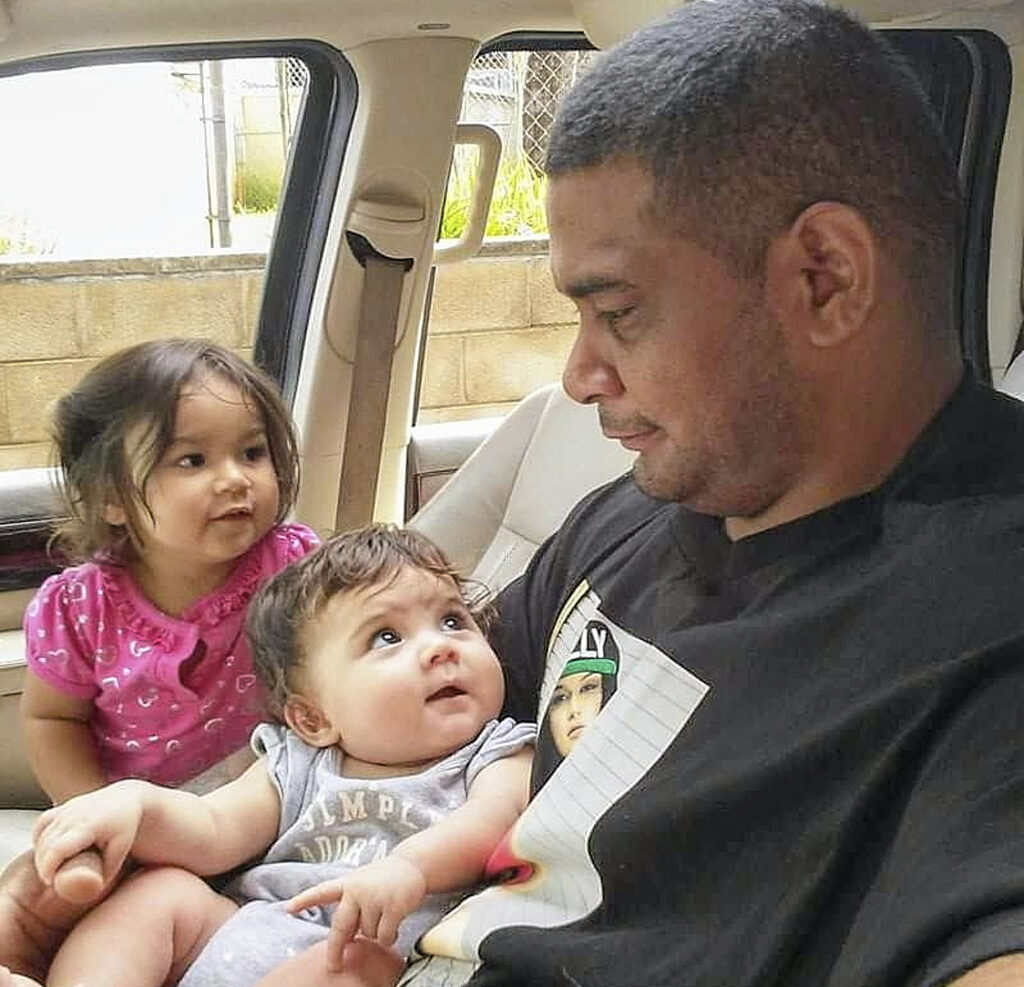
Almost lost in all of these courtroom machinations is Vaefaga, a father of four.
Danielle Majewski, Vaefaga’s former partner and mother of two of his children, was surprised to hear the criminal case against his attackers has not been resolved more than two years after Vaefaga was killed.
She said they met in a Honolulu park and found “love at first sight.” But the couple struggled to survive when they lived together and finally found themselves living in their cars.
He took the girls with him everywhere, Majewski said, and would watch them when Majewski went to work at an auto parts store. She watched the girls when Vaefaga found jobs as a mechanic.
Vaefaga “very much was a family person” who had gotten into trouble and been jailed before, but did well when they were together, she said.
Majewski said she finally moved to the mainland with her daughters because she couldn’t handle living homeless anymore, and Vaefaga had hoped to join them. Instead, he landed in jail again.
She said people won’t understand the life he lived because they didn’t walk the path that he did, and can’t understand the choices that he made.
She said she tells her oldest daughter: “Whatever was bad, just let it go, forget about it, and just remember the good times.”

