Honolulu’s Airport Has AI Theme Songs. The Internet Is Divided
The AI-generated tunes celebrating the islands are played hourly over the airport sound system. Some travelers think they misrepresent local culture.
Kyle Dahlin was flying from Honolulu back to his job on the math faculty at Virginia Tech in December when his ears perked up in a departure lounge at the Daniel K. Inouye International Airport.
“I remember hearing some music on the overhead sound system that was unfamiliar,” he said, “and thought, if that was a local performer I’d probably know it.”
Dahlin, who grew up in Kailua, said he got out his phone to use Google detection to try and identify the song. When the song didn’t show up on any playlist, he was pretty sure it had been created using AI.
“You can tell from the lyrics that they don’t quite rhyme,” he said. “The AI-singer can get away with it, but a real performer would struggle.”
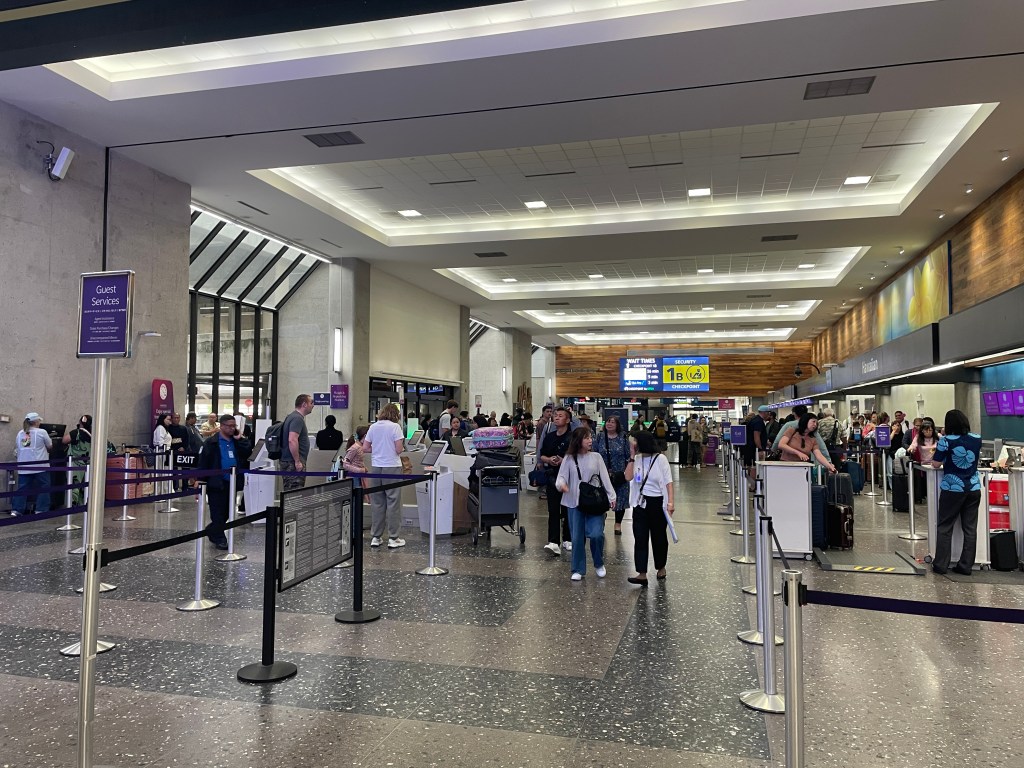
Honolulu’s airport has started playing 17 island-themed, AI-generated songs on rotation, according to state transportation spokeswoman Shelly Kunishige. They play on rotation at the top of the hour from 5:00 a.m. to midnight, and they’ve gotten mixed reactions.
One song goes: “From the baggage crew to the TSA line, everything’s fine. We move together, help the keiki, kūpuna and friends from afar, each one’s ʻohana, that’s who we are, Aloha every day at HNL.”
Dahlin said he started thinking about the lost opportunities for local performers.
“Hawai‘i has always had its own local music scene. So for a state agency to not be supporting that was pretty shocking,” he said. “There are a lot of people I went to high school with who would jump at the chance to create music like that for the airport, for the exposure.”
The passenger experience at the airport is managed by the state Department of Transportation.
“The songs highlight different aspects of the islands, aviation and the airport, including the airlines, our federal partners and airport staff,” Kunishige said. No state funds were used to produce them, and they started being programmed last November.
Kunishige said airport management had temporarily discontinued the AI-generated songs to address a volume issue, but did not say when they had stopped running them.
“Once that is resolved they will be used again to highlight the changing of the hour,” she said.
The transportation department did not answer a question about who was behind the idea for the motivational songs.
The tracks have certainly got people talking and generated several Reddit discussions with people posting examples they’ve recorded on their phones. “AI slop holiday music,” was the headline of one thread. Other examples were shared on YouTube and Instagram.
Bill Collins of ʻAiea said the songs are “very obviously AI” to anyone who’s experimented with sites like Suno, a popular AI music-generating website that allows users to create music in any genre or on any topic, including family anniversaries, sports teams, weddings or apparently, airport terminals.
“One song seems to be called ‘Party at HNL’ or something like that,” Collins said.
“I think this is a terrible representation of our city and state to visitors, and inexplicably lazy. It’s not just the use of AI when we have such a vibrant music scene –– the songs are absolutely terrible.”
Not everyone agrees with that critique, with some people on social media showing enthusiasm for the Jawaiian-sounding earworms with lyrics like “The sunrise over Diamond Head, we’re ready for the day, stars shining bright, then the morning breaks, from the gate to the curb you can feel it in the air, that island spirit, aloha’s everywhere.”

Dahlin said he and others are concerned that the AI-generated soundtrack is displacing the rich local musical culture of Hawaiʻi.
“It’s misrepresenting the music as well, I’m sure, to tourists,” he said. “You know, they don’t know what’s real.”
The songs are not replacing the more traditional music playlist that runs the rest of every hour, featuring songs by local artists including Aunty Genoa Keawe and Israel Kamakawiwo‘ole, Kunishige said.
That track list is played at Hawai‘i’s main airports, she said, and is purchased by the Hawai‘i Department of Transportation on an annual subscription basis for approximately $10,500, which includes licensing fees for songwriters and musicians.
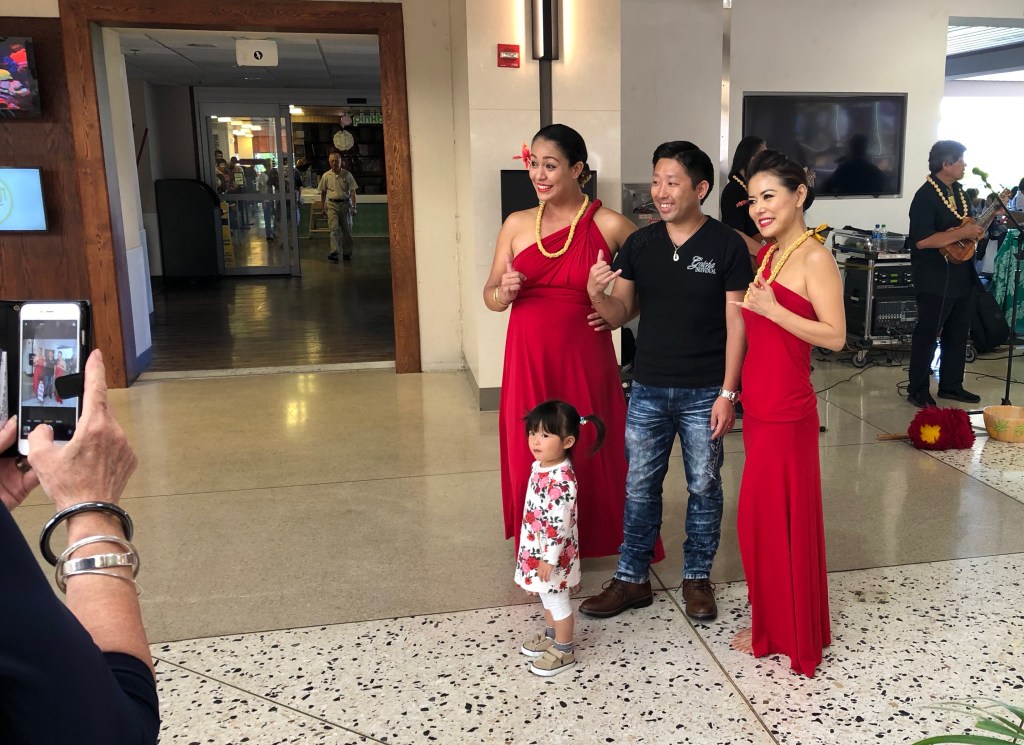
Hawai‘i airports also still feature live Hawaiian music, albeit less frequently, funded by the Hawai‘i Tourism Authority. Local musicians and dancers perform three times a week at HNL, and once a week at the Hilo, Kona, Kahului and Līhu‘e airports.
Aloha Music Meets Artificial Intelligence
Ever since Hawaiʻi became a commercial airline destination in 1935, some version of Hawaiian music has been used to greet or soothe travelers at Honolulu’s Daniel K. Inouye International Airport.
In the 1950s, that included performances by Joseph Kahaulelio’s hula troupe, newspaper archives show. A 14-day Hawaiʻi package tour advertised in the Waco Herald in 1964 promised “hula girls and music, dancing and singing” upon arrival at the airport.

In this decade, Hawaiian Airlines staff still perform “local style” sets in lounges, and slack key master Uncle Ledward Kaapana is known to break out his guitar for a kanikapila while waiting to board. At least until a security guard asks him to stop so people can hear the announcements.
Now, as artificial intelligence creeps into many aspects of online life, AI music is gaining a foothold in the soundtracks of public and corporate spaces.
Dahlin said that he has lived in other parts of the country, like Indiana, and there’s “no Indiana music,” but Hawaiian music is unique and identifiable.
“I hadn’t flown Hawaiian Airlines in a while, and the last time I heard an AI track it was in the Hawaiian terminal where they play a lot of traditional Hawaiian music,” he said. “And that music was getting preempted by an announcement and then the AI music.”
While the playlist can be heard in public areas like the departure hall, Alaska Hawaiian does not use AI-generated content onboard its aircraft, in membership lounges, or in its marketing or events, the company’s regional communications director Alex DaSilva said in an email.
The potential impact of AI on the livelihood of professional musicians and others in the creative industries is serious, according to organizations like the United Nations and the American Federation of Musicians and there have been various attempts to limit the fallout through legislation, contracts and changes to royalty structures.
Music creators could see their revenues fall by up to 24% because of AI, a recent United Nations report found.
“I feel like most non-musicians didn’t really understand the economic realities of being a musician before AI was in the mix,” said Travi Dee, a professional musician on Oʻahu and the mainland for 25 years. “It’s just one more pointless obstacle for us.”
“Seeing businesses turn to AI is not what we meant by suggesting folks stop expecting free music from artists,” Dee said.
Bill To Limit Spread Of AI Music Fails
AI-generated music was the subject of discussion in a bill that already died this Legislative session. House Bill 2357 would have prohibited music streaming platforms from making music available in Hawaiʻi that was performed or attributed to an AI-generated artist.
Honolulu musician Randy Wong submitted testimony on the bill to explain the impact firsthand.
Last year Wong got into a lengthy negotiation with the Spotify streaming platform to get it to take down an AI-generated album that spoofed compositions from his tiki-lounge exotica music project, The Waitiki 7.
“The AI-generated version of the music had a title similar to mine and was released the day after our album went online,” Wong said. “This caused significant confusion and lost sales, and it was difficult to remedy.”
In general, music played in public spaces like the airport should be sourced through a licensed music provider, Theresia Howe, program development director at the Henry Kapono Foundation, said in an email. The foundation set up by the veteran local performer promotes live performance and fosters emerging musical talent.
On a relatively quiet Wednesday morning, the background soundtrack in Alaska Hawaiian’s Terminal 1 was a barely perceptible Polynesian choir.
The speakers in the roof of the walkway between Terminal 1 and Terminal 2 were playing more traditional (and human-generated) aloha fare.
Fans of the AI-generated bangers will be most likely to encounter them on the other side of the security barriers while waiting to board at their designated gates.
But not all the AI-generated music will be as obvious to detect as “Aloha Every Day.”
Two Civil Beat reporters recorded samples of 10 different music tracks that were being played on both sides of security screening and ran them through an online AI music detection app.
While eight of the tracks were “likely human-generated,” another two of the songs likely had “AI-generated elements,” the apps found.