

Public Access To North Shore Beach Has Been Cut Off
The state plans to conduct a site visit and open a formal investigation if authorities determine a violation has occurred at Mokulēʻia.
Walking down the public beach access through the polo fields near Dillingham Ranch on Oʻahu’s North Shore, visitors are greeted by picturesque ironwood trees as horses graze their way through a field of flowers.
Just past the paddock, an uncrowded beach trimmed with pale blue water and a sprawling reef guides beachgoers along shorefront horse trails and driftwood formations.
A quarter-mile down, the path abruptly stops.

Beach access is a priority for Hawaiʻi, with a variety of laws aimed at protecting the public’s right to access beaches, defining sandy beaches below the highest high water mark as a public trust resource.
But along this stretch of beach in Mokulēʻia visitors are met with sandbags, piles of fallen trees and signs that threaten trespassers with guard dogs and another that warns the reader to “Keep off the sea wall.”
Beach access laws in Hawaiʻi have led to confrontations between property owners and government officials in recent years. In this instance, the property owners of the seawall were notified that the seawall itself was a violation of rules protecting beaches in the conservation district. The homeowner has been appealing the decision in court.
“There’s some history there, but I do think it’s rotten, and it does violate the public trust doctrine, as far as I can tell,” said Marvin Heskett, former chair — and current committee member — of the Oʻahu chapter of the Surfrider Foundation.
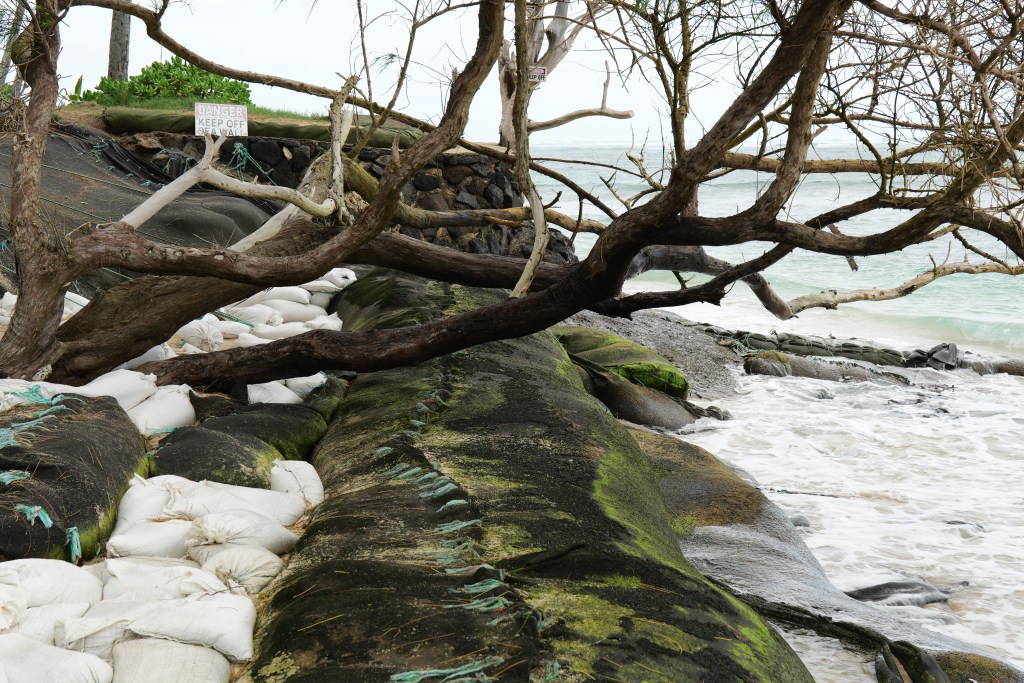
In addition to the seawall, temporary burrito systems — fabric filled with sand and stacked to create temporary erosion control — are prohibited by state law.
Passed in 2020, Act 16 says “unauthorized structures, materials, armoring, or hardening structures, including seawalls and revetments, sandbags, geotextile fabrics, and sand burritos placed in the shoreline are a nuisance” that are only permitted if granted through an emergency permit from the Department of Land and Natural Resources.
Due to their remote location, these burritos have flown under the radar, while residents 10 miles down the road in Pūpūkea are being fined hundreds of thousands of dollars for similar violations.
“This could be a potential conservation district violation,” Michael Cain from the DLNR’s Office of Conservation and Coastal Lands said in an email. “We will conduct a site visit and open a formal investigation if we believe a violation has occurred.”
Who Can Be Contacted?
Department of Land and Natural Resources Office of Conservation and Coastal Lands Administrator Michael Cain. Office number: (808) 587-0377
Violations can also be reported to Department of Land and Natural Resources enforcement officers through their tip line: (808) 643-3567, email via dlnr@hawaii.gov or through their DLNRTip App.
Seeking More Tips For Fix It!
Tell us where the problem is, as specifically as possible. A cell phone photo would be helpful. Here are ways to get in touch:
You can submit in minutes using this form.
You can send us an email at news@civilbeat.org. Put “Fix It” in the subject line so it doesn’t get lost among the many other news tips we receive.
You can send a letter to the newsroom at P.O. Box 10857, Honolulu, HI 96816.
We won’t use your name without your permission but, if we pursue your fix, we will get back to you with what we find.
Civil Beat’s coverage of climate change and the environment is supported by The Healy Foundation, the Marisla Fund of the Hawai‘i Community Foundation and the Frost Family Foundation.

