

Here’s How Sea Level Rise Could Transform Hawaii
Use Civil Beat’s interactive map to see how new climate change predictions could impact your neighborhood.
Sea level rise could be a lot worse than previously predicted.
A climate change study published in May by the National Academy of Sciences found that the global sea level could rise over 2 meters, or about 6 1/2 feet, by 2100 if emissions growth goes unchecked.
That’s more than double the upper value put forth by the United Nations’ Intergovernmental Panel on Climate Change in their fifth assessment report, published in 2014.
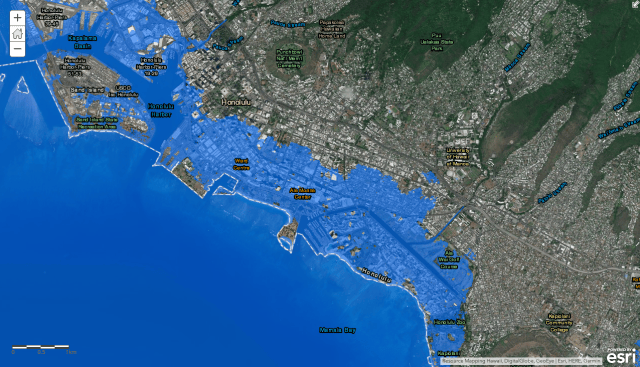
Sea level rise of 6 feet is something of a worst case scenario. The measurement is a 95th percentile value, which means that 95% of the time, the measurement was less than 2 meters in a scenario where the global temperature increased by 5 degrees Celsius by 2100. The median value, or 50th percentile value, in the same case would be a rise of 51 centimeters, or 1.7 feet.
The study was led by climate scientists from colleges across the globe and focused on measuring the effects of rising global temperatures on ice sheets.
This interactive map shows what 6 feet of sea level rise would look like across Hawaii.
Sea level rise data in map above is from the National Oceanic and Atmospheric Administration and includes data for Kauai, Oahu, Molokai, Lanai, Maui and Hawaii.

