

New Data Shows Hawaiian Islands Are Sinking Faster In Some Areas
Infrastructure, businesses and communities in low-lying areas are at risk of flooding sooner than scientists initially anticipated, particularly in certain urban areas of Oʻahu.
A recent study conducted by researchers at the University of Hawai‘i Mānoa identified that parts of the Hawaiian Islands are sinking faster than other areas.
Researchers found that as the Hawaiian Islands move farther from the hotspot beneath Hawai‘i island, they’re slowly sinking due to their own weight.
Researchers said that this islandwide subsidence rate is low on Oʻahu, at around 0.6 millimeters, which correlates to the thickness of approximately 10 sheets of printer paper each year.
Despite this, the study did find that certain areas along the South Shore of Oʻahu are collapsing at a rate 40 times faster than other parts of the island, exceeding 25 millimeters per year.
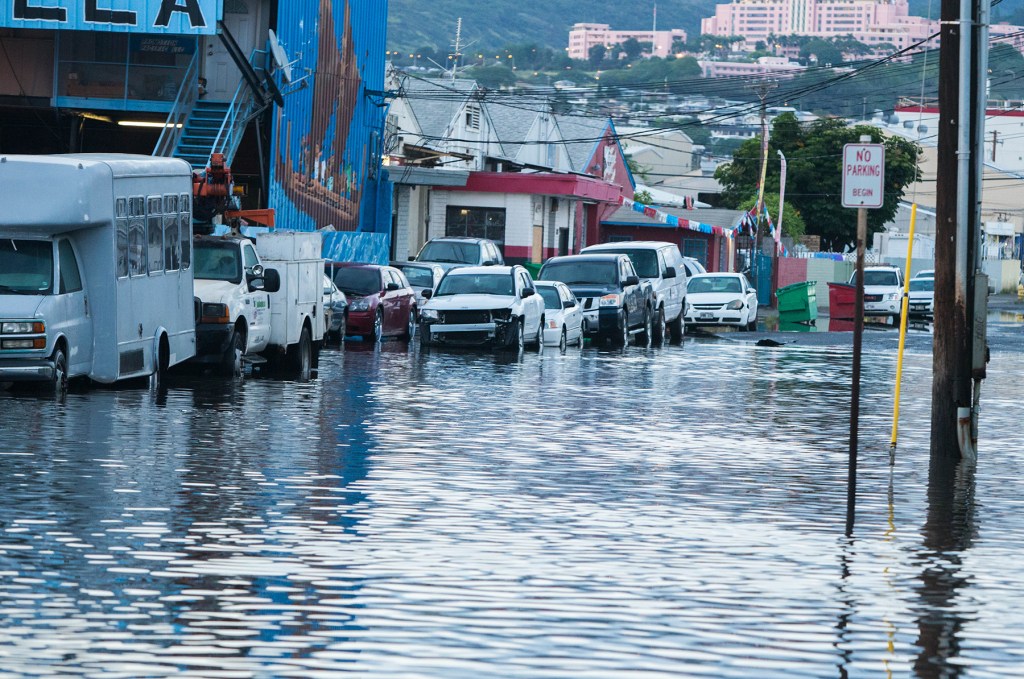
The research also highlights that as sea level rises, the infrastructure, businesses and communities in low-lying areas are at risk of flooding sooner than scientists initially anticipated, particularly in certain urban areas of Oʻahu.
“Much of the urban development and infrastructure, including parts of the industrial Māpunapuna area, is built on sediments and artificial fill,” said UH Mānoa researcher Kyle Murray.
Murray is the lead author of the study and researcher with the Climate Resilience Collaborative (CRC) at the UH Mānoa School of Ocean and Earth Science and Technology.
“We think the majority of subsidence is related to the compaction of these materials over time,” Murray added.
The team studied nearly 20 years of satellite data and developed high-resolution technology to accurately map coastal topography. The combination of research showed how sea level rise and ongoing subsidence will exacerbate future flooding.
Researchers said that the rate of land subsidence is faster than the long-term rate of sea level rise in Hawai‘i, which has been recorded as 1.54 millimeters per year since 1905.
This means certain areas will experience chronic flooding sooner than anticipated.
In areas like the Māpunapuna industrial region, subsidence could increase flood exposure area by over 50% by 2050.
Researchers clarified that since the shoreline plays a vital role in sustaining Hawai‘i’s coastal communities, economy and infrastructure, urban planning and coastal adaptation strategies are crucial with these new findings.
To read the full report, click here.

