

Abercrombie Vetoes 7 Bills, Lets 6 Become Law Without Signature
Governor signed 229 bills passed by the 2014 Hawaii Legislature.
Gov. Neil Abercrombie decided Tuesday to veto seven of the 245 bills that the 2014 Hawaii Legislature passed, including bills relating to tourism, law enforcement and succession.
The governor is letting six become law without his signature, which basically means he can live with them despite his concerns.
In all, Abercrombie signed 229 bills from this past legislative session, which ended May 1. In a release Tuesday, he highlighted the minimum wage law and money to protect hundreds of acres of North Shore land from development.
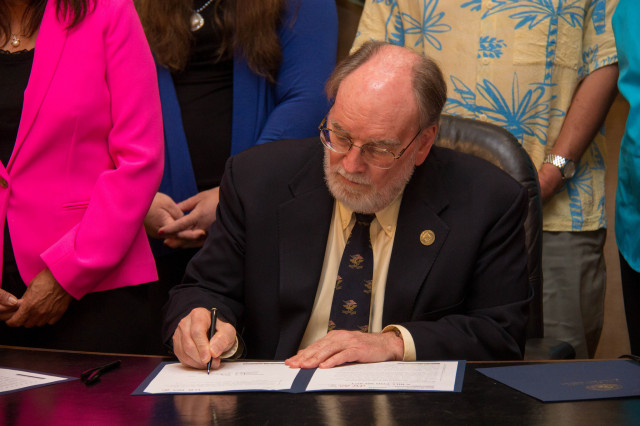
Gov. Neil Abercrombie signs a bill, July 2, 2014.
Governor Neil Abercrombie via Flickr
“While fewer bills reached my desk this year compared to years past, laws generated this session will have a positive impact on Hawaii and its people,” Abercrombie said.
The governor let the Legislature know June 23 that he was thinking about vetoing 10 bills. But by Tuesday, the veto deadline, he had whittled it down to seven.
Here are the bills Abercrombie vetoed and his reasons:
- Senate Bill 60 (Relating to Victims of Crimes) – While Gov. Abercrombie supports the concept of restorative justice, he objected to this bill because, as written, it does not provide adequate protection for victims of domestic violence, child sexual assault, or elder abuse from intimidation, coercion, and manipulation by the offenders.
- Senate Bill 2431 (Relating to the Hawaii Tourism Authority) – Gov. Abercrombie vetoed this legislation because it makes permanent the provision of Act 58, Session Laws of Hawaii 2004, which takes away the checks and balances that ensure transparency in the operations of Hawaii Tourism Authority that the comptroller’s account supervision provides.
- Senate Bill 2589 (Relating to Law Enforcement) – The governor agrees with the underlying objectives of the bill to transfer the harbors law enforcement functions of the Department of Transportation Harbors Division to the Department of Public Safety, but believes both departments are already working collaboratively to improve efficiency and effectiveness, and that they should be allowed more time and opportunity to administratively implement the objectives of this legislation with duties and responsibilities being resolved through a memorandum of agreement.
- Senate Bill 2874 (Relating to the Board of Land and Natural Resources) – House Bill 1618 (Relating to the Composition of the Board of Land and Natural Resources), which Gov. Abercrombie signed into law (Act 104) on June 19, is substantially similar to this measure, so there is no necessity to also approve this bill.
- House Bill 1288 (Relating to Order of Succession) – The governor objected to this measure because it does not provide for succession in the situation when the Office of the Governor becomes permanently vacant at the same time as the Office of the Lieutenant Governor, and the Senate President and the Speaker of the House belong to a political party different from that of the governor.
- House Bill 2163 (Relating to Parental Parity) – Gov. Abercrombie vetoed this bill because the rebuttable presumption that an asset given to a parent is a joint gift is vague, ambiguous and inconsistent with well-established principles guiding the parties and the courts in divorce matters.
- House Bill 2427 (Relating to the Repeal of Non-General Funds) – This measure repeals several funds, including the Center for Labor Education and Research (CLEAR) Revolving Fund, which the governor believes should be retained and used by CLEAR instead of being deposited into the General Fund.
Here is the list of bills the governor is letting become law without his signature:
- Senate Bill 2288 (Relating to Education)
- Senate Bill 2365 (Relating to Insurance Claims)
- Senate Bill 2470 (Relating to the Hawaii Health Connector)
- Senate Bill 2483 (Relating to Condominium Associations)
- Senate Bill 2682 (Relating to Financial Disclosure Statements)
- Senate Bill 2821 (Relating to Insurance)
The governor line-item vetoed the budget bill, House Bill 1700, on June 23 to address an inconsistency of approximately $444 million between it and the bond authorization bill, House Bill 1712, that had prevented him from signing both into law. Both have since been signed, the release states.
Visit capitol.hawaii.gov to learn more about any of the bills.

