

Bikini Atoll: ‘The Day the Sun Rose in the West’
A survivor of radiation poisoning from a 1954 U.S. nuclear test in the Pacific talks about experiencing the massive explosion from his tuna boat.
Hiroshima. Nagasaki. Lucky Dragon #5.
To the Japanese, the incident that literally befell the 23 crew members of a tuna fishing vessel caught in the wake of the Castle Bravo 15-megaton hydrogen bomb test on March 1, 1954, makes the three names utterable in the same breath.
That is, to the Japanese people, not their government. Hiroshima and Nagasaki victims affected by radiation are granted “hibakusha” (explosion-affected people) status. But even though the blast in the Bikini Atoll was a thousand times more powerful than the bomb dropped on Hiroshima, political expediency dictated that the crew of the Lucky Dragon #5 be denied membership into that unfortunate club.
Of the 23 crew members, seven are still alive. The first to die was chief radioman Kuboyama Aikichi on Sept. 23, 1954, less than seven months after the detonation of the most powerful nuclear device ever tested by the U.S. Doctors concluded that Kuboyama’s death at the age of 40 was due to acute radiation syndrome (ARS). Extended hospital stays and constant blood transfusions leading to Hepatitis C and severely damaged livers ensued for most of the rest of the crew.
None escaped unscathed.

Many of the Lucky Dragon’s crew decided it was better to remove themselves from the spotlight and simply go on with their lives as best they could after long hospital stays. One, however, Oishi Matashichi, decided that his story, and that of his fellow sailors, must be told at the cost of heavy criticism, even by some of his own crew members. Japan is a country where discussing grievances in public is shunned.
He has told his story through countless school visits and written two books, “Shi no Hai o seotte: Watakushi no jinsei o kaeta Daigo Fukuryumaru” and “Bikini jiken no shinjitsu – Inochi no kiro de” (the latter translated to English under the title “The Day the Sun Rose in the West: Bikini, The Lucky Dragon, And I”). A cerebral hemorrhage is the latest malady to beset the fisherman turned dry cleaning/Laundromat owner and anti-nuclear activist.
In the shadow of the hull of the decontaminated Lucky Dragon #5 on display at the Tokyo Metropolitan Daigo Fukuryu Maru Exhibition Hall, I met the 81-year-old Oishi to hear his story.
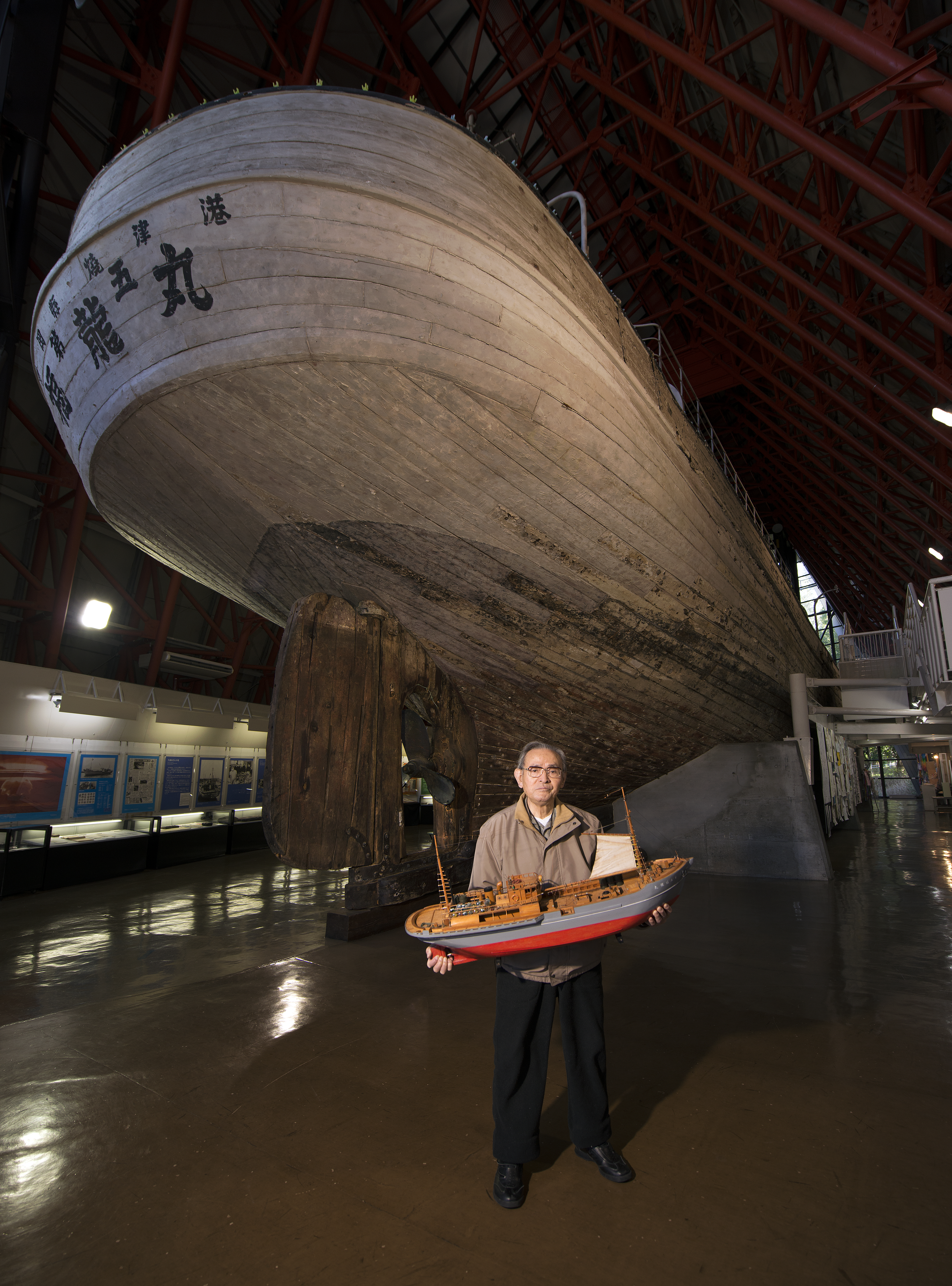
Former Lucky Dragon No. 5 crew member Oishi Matashichi stands under the hull of the boat at the Daigo Fukuryu Exhibition Hall in Tokyo.
The Lucky Dragon #5 incident was one of the inspirations for the 1954 film “Gojira” (“Godzilla”), the story of a prehistoric monster resurrected by repeated nuclear tests in the Pacific. The monster that killed Oishi’s crew member Kuboyama and caused endless suffering and an early deaths for many of the crew, was real, and ironically named “Shrimp.”
This first test by the U.S. of a practical deliverable hydrogen bomb (AKA fusion bomb) unleashed a fireball almost four and a half miles across within a second and resulted in the contamination of more than 7,000 square miles of the Pacific Ocean. High doses of radioactive fallout fell not only onto the deck of the Lucky Dragon but rained down upon the inhabited Marshallese atolls of Rongelap and Rongerik, causing severe injuries to the local populace.
Lining the deck of the Lucky Dragon today are miniature plastic Godzillas.
Just outside the museum entrance is a stone monument with the words of Oishi’s fellow crewman, Aikichi Kuboyama: “I pray that I am the last victim of an atomic or hydrogen bomb.”
But the nuclear age continues. In 2011, a tsunami-caused meltdown at Japan’s Fukushima nuclear power plant led to a radiation leak. And the Lucky Dragon #5, which certainly did not live up to its name, is testament to the dangers we all face.
Civil Beat: Tell us about the day of the hydrogen bomb test.
Matashichi Oishi: It was the time just after the war and the world was still in chaos. Japan was a poor country. People didn’t have enough food. Although I had heard about the atomic bombs in Hiroshima and Nagasaki, I didn’t know anything about these kinds of weapons. Maybe the government was controlling this kind of information to a certain extent.
This was my frame of mind when the enormously big hydrogen bomb test happened so I didn’t have any idea about what was going on in front of my eyes. I didn’t have a single thought that it was an atomic or hydrogen bomb. I thought some terrible natural disaster had happened. I wondered if a meteorite had hit the earth or a volcano had erupted under the sea. But we didn’t find anything like that around us so we couldn’t do anything but to wait and see what would happen next.

The Bikini Atoll nuclear test known as Castle Bravo.
The bright light came the first. It changed the sky. I don’t know how to explain its color, maybe orange, yellow or red, the light which had that kind of color covered all over the sky above our heads and did not disappear. Then the light gradually went away and the sky returned to normal. But all of us were worried.
Then the sound came after the dramatic light faded away. I felt it took about seven or eight minutes but some of the other crew members thought it was more like 15 minutes.
How would you describe the sound?
It did not sound like an explosion, it was more like a rumbling of the earth which came from deep under the sea. It sounded like “Goooo…” or “Do-Do-Do…” as if the sound covered the whole ocean. Everyone was so shocked. We all laid face down on the deck, thinking we might not survive. Many things came to our knowledge afterwards but we did not know about the bomb test and wondered what was going on.
Were you not aware of a U.S. military exclusion zone?
We were told that there was an exclusion zone of the American army but we thought we were safe because we were not in the zone. All we knew was that the American army was doing many kinds of things inside the zone but not what kinds of things. We couldn’t know other than that because more detailed information was classified.
I imagined maybe some kinds of experiments or military exercise were going on.
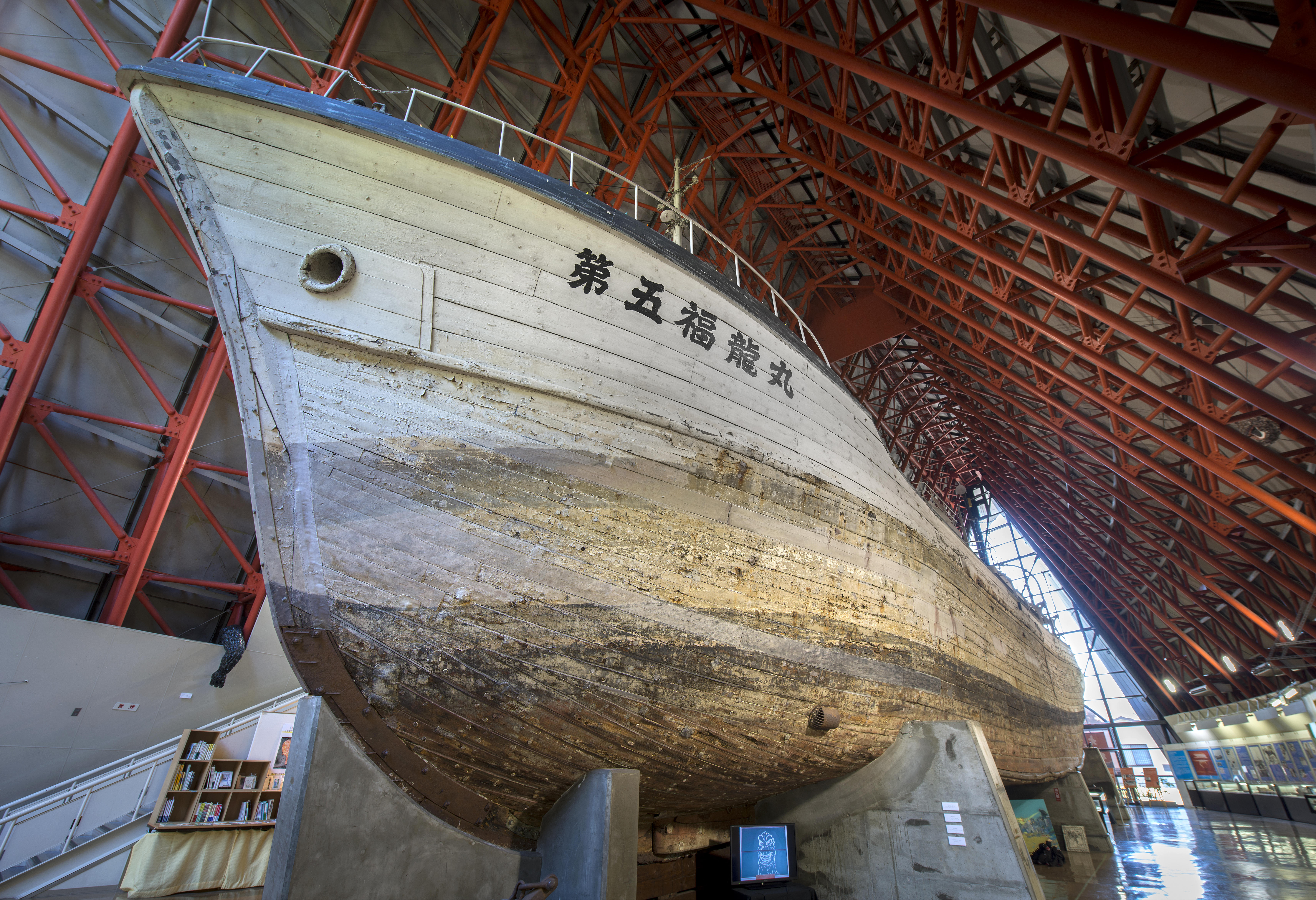
The Lucky Dragon No. 5 on display at the Daigo Fukuryu Exhibition Hall in Tokyo.
photo: Mark Edward Harris
Were you not aware that there was going to be a hydrogen bomb test in this area of the Pacific?
No, we were not. Maybe that is because the information about the test was classified military information. Maybe even the Japanese government did not have the information about it. There was no way we could have that kind of information. That’s why we imagined something different. From what I heard afterwards, it looks like we were about 160 kilometers (100 miles) away from the epicenter of the blast.
Where were you on the boat when the explosion happened?
We usually started our job around midnight on the boat. We threw a long line into the sea which took till around dawn. After that, we rested for a while waiting for fish to come into the long line. It was around that time that the explosion occurred. We were about to lie down and take a nap.
Since the light and the sound came from far away, we thought something terrible had happened and that we should run away from the area where we were immediately, though we did not know what was going on. We started to retrieve the long line from the sea soon, but it took more than six hours to do it.
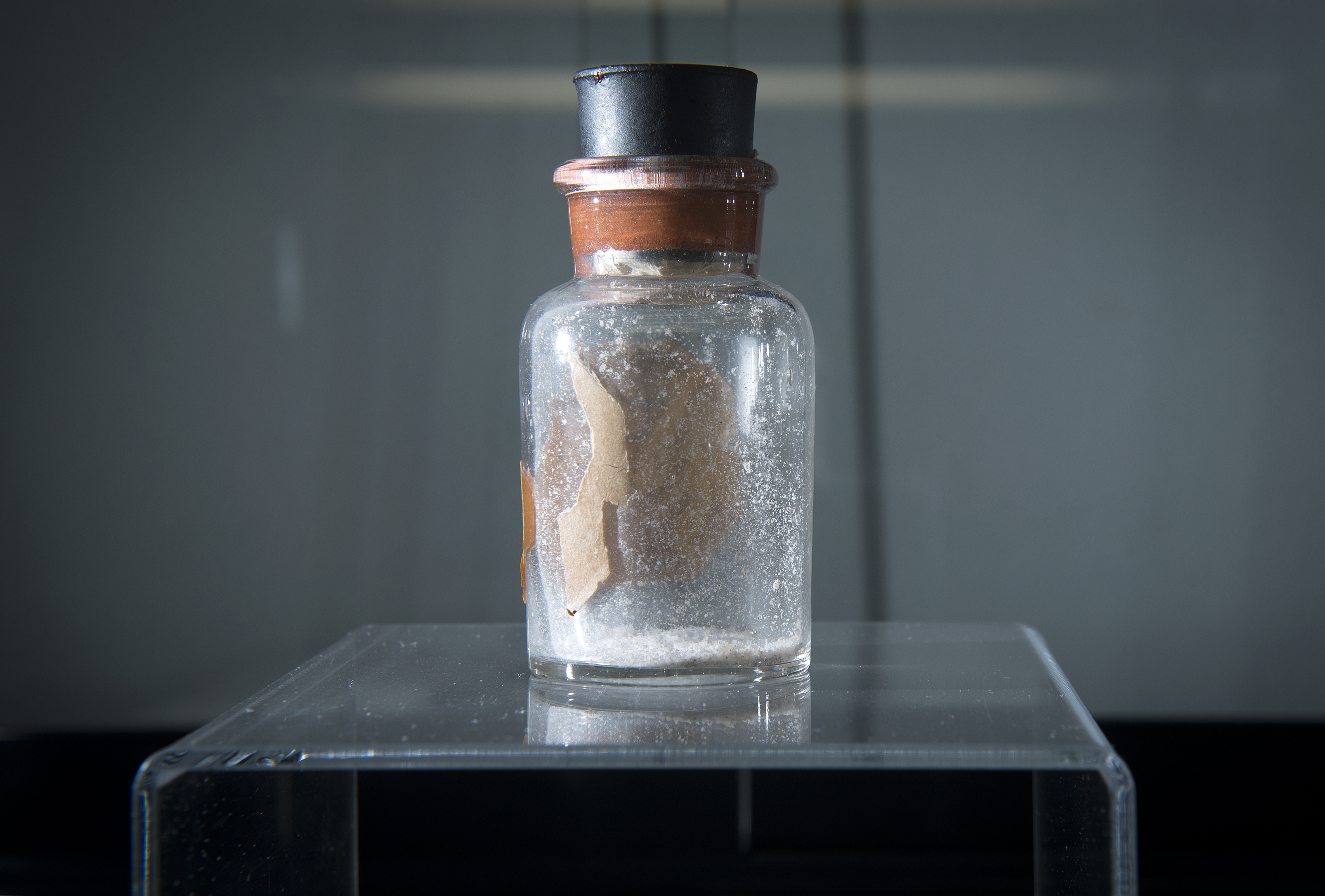
A vial used by the Lucky Dragon Crew to store ash from the fallout.
Mark Edward Harris
In the meantime, something very white, which looked like snow, fell down from the sky. We didn’t have any knowledge about radioactivity. The white ash hit us in our faces and everywhere else, but we didn’t think it was dangerous because it was not hot, it had no taste, and it didn’t smell. I licked it. Our faces and mouths were covered with the ash. Everyone tried to lick it to examine what it tasted like and chewed it to see how hard it was. It didn’t have any taste. It was gritty like sand. Its color was white like snow but it didn’t melt. We wondered what it was. It was coral powder which blew up into the sky because of the explosion but we didn’t of course know what it was at that time.
We swept away the ash because it was interrupting our job. But we were not afraid of it because we were not aware of the fact that the ash contained strong radioactivity.
The light was so bright that some people who were sleeping woke up and stared into the direction where the light came from. All of us were wondering what it was all about. When the light disappeared and the sea began to show its normal look, we thought that it was better to get out of the area as soon as possible. Then we started working in the falling white ash. The white ash covered the surface of the boat so thickly that our footprints were left on the boat. We swept the ash into the sea because we didn’t think it was dangerous. We were exposed to strong radioactivity the whole time we were on the boat after the explosion.
Since it was the last day of our fishing voyage, we made ourselves ready for the return trip to Japan and headed directly to our homeport. But it took about two weeks until we got to Japan and we were constantly exposed to the radioactivity. We were all exposed to radioactivity equally. We were so ignorant about the danger of the ash.
When did you first realize that the ash was dangerous?
We gathered some of the ash and carried it with us back to Japan since we had not seen anything like this before. We decided to ask some scientists to examine the ash and handed it to some universities such as Shizuoka University after we got to port. People got to know about the danger of the ash and the radioactivity from atomic and hydrogen bombs after the examinations. The whole country, then the whole world was thrown into an uproar.
How much ash did you bring back from the boat?
Shiro Handa, who was sleeping on an upper bunk above me, gathered the ash into a plastic or a paper bag. We handed it to scientists in Japan. I heard Handa was telling Kuboyama that we should bring the ash back to Japan and ask scientists to examine it. He hanged the bag which contained the ash above his bed. I think scientists also visited the boat afterwards and gathered the ash on the boat with a vacuum cleaner or something.
American nuclear physicist Ralph E. Lapp commented, “But for the accident of the Lucky Dragon, the world might still be in the dark about the nature of this revolutionary new weapon and its meaning to all men.” Many people in the Marshall Islands, specifically on the Rongelap and Utirik atolls, were also exposed and many suffered radiation sickness. Why do you think the Lucky Dragon #5 incident attracted more attention than the exposure to the local people?
We thought that we were the only people who were affected by the bomb test. We didn’t know the fact that the people on the Marshall Islands also were affected by the test until about three months after the explosion.
The incident to the Japanese boat attracted more attention than the effect on the local people because the Japanese media had more power for media than the local government. The Japanese could broadcast what they found as soon as they knew the results of the investigation. Maybe people on the Marshall Islands couldn’t do these kinds of things because of pressure from the American government since the results of the test was something that the American government didn’t want people to know about. I can’t say for sure because it’s something related to politics.
In your book, “The Day the Sun Rose in the West: Bikini, The Lucky Dragon, And I,” you say that there is a special identification card for the people who were exposed to radioactivity in Hiroshima and Nagasaki, but there are not such cards for the crew members of the Lucky Dragon #5.
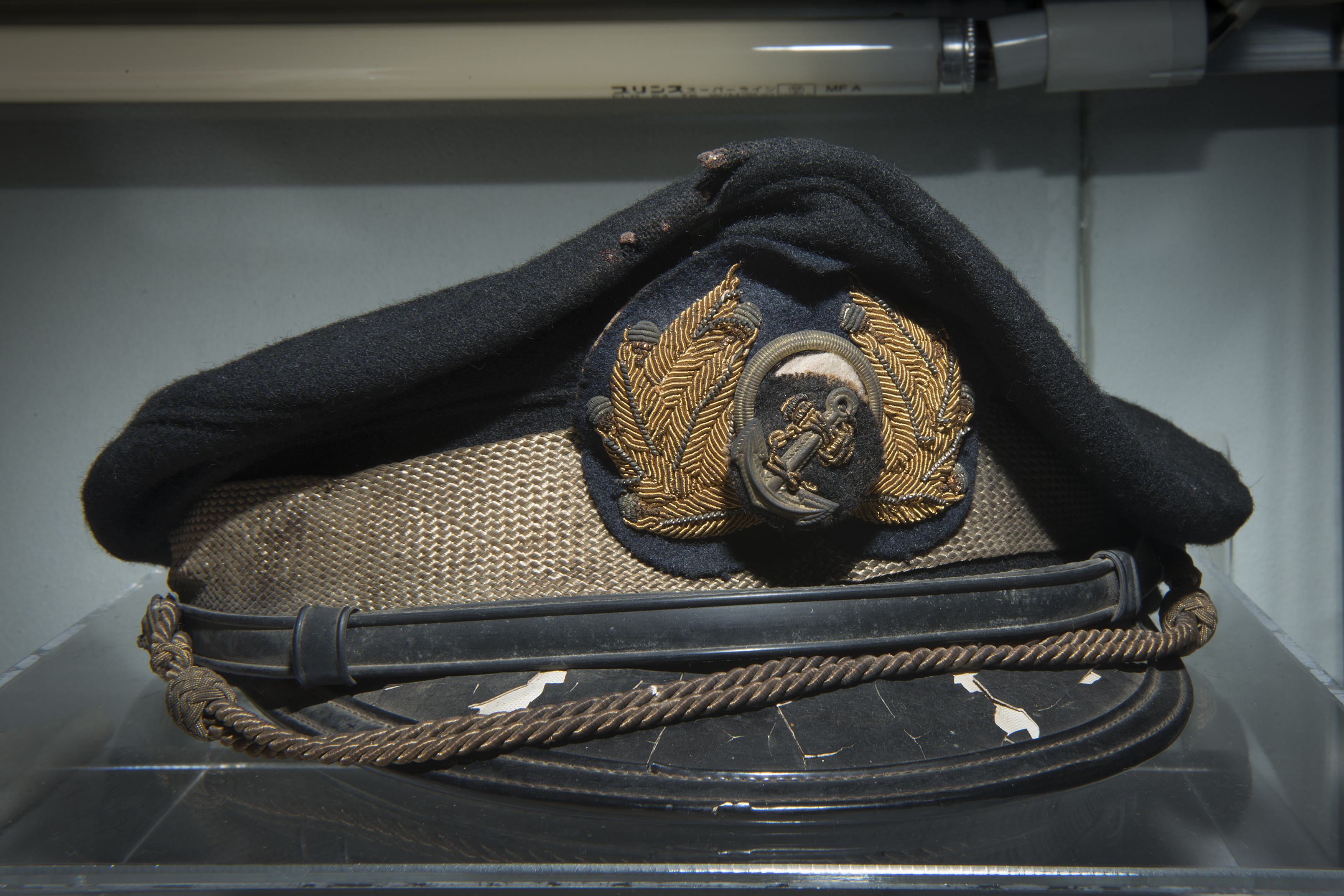
A hat worn by one of the crew members.
Mark Edward Harris
That is the most frustrating thing for me. I think there is no difference between them and us. But the government doesn’t admit that we are victims of a hydrogen bomb. I think that is because of political issues. If the government admitted it, the legal responsibility issue regarding the bomb test might spread without limitation. I think the government didn’t admit it hoping the problem would end quietly.
(The U.S. and Japanese governments quickly negotiated a no-fault compensation settlement with the transfer to Japan of $15.3 million, with the surviving crew receiving about ¥ 2 million each ($5,550 in 1954). Under the terms of the agreement, the Japanese government would not pursue further reparations.)
It was Mr. Kuboyama who died first. How soon after exposure did he start to show symptoms of acute radiation sickness?
He seemed to be fine for a while after our return. The doctors were worried more about three other patients in particular rather than Mr. Kuboyama. The doctors were worried about the others because the numbers of their white blood cells were diminishing. It looked like something else gradually undermined Mr. Kuboyama’s body. However, the government did not admit diseases which occurred later as diseases which resulted from the radioactivity of the bomb test. Maybe diseases resulting from radioactivity are not simple and doctors couldn’t tell causes of the diseases easily.
You went to the Marshall Islands in 2002, 2004, and in 2014 for the 60th anniversary of the Bikini incident. What were the experiences like?
I told my opinion on nuclear weapons in the Marshall Islands but it was not easy to convey my thoughts to the audience. We can’t destroy all the nuclear weapons in the world even though it was necessary to do so. Once a country possesses a nuclear weapon, the country can’t stop keeping it. I don’t have an answer to this difficult problem. I felt that the local people didn’t take this problem as seriously as the Japanese did. Maybe they don’t have as much knowledge about the danger of nuclear weapons as Japanese have.
How did you feel about going to the Marshall Islands on March 1, which was the same place and day of the year as the bomb test?
The sea around the Marshall islands was so beautiful and looked as if nothing had happened that I couldn’t believe the terrible incident happened here and harmed human beings. I think scientists and members of the armed forces should know what really had happened here. Otherwise, the danger of nuclear weapons to human beings lasts forever. I wish there was a way to get rid of the danger.
Special thanks to Sachiko Nomura for her translation and coordination skills and the staff of the Tokyo Metropolitan Daigo Fukuryū Maru Exhibition Hall.

