

Can We Trust the Honolulu Rail Numbers?
Recent stories about the Honolulu rail project’s finances have raised concerns that officials may be fudging the numbers for political purposes.
Several articles have been published recently that raise questions about Honolulu rail’s financial information. Errors and inconsistencies I’ve noticed have led me to question the integrity of the project’s financial plan. As a CPA, I have very little faith in the projected revenues and costs that have been provided to us.
In response to questions by the state director of the Hawaii Department of Budget and Fiscal Services, HART provided a document showing detailed revenue through December 31, 2014. That document, “Revenues from January 1, 2007 to December 31, 2014,” shows total revenues of $1.669 billion. (For those who understand accounting, this document also mixes cash basis and accrual basis amounts.)

HART
Each month the Project Management Oversight Contractor provides a report to the Federal Transit Administration and HART. Figure 7 of the January 2015 report shows “Planned vs. Received Project Funding” and is $300 million higher than the report given to the senate. The difference is in the beginning cash balance and some miscellaneous revenue.
On the one hand, we have higher revenues reported to the FTA (where they expect to see enough revenue coming in to support the completion of the rail), and on the other, we have less (where HART and the mayor are trying to make the case that more money is needed). I’ve asked HART for an explanation of this $300 million difference and haven’t received one. Could it be an error? Yes, but in my opinion, that doesn’t make the situation much better.

HART
HART also provides financial information to the public. In its “HART Facts – January 2015” revenue as of December 31, 2014, revenue is listed as $2.085 billion and is another example of a different total for the same period. The main difference between this and the other two documents is the new starts funds, which include amounts “obligated” through the end of 2014. While some people understand the difference between amounts obligated and funds actually received, it would be far better to be consistent.
Can we rely on any of these numbers?
Is a 40 percent increase in real property taxes needed to cover the current deficit? Or is it more like 5.6 percent?
Is 33 percent of the surcharge paid by tourists? Or is it more like 17 percent? Hint: the 33 percent figure is based on statewide general excise tax. The 17 percent is based on Oahu only.
Is it 10,000 local jobs per year? Or less than 1,000? It was recently reported that it’s actually just under 900.
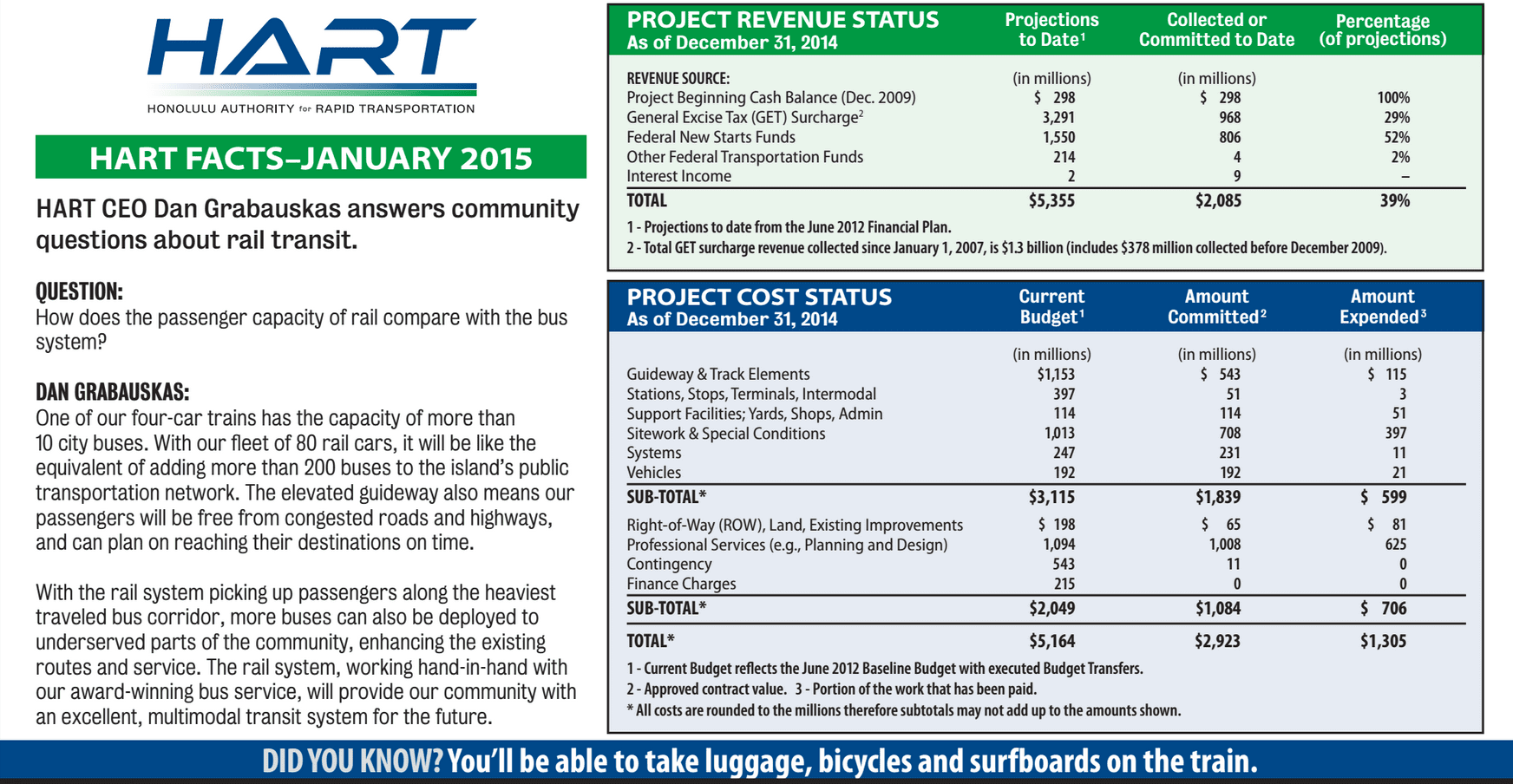
HART
In testimony before the Honolulu City Council, I pointed out a cash flow report provided by HART, which was attached to Resolution 15-7, FD1, had a $140 million math error. In this spreadsheet the “FFGA Total” column simply does not add up, yet the council approved it with the math error.
And what about the state administrative fee? Currently at 10 percent, it covers about 80 percent of the cost of running the entire state tax department, but one HART board member suggested it be 25 percent — a bargaining chip to be offered to the Legislature in return for an extension of the rail surcharge tax.
Before we accept a surcharge extension, let’s get the numbers right. Let’s look at realistic costs to complete, realistic costs to maintain, and yes, realistic costs to stop and do something else. (And please note, I do not believe doing nothing is an acceptable solution, but without realistic numbers of the cost to stop, it is difficult to determine the best course of action.)
Taxpayers’ pockets are not bottomless pits in which we can keep mining for money. We need to step back and insist that we be given good numbers upon which good decisions can be made.
 GET IN-DEPTH
REPORTING ON HAWAII’S BIGGEST ISSUES
Community Voices aims to encourage broad discussion on many topics of community interest. It’s kind of a cross between Letters to the Editor and op-eds. This is your space to talk about important issues or interesting people who are making a difference in our world. Column lengths should be no more than 800 words and we need a current photo of the author and a bio. We welcome video commentary and other multimedia formats. Send to news@civilbeat.org. The opinions and information expressed in Community Voices are solely those of the authors and not Civil Beat.
