

Honolulu Police Corruption: Feds Want Judge To Throw The Book At Kealohas
Honolulu Police Chief Susan Ballard and the city’s top civil attorney have submitted letters to a federal judge that could be used to increase the sentences for Louis and Katherine Kealoha.
Federal prosecutors are seeking tough sentences for former Honolulu police chief Louis Kealoha and his former city prosecutor wife, Katherine Kealoha, when their punishment is finally handed down next week.
Attorneys in the case have been filing numerous sentencing statements and recommendations this week as the sentencing date approaches. It’s scheduled for Tuesday before U.S. District Court Judge J. Michael Seabright.
In June, the Kealohas and two other police officers were found guilty of framing a family member for the theft of their mailbox and other felony offenses.
Federal prosecutors filed a declaration from Honolulu Police Chief Susan Ballard that describes excessive surveillance of the family member — Katherine’s uncle, Gerard Puana — and the problems that created for public safety and the Honolulu Police Department’s operations.

In particular, Ballard cited the recollections of HPD Sgt. Danny Sellers who testified during the Kealohas’ criminal trial that 20 to 30 officers — many of them from a specialized investigative unit assigned to take on organized crime and terrorism cases — conducted five days of 24-hour surveillance on Puana after the Kealohas reported he stole their mailbox.
Federal investigators have since proved that the Kealohas framed Puana for the crime in an attempt to undermine his credibility in a civil lawsuit he’d filed against Katherine Kealoha. He and his mother accused her of bilking them out of hundreds of thousands of dollars via a reverse mortgage.
“Surveillance such as this would never have been undertaken for a solitary non-violent theft offense especially without any other evidence or intelligence elevating it in severity,” Ballard wrote. “For example, there was no evidence of this incident being part of a neighborhood crime spree or organized crime ring or anything else to indicate that this one event was worthy of all the resources that were expended.
“The commitment of such resources for a seemingly minor offense was impossible to justify, not just within the HPD, but to other law enforcement agencies and major city police departments. It caused significant embarrassment to the department locally as well as nationally.”
Ballard said the surveillance was especially problematic because Sellers testified that about 15 of the officers came from the District 6 Waikiki patrol district, an area that is already tough to police and important to the state’s economic well-being.
“The commitment of (Crime Reduction Unit) officers from a single district at one time significantly hinders the unit’s ability to carry out its routine duties as well as conduct criminal investigations affecting the district,” she wrote. “This particular situation is aggravated by the fact that District 6 is vital to the economic health of the entire state, which is why two CRU units are allocated there.”
“Cases grow cold and crime goes unanswered without active investigation especially when they involve a transient population like tourists,” she said.
Ballard and Louis Kealoha had a fractious relationship while he was police chief. After he was forced to resign due to a U.S. Justice Department investigation into public corruption and abuse of power, the Honolulu Police Commission appointed her as his replacement.
Since then Ballard has been trying to rebuild trust within HPD and the community as it grapples with the fallout from one of the largest public corruption scandals in Hawaii’s history.
Several police officers, including Sellers, have either pleaded guilty or been convicted of committing crimes related to the mailbox theft, frame job and cover up. The Kealohas have also pleaded guilty to a number of other crimes stemming from allegations of bank fraud, identity theft and prescription drug trafficking.
The $250,000 Severance Payment
Ballard’s statement comes at the same time city officials struggle to recover $250,000 from Kealoha that he received as part of a severance package approved by the Honolulu Police Commission in January 2017 after he was named a criminal target in the Justice Department’s corruption investigation.
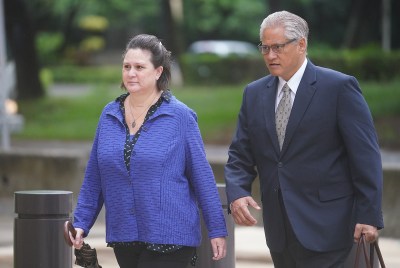
That deal — which included provisions that allowed Kealoha to retire from HPD in good standing with his full complement of benefits and a pension worth an estimated $150,000 a year — said that if he was convicted of a felony within six years he would need to return the $250,000 to the city. Kealoha, however, has refused to relinquish the money.
On Monday, Acting Corporation Counsel Paul Aoki sent a letter to Seabright asking him to consider Kealoha’s debt to the city when he decides the former police chief’s fate at next week’s sentencing hearing.
Aoki told Seabright that Kealoha is not only withholding the money, he’s actively ignoring the city’s demands that he return it.
“Despite receiving the City’s demand letter on October 31, 2019, which was mailed to him by certified mail with return receipt, Kealoha has not responded to date,” Aoki said. “Kealoha has breached the Retirement Agreement and failed to reimburse the amount paid to him by the City, pursuant to the Retirement Agreement. We respectfully request that the foregoing be considered with respect to Kealoha’s sentencing.”
Aoki is now serving as the city’s top civil attorney because his boss, Corporation Counsel Donna Leong, went on paid administrative leave after receiving a target letter from the Justice Department indicating she was suspected of criminal activity.
In particular, federal investigators are looking at Leong’s involvement in negotiating Kealoha’s $250,000 severance package, which Honolulu police commissioners have said was sold to them by her as a “take it or leave it” proposition.
Read Ballard’s declaration here:
Read Aoki’s letter here:

