

Thousands Turn Out For Free COVID-19 Tests On Oahu
Anyone on the island can get tested — even if they don’t have symptoms — as part of a new effort to halt the spread of the virus.
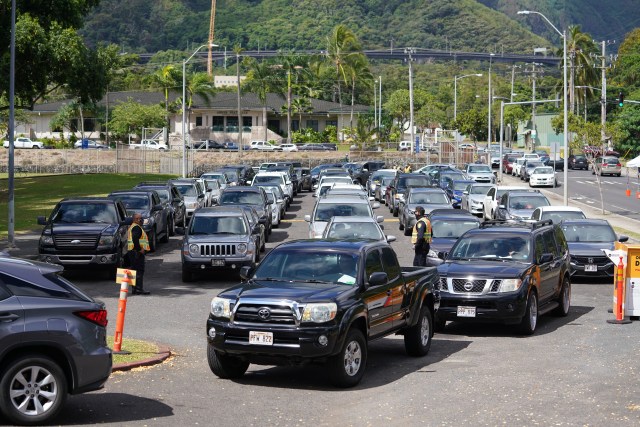
At the free COVID-19 testing site at Kaneohe District Park on Wednesday, traffic backed up in three directions within hours of opening and the line of people waiting in cars snaked across the Windward Community College campus.
Wednesday marked the start of a two-week testing spree in Hawaii funded by the federal government, which is offering COVID-19 testing to anyone in Hawaii for the next two weeks — regardless of whether they have symptoms. The first day of testing had some setbacks.
When traffic wouldn’t let up, Debbie Boltz, 74, decided to park and walk a mile in the summer heat to her 2 p.m. appointment, only to find out upon arrival that testing staff would only accept specimens from people in their cars, regardless of whether they had an appointment.
“I’m thinking, wait a minute, could there be a way to delineate people with appointments as opposed to those without?” Boltz said.
Boltz says she was told the tests had been overbooked Wednesday. People had been registering online through a mainland company hired by the federal government to coordinate testing.
Earlier in the day, people reported being turned away from the site because the location ran out of nasal swab specimen collection kits. The testing site reopened later in the afternoon.
Approximately 3,600 people had signed up to be tested on Oahu on Wednesday, according to Honolulu Mayor Kirk Caldwell, Hawaii News Now reported.
U.S. Surgeon General Jerome Adams is on Oahu to oversee the testing operation. People can register online to speed up the process, but people who are not registered will also be assisted on-site.
“Just because you got a test before, doesn’t mean you couldn’t be positive now,” Adams said Wednesday. They have enough supply to offer 5,000 tests per day at the various locations for at least 14 days, he said.
Testing hours vary depending on location. The Kaneohe District Park was only scheduled as a testing site for Wednesday.
The specimen samples are sent to FDA-approved labs in California and patients can expect to receive results via email within three days, according to Adams. The tests are molecular-based with a 90% accuracy rate, he said.

Unlike prior testing efforts led by the state, people can get tested whether or not they have symptoms.
“The whole point of the surge testing is so anyone for any reason can get tested,” said U.S. Surgeon General Jerome Adams, who demonstrated how to take a nasal swab specimen at a press conference held Tuesday. “We want to get a handle on who’s got it and who doesn’t. You do not need a doctor’s order. You do not need any money. It’s free. We want everyone to get tested.”
Hawaii’s worsening outbreak has placed it on the list of hotspot states that have conducted federal surge testing in recent months, such as Florida, Louisiana and Texas. More than 10% of tests returned positive on Wednesday, taking Oahu’s outbreak into the “red zone,” Adams said.
The program is funded by the federal U.S. Department of Health and Human Services and operated by the private Texas-based company eTrueNorth.
Dr. Micah Brodsky’s truck was among the last five cars that made it onto campus before police ushered other cars away. He left his house early for a 2:50 p.m. appointment.
It was the second time in eight weeks the veterinarian had left his house. Brodsky and some of his colleagues at the Hawaii Marine Animal Response wanted to be tested as a precaution before an upcoming in-person training. He sat in line for an hour and finally got his test. Sitting in traffic was worth it to him, though.
“I’m grateful,” he said.
Civil Beat Reporter Christina Jedra contributed to this story.

