

Prominent Hawaii Defense Contractor Arrested For CARES Act Fraud
Martin Kao is a prolific political donor whose company, Navatek LLC, has received millions of dollars in federal contracts.
WASHINGTON — A politically connected defense contractor in Hawaii was arrested and charged Wednesday by the U.S. Justice Department for allegedly bilking the federal government out of $12.8 million in coronavirus relief aid meant to help small businesses.
Martin Kao, 47, is the CEO of Martin Defense Group, formerly known as Navatek LLC, a Honolulu-based company that over the years has received millions of dollars in federal contracts, primarily to design state-of-the-art ship hulls for the U.S. Navy.
He’s charged with bank fraud and money laundering for falsifying loan applications for the Paycheck Protection Program that was created by Congress as part of the $2 trillion CARES Act meant to stave off financial ruin for individuals and businesses during the COVID-19 pandemic.
According to the criminal complaint, Kau lied to lenders about how many employees he had so that he could receive more money than he was eligible for and used his subsidiary companies to mask the fact that he had already obtained PPP loans from other institutions, which effectively allowed him to double-dip into the program.

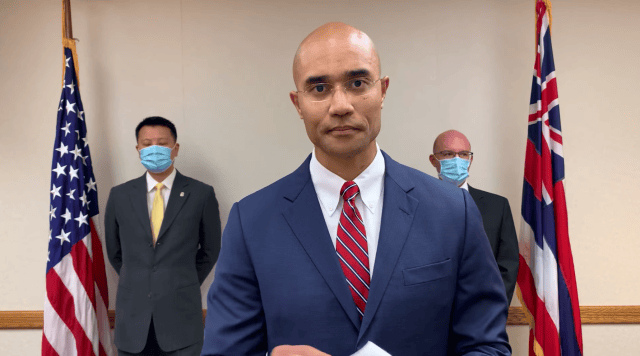
Kenji Price, the U.S. Attorney for the District of Hawaii, held a press conference to announce the charges faced by Kao. He said he wanted to use the opportunity to send a message.
“If you game the system to get money that businesses so desperately need in Hawaii, we will find you, we will expose you and we will hold you accountable to the fullest extent of the law,” Price said.
Kao was taken into custody Wednesday. The U.S. Attorney’s Office filed a motion to hold him without bail saying he is a serious flight risk. An initial hearing was scheduled for 9:30 a.m. Thursday.
Multiple sources said federal investigators raided Kao’s offices in Honolulu.
Kao issued a statement through his public relations firm, CommPac, and spokesman Andrew Pereira:
“Navatek is a highly reputable company with a long record of service to its clients and the people of Hawai‘i. The government’s actions today were a complete surprise. As a company, we will address the allegations and have retained legal counsel to review these claims.”
CARES Act Fraud A Serious Problem
The U.S. Attorney’s Office has launched a number of investigations into potential CARES Act fraud in the islands, Price said, and several agencies, including the FBI, IRS, Secret Service and Hawaii Attorney General’s Office are working in concert to root out wrongdoing.
Across the country, federal prosecutors have filed charges against dozens of people accused of trying to bilk the federal government out of hundreds of millions of dollars in coronavirus relief aid. In some cases, individuals have been accused of spending the money on their own lavish lifestyles by purchasing exotic cars, such as a $318,000 Lamborghini, or spending thousands of dollars at bars and strip clubs.
Price said the evidence collected by IRS investigators show that Kao transferred more than $2 million in PPP money from Navatek to a personal bank account, but did not provide any more details about how that money was spent, noting only that it was the subject of further inquiry.
“These investigations unfortunately reveal what experience teaches,” Price said. “When the federal government distributes money there is generally a fraudster out there who tries to get his or her hands on it illegally.”
Kao is a prolific political donor. He, his family and his employees have contributed hundreds of thousands of dollars to federal politicians in recent years, including several members of the Senate Appropriations Committee. Hawaii Sen. Brian Schatz, who is on the committee, has received significant campaign contributions from Kao and his affiliates.
Kao’s company also appears tied to a mysterious $150,000 donation made to a super PAC supporting U.S. Sen. Susan Collins of Maine, who is up for reelection.
The Campaign Legal Center in Washington, D.C., filed a complaint with the Federal Election Commission against the company that made the donation, the Society of Young Women Scientist and Engineers LLC, which the Legal Center said appeared to have been created for the sole purpose of hiding the identities of the donors, which could be a violation of the law.
The Federal Case
The criminal complaint details how Kao tried to use his political connections to convince financial institutions to give him millions of dollars in PPP money.
In April, shortly after the program was created, Kao applied to Central Pacific Bank for $10 million — the maximum allowed — using inflated employment figures that showed he had nearly 500 employees when in reality he had fewer than 150.
While Navatek is headquartered in Honolulu it has branch offices in other states, including Maine, Rhode Island, Michigan and Oklahoma.
Kao emailed Central Pacific Bank on April 2 to highlight this “growing presence” and noted that he works “very closely” with several U.S. senators who were champions of the CARES Act. He told the executive, according to the complaint, that he wanted to give the lawmakers an update and hoped he could provide them with a positive story about the bank’s ability to secure the loan on Navatek’s behalf.
“If you game the system to get money that businesses so desperately need in Hawaii, we will find you, we will expose you and we will hold you accountable to the fullest extent of the law.” — U.S. Attorney Kenji Price
Days later he sent another email saying he had just gotten off the phone with a U.S. senator and member of Congress who “specifically asked about the status of our PPP loan application and were very adamant about stepping in if our application was getting stalled.”
Kao continued to pressure the bank over the next several days with follow-up emails, according to the complaint, saying that he was working with Senate staffers who were more than happy to help the bank get Navatek’s loan approved. He also tried to downplay any discrepancies in the paperwork, noting in an email that at least one Senate staffer “wanted to STRESS that these are simple checks of information and mathematical accuracy … it is NOT an audit and the bank is ABSOLUTELY empowered and relying on the applicant’s representations and certifications.”
“The bank has ZERO risk!” Kao added. “I’m not barking at you. I’m just relaying a message from one of (the) highest authorities possible in Hawaii. Can you make sure this message gets to the correct person(s).”
The complaint made clear that Kao had referenced specific politicians and their staff in his emails to Central Pacific Bank, but Price refused to divulge the names of those individuals when asked about them by Civil Beat at his Wednesday press conference.
“What we’ve alleged in the complaint is all I’m permitted to disclose at this point,” Price said.
Other emails obtained by the Justice Department show Kao didn’t just rely on dropping the names of politicians. On April 20, just days after Central Pacific Bank transferred $10 million in PPP loan money to Navatek, the complaint states an unnamed Washington, D.C.-based consultant sent an email to an executive at Radius Bank, an online bank based out of Boston, Massachusetts, to see if it would help Kao and his company secure federal money.
The consultant said that Kao “tried to go through their bank for the PPP loan and were ultimately unsuccessful.”
Kao followed up the same day with an email of his own saying that he submitted an application with a local Hawaii bank for a separate company and “that is the one that got fumbled.”
In all, federal investigators detailed three attempts by Kao to obtain PPP loans. Navatek received $2.8 million from Radius Bank. Another application sent to First Hawaiian Bank for the same amount stalled out after an official there started asking questions about whether Navatek had already received money through the PPP program.
The complaint states that investigators also interviewed a former executive from Navatek and another employee who left the company in August. The description of the executive appears to match up with that of Steven Loui, owner of Pacific Marine & Supply, who sold the company to Kao several years ago.
The former executive and the unidentified employee both told investigators that they believe Kao was exaggerating on his loan applications. They also both said that Navatek, which didn’t announce its name change to Martin Defense Group until last week, did not seem to be struggling during the COVID-19 pandemic.
Most of the work came from government contracts, which were ongoing, they said, and the company was hiring new staff and opening additional locations.
“There were never any concerns raised over revenues or any talks of furloughs,” the complaint says. “The company did not slow its expansion plans.”
The Justice Department has outlined its desire to reclaim the money Kao and Navatek received through the PPP loans through the asset forfeiture process.
Read the full complaint here:

