‘Asking For A Miracle’: Hawaii Evaluates Global Roadmap To Avoid Climate Catastrophe
Already feeling the effects of a warming planet, Hawaii has set ambitious goals to combat climate change. But a new report says staving off a worst-case scenario requires global action.
This week the world’s top climate scientists fired off a final warning: Greenhouse gas emissions must peak worldwide by 2025 to avoid the most devastating impacts of global warming.
At stake is the habitability of large parts of the world.
One of the most impactful changes the world can make to slash emissions is to ditch fossil fuels, according to the Intergovernmental Panel on Climate Change, which published the last in a series of three reports on Monday prescribing a last-chance roadmap to limiting global temperature rise.
The report, University of Hawaii climate change expert Chip Fletcher said, is “frankly asking for a miracle.”
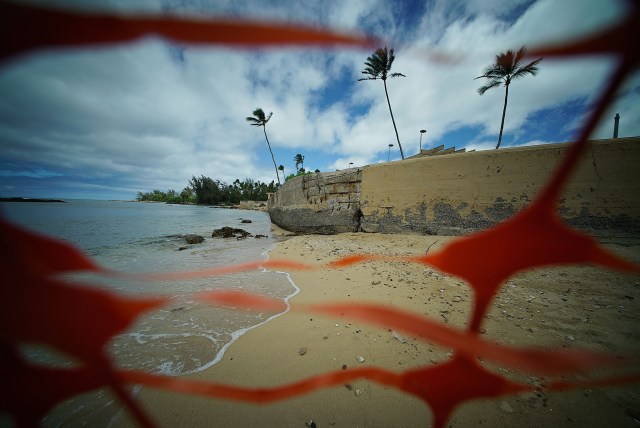
One of the hurdles to hastening progress on global emissions goals is the glaring gap between what some nations have pledged to do to curb emissions and what they’re actually doing in practice.
“Many of the world’s nations have been flat out lying with regard to not keeping promises that they’ve made,” said Fletcher, interim dean for academic affairs at the School of Ocean and Earth Science and Technology at the University of Hawaii Manoa. “The climate agreement that everybody signed on to back in Paris in 2015, that needs to be revisited with economic repercussions for those nations that are making promises that they’re not keeping.”
A number of energy economists and think tanks are projecting that greenhouse gas emissions are likely to continue to rise through the end of this decade, eventually stabilizing by mid-century and then sinking into a decline during the second half of the century, Fletcher said.
“And that,” he said, “is a recipe for a world that is incredibly unsafe for us and for our children.”

Hawaii, for its part, is farther along than most of the rest of the world in making a renewable energy transition.
With the impacts of sea level rise, drought and intensifying storms unfolding in many residents’ backyards, climate change is no longer an existential threat in Hawaii but a clear and present one. As such, the state has benefited from a public consensus that the effects of climate change are happening now and therefore must be dealt with.
In 2018, the state passed a law that sets a goal of making Hawaii carbon net-negative by 2045 — the most ambitious emissions reduction goal of any state.
The Covid-19 pandemic helped the state achieve an earlier climate goal of reducing statewide greenhouse gas emissions to 1990 levels by 2020, according to a greenhouse gas emissions report by the Hawaii Department of Health.
But research by the University of Hawaii Economic Research Organization found that the state’s post-pandemic emissions levels are likely to rebound, potentially threatening its ability to realize its 2045 carbon net-negative target.
Then there’s this important caveat: The pent-up demand for air travel that’s causing Hawaii tourism to rebound isn’t reflected in the state’s greenhouse gas emissions calculations because the state doesn’t consider emissions from transpacific flights.
‘Completely Disappointing’
Leah Laramee, interim state climate coordinator, said she anticipates some of the positive emissions reductions associated with the pandemic will stick.
Working from home is likely here to stay, at least in some capacity. That’s a win for curbing transportation-related emissions, and government leaders can build on this progress by incentivizing people to use electric vehicles or improving the walkability of Hawaii’s cities, towns and neighborhoods, she said.
On a global scale, the pandemic presented the world with a lost opportunity to invest stimulus funds disbursed by governments to combat an economic recession into initiatives likely to help reduce greenhouse gasses. Only about 6% of the $13 trillion in stimulus money from 19 countries and the European Union analyzed by a Johns Hopkins University study funded climate-beneficial objectives.

Fletcher rendered this missed chance to fund climate initiatives as “completely disappointing.”
“It’s difficult for us as a global community to keep our eye on the long-term problems,” he said. “But, because of that, climate change is no longer just a long-term problem. It’s an immediate problem and places that recognize this, like Hawaii, are doing a fairly good job addressing it. It’s places like Hawaii that are leading the way.”
Combating climate change requires a holistic approach, and curbing emissions is just one piece of the puzzle, Laramee said.
As the state experiences reduced rainfall and intensifying big rain events, sometimes referred to as rain bombs, it needs to boost investment in reforestation, water systems protection and food sustainability, she said.
“Hawaii’s been such a strong leader worldwide. We’ve set really aggressive goals,” Laramee said. “I think it’s one of those things where you’re doing a lot of prep-work for something and hopefully we can move it into action. We have made pledges and statements saying we’re in a climate emergency, and we need to start investing funding to recognize that.”
Small Actions Make A Difference
Many people aren’t waiting for government to lead the way on climate change action.
For Lucienne de Naie, an executive committee member of the Sierra Club of Hawaii, there’s not much new in the IPCC’s latest guide to actions that could prevent the most catastrophic climate change scenarios.
“It reminds me of that line in the Tolkien book about the hobbits — they make long lists of what everybody already knows,” de Naie said. “It’s needed in many ways, but I’m a person of action: Plan an action, get some help, take an action.”

The Sierra Club is championing public policies at the Hawaii Legislature that would facilitate the transition from fossil fuels to clean renewable energy and it’s supporting county policies that facilitate managed retreat from at-risk shorelines, protect wetlands and reduce water waste, according to de Naie.
But so many people want to feel that they’re doing something to combat climate change in their backyard. So de Naie said the Sierra Club supports programs that bring people together to plant trees or protect habitats essential to carbon absorption, such as watersheds.
“Obviously none of us can march over to Russia or China and say, ‘Burn less oil,’” she said. “But things do change and this is something that’s going to switch during our lifetime. We might as well try to be prepared for this change that’s upon us and make sensible decisions to make the transition less painful.”
Rob Weltman of ReTree Hawaii, a Maui-based program founded in 2019 that matches volunteers with opportunities to plant trees, said the IPCC report underscores a need to apply more pressure on politicians to do more to address climate change. But it also highlights the value of an all-hands-on-deck approach, he said.
It could be something as simple as planting a native shrub in your own backyard, he said.
Last November, Retree Hawaii hosted 68 planting events on every island except Niihau. All told, 1,426 volunteers planted 10,614 trees, shrubs and other plants at schools, hotels, golf courses, parks, roadsides, backyards and on conservation land, Weltman said.
“The fact that things are worse than we thought a year ago does not mean that small actions are useless,” Weltman said. “To the contrary, it means that everything needs to be done to combat climate change, both big things and small things. The message should not be that the only thing that can solve this is the government.”
Civil Beat’s coverage of climate change is supported by the Environmental Funders Group of the Hawaii Community Foundation, Marisla Fund of the Hawaii Community Foundation and the Frost Family Foundation.