

Pacific Territories Are Getting Millions To Address Climate Change. Is It Enough?
Congress approved a large influx of money to American Samoa and other territories, but threats from rising temperatures are evolving.
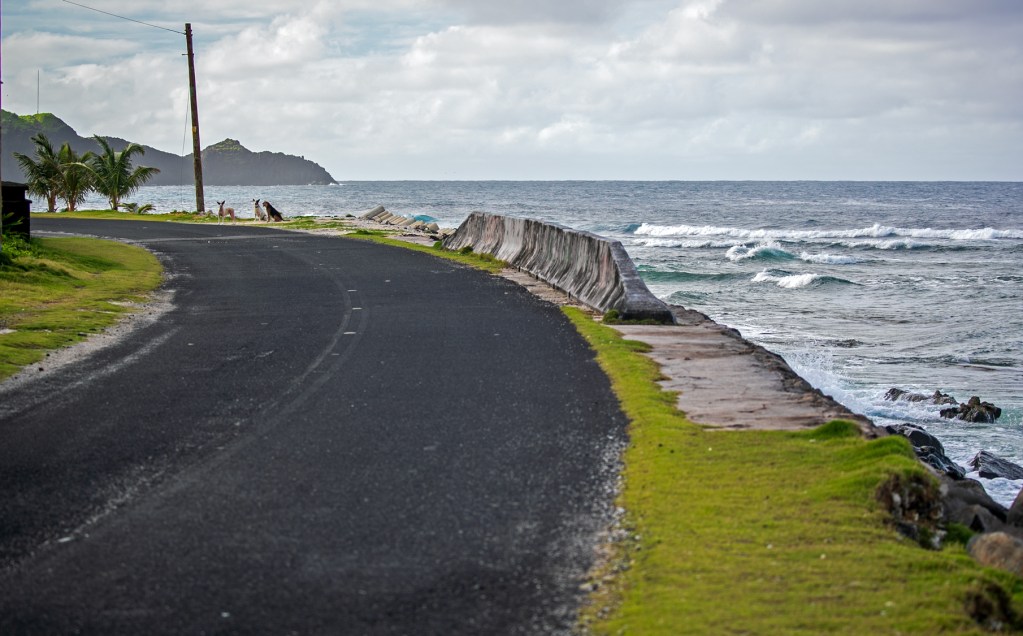
WASHINGTON — In American Samoa, the oceans are rising and the land is sinking.
Even the territory’s largest private employer — the StarKist tuna cannery that provides nearly 80% of all private employment — sits along the water’s edge.
That makes recent federal investments in island infrastructure all the more important, especially when it comes to climate resiliency.
But a lingering question is whether it will be enough.

Earlier this year, representatives from the U.S. Government Accountability Office traveled to American Samoa to meet with members of the territory’s newly formed climate resilience commission, chaired by Lt. Gov. Talauega Eleasalo Vaalele Ale.
They discussed, among other things, the challenges American Samoa and other Pacific Island territories face when it comes to competing against states for federal funding.
“As a small island in the middle of the ocean, we feel the effects of climate change every day,” Talauega told GAO officials. “We see it in the rising tides and we feel it in the increased heat in the day. We are mindful of the constant change and have refocused our efforts through this commission.”
President Joe Biden’s Bipartisan Infrastructure Law, which passed in 2021, will provide tens of millions of dollars to American Samoa to help rebuild roads, improve its harbors and address the warming climate.
According to the White House, nearly $70 million has already been announced for the territory, including $4.6 million for bridge repairs, $10.7 million for lead pipe replacement in water lines and $2.1 million to help reconstruction the Anuu’u Wharf in Pago Pago.
About $1.7 million has specifically been identified to address climate resiliency, which includes $250,000 to protect the Ofu Airport against storm damage and erosion. The territory’s total budget for fiscal year 2022 was about $550 million, with about half of that coming from federal grants.
Guam and the Northern Mariana Islands so far are set to receive $142.6 million and $83.3 million, respectively, through the law.
There’s no question that American Samoa and other Pacific Island territories are on the front lines of the climate crisis.
The United Nations Intergovernmental Panel on Climate Change released its 2023 report finding that small island states in the Caribbean and South Pacific face some of the greatest risks to human health and safety due to increasing global temperatures.
As those temperatures continue to rise the threats faced by island inhabitants could lead to increased scarcity of resources, including food and water, as well as forced migration, the report said.
Esther Kiaaina is a member of the Honolulu City Council who served as the assistant secretary for insular areas at the Department of the Interior during the Obama administration.
She said American Samoa and other U.S. island territories are confronting the challenges of climate change every day, which can make it hard to quantify how much money is enough to help adapt and ensure that their ways of life survive.
“That’s a doozy of a question,” she said.
In general, the territories have not been on the same footing as U.S. states when it comes to access to federal resources, such as Medicaid.
“Short of statehood, this is one of the most important things we can do.”
U.S. Sen. Brian Schatz
They also don’t have the same clout in Congress, where they are represented by elected delegates in the House who do not have the same voting power and authority as their peers.
Still, Kiaaina said the Bipartisan Infrastructure Law combined with other major pieces of legislation passed during the last Congress, including trillions of dollars in Covid-19 relief aid, have resulted in a large influx of money to the territories.
The challenge now, she said, is figuring out how best to spend it so that it’s effective.
“Of course, it’s good to get a lot of that money out there as a matter of equity,” Kiaaina said. “The concern is not just about the dollars. The question is, do they have the capacity for implementation of all of these dollars to get the job done?”
Republican Congresswoman Aumua Amata Coleman Radewagen, the delegate from American Samoa, was not available for an interview for this story.
Hawaii Sen. Brian Schatz, a member of the Senate Appropriations Committee, described the money in the Bipartisan Infrastructure Law as a critical “first step” in the quest to address climate adaptation across the Pacific, but he also acknowledged that it won’t be enough.
“Short of statehood, this is one of the most important things we can do,” Schatz said.
While the delegates themselves are their main advocates for their communities, he said he also considers the needs of other territories and insular areas in the U.S. when making funding and policy decisions.
“It’s important to not just be sympathetic to, but in solidarity with our fellow Americans even if they don’t have, formally speaking, a representative in the Senate,” Schatz said. “I just try to be supportive in terms of federal resources wherever I can.”

