

Hawaii Governor Promises 10,000 New Affordable Rentals In The Next 10 Years
The homes will include units for middle-income people considered too affluent for most federally subsidized housing.
More than 10,000 new affordable rental properties for a range of income levels could come on line across four islands over the next decade, as part of a master housing plan Gov. Josh Green announced Tuesday.
The enormous number of new rental homes would be built at the site of existing projects managed by the Hawaii Public Housing Authority, and include more than just homes for the lower-income residents who qualify for government housing under federal guidelines. Middle income families considered too affluent to qualify for government housing also would be eligible for some properties.
For example, a family of four earning up to $131,000 could qualify. The goal, Green said, is to retain and bring back needed professionals like nurses and teachers, who often flee the islands because of the high cost of housing here.
Most of the units, however, would be reserved for households earning 80% or less of the area’s median income. That’s about $73,000 for a one-person household and $104,000 for a family of four, according to federal guidelines.
In addition, some 10% of the new homes will be offered for sale as affordable leasehold properties in which the state retains an ownership stake and the buyer obtains a long-term lease.
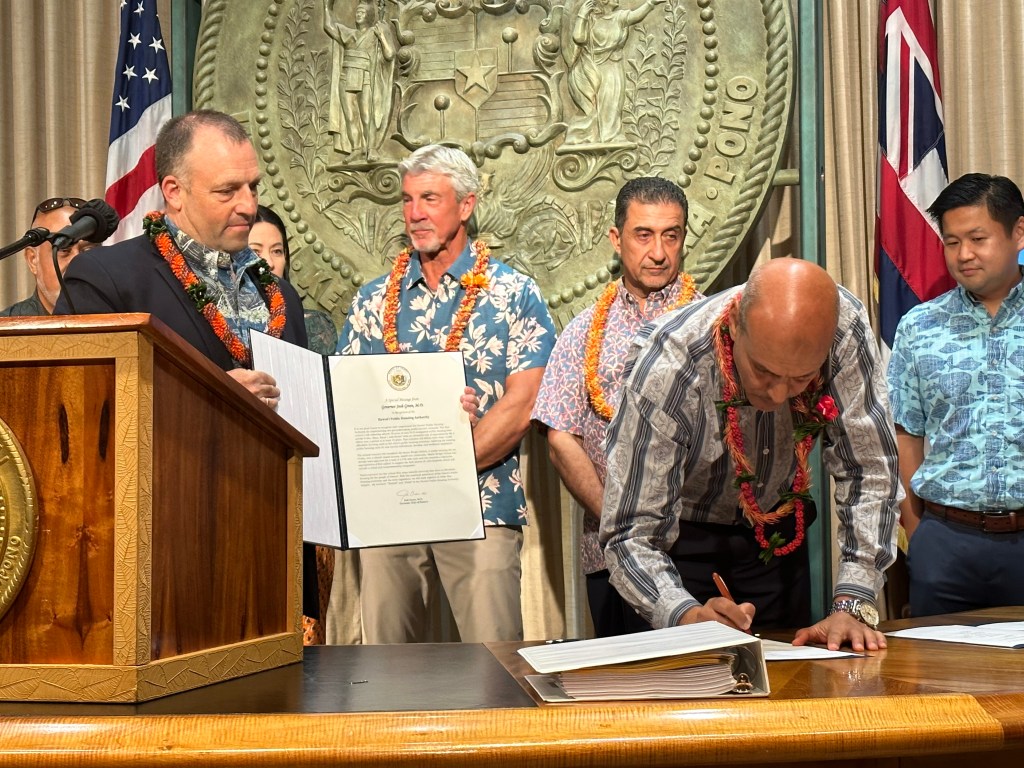
Green said one hope was to offer affordable homes so people who have left the islands could return.
“Let’s go big and have people come home,” Green said.
He predicted the developments could cost $6.6 billion over 10 years, although the developer chosen to lead the project said state taxpayers would provide only a sliver of that under financing structures used to build affordable homes.
Green acknowledged that it will take years to build that many new homes, but in stating the ambitious number, the governor has set a clear goal.
“We’re going to go as big and as fast as we can,” he said.
Green said Highridge Costa, a California-based firm responsible for some 30,000 affordable housing units in more than 300 communities throughout the U.S. and Puerto Rico, will lead the developments.
On hand for Green’s announcement were Highridge Costa’s president and chief executive, Michael Costa, and the president of Highridge Costa’s development arm, Moe Mohanna. Also at the press conference were the Hawaii Public Housing Authority’s executive director, Hakim Ouansafi; Hawaii’s chief housing officer, Nani Medeiros, and Troy Hashimoto, chairman of the House Housing Committee.
Green campaigned on a promise to address a shortage of housing that’s often described as a crisis. With the cost of a single-family home on Oahu hovering around $1 million and interest rates driving up the cost of borrowing, the dream of owning a house is of out of reach for the vast majority of people. A recent report by the University of Hawaii Economic Research Organization showed that most people also can’t afford a condominium.
Especially hard hit are people at the lower end of the economic ladder. And a paucity of affordable units means big waitlists for the few units that come vacant, Ouansafi said.
“The only option to serve the waitlist is to build more housing,” he said.

The idea unveiled Monday is to renovate approximately 1,200 units spread across six housing developments on Oahu and one each on the Big Island, Maui and Kauai. In addition, the developers would build about 10,900 additional homes at those sites. For the aging Mayor Wright Homes complex in Honolulu, it would mean renovating 364 and building 2,450 more.
Sen. Stanley Chang, who chairs the Hawaii Senate Housing Committee, has long championed the idea of the state developing homes to sell as leasehold properties in which the state retains an ownership interest. He commended the governor’s announcement that as many as 10%, or 1,000 homes, would be offered for sale under this model.
But Chang cautioned that HPHA and Highridge face numerous challenges, including the need to obtain building permits and other regulatory permissions needed to build in a state well-known for strong restrictions on development.
“A lot of things are going to have to happen for the 10,000 units to get built,” he said. “But the headline is that the governor is willing to say a number. I don’t think any public housing authority in the country has proposed something this big, ever.”
“The governor was elected on a strong housing mandate, and HPHA is really stepping up to the plate,” Chang added.

