Even Rubble And Ash Couldn’t Shake A Longtime Lahaina Man’s Sense Of Home
Mario Siatris makes peace with his losses and plans a new start after the Maui fires.
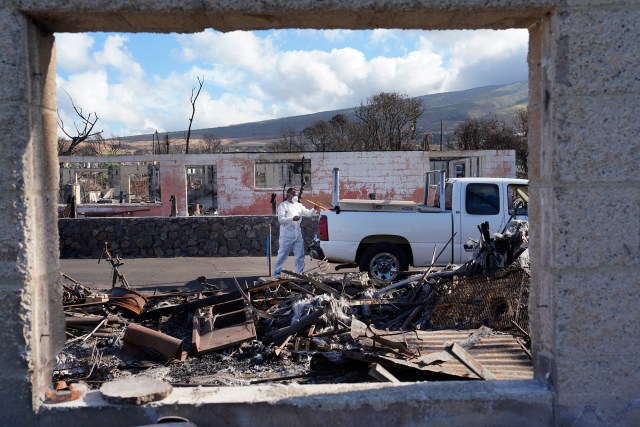
Mario Siatris and U‘i Kahue-Cabanting drive into the ruins of their neighborhood for the first time since the Aug. 8 Lahaina wildfire. Individual house lots have been reduced to a flat, monotonous landscape of rubble, fire-crisped trees and burned-out cars.
Stripped of familiar landmarks, Lahaina’s disfigured grid warps the business partners’ spatial memory. They nearly miss the turn onto their street.
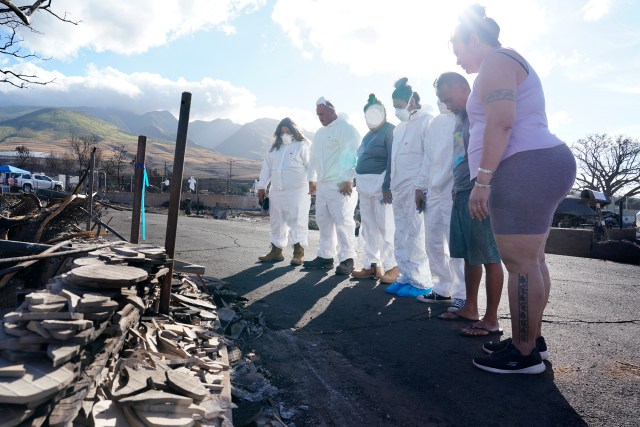
Standing at the edge of the wreckage of the home they lost in the fire, Mario and U‘i bow their heads and pray for serenity and closure. They’re joined by five housemates, including Mario’s two adult children.
Mario places ti leaf cuttings, a Hawaiian symbol of blessing and protection, around the ashen perimeter. Harsh and stark as it is, the land still feels like home to him.
Mario, who owned the century-old plantation house on Mela Street, weeps for its lost botanical treasures, most of all the giant mango tree and its waxy, kidney-shaped fruit.
The old trunk, blackened by fire, is marked with blue spray paint — a sign that a botanist studied the tree for signs of life and found none. But Mario, a gardener by trade and by nature, inspects the tree himself anyway.
“It’s dead,” he says. “Everything is dead.”
When it comes to the crumbled house, Mario is too overwhelmed to scour the dregs for valuables. The work is daunting and the sun is hot. He doesn’t even bother with his shovel.
“I know it’s all gone,” he says. “And if there’s something left, it’s like I don’t know if I want to hold on to these things. It’s like, ‘Okay, take it as a sacrifice.’ Everything can be replaced.”

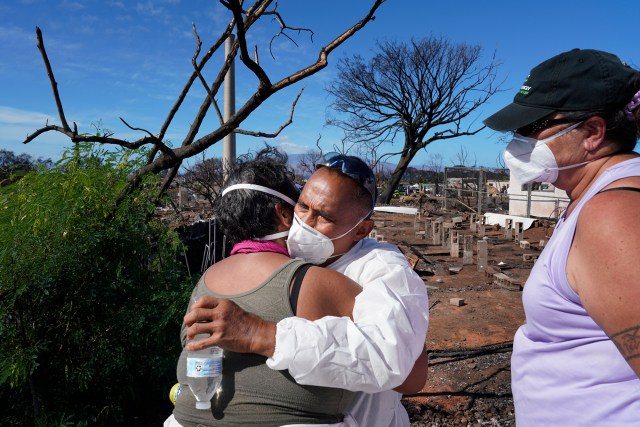
Instead, Mario visits with his neighbors, many of whom he hasn’t seen in the three months since the fire engulfed their close-knit community in the heart of Lahaina. Mario approaches a woman whose sister died in the fire and wraps her in a long embrace. Together, they cry.
“I didn’t lose everything,” he says. “My valuables is me and my kids. These are just material things that we lost.”
Mario is ready to grant his permission to the U.S. Army Corps of Engineers to demolish and clear his lot. The sooner, the better.
He’s impatient to move back onto the property. As soon as the government allows, he figures he’ll buy and park a trailer on his land and resume living on his own terms.
“I just want a new, clean start,” he says. “I don’t know how long it’s going to take, but we just have to hold on. It’s going to be a long road, man.”
Civil Beat’s coverage of Maui County is supported in part by grants from the Nuestro Futuro Foundation.