

Hawaii Governor Renews Call To Charge Visitors A Climate Impact Fee
Green’s latest proposal calls for a one-time payment of $25 when checking into a hotel or rental unit, but it could also involve an increase to the hotel tax.
Citing the growing impacts of global warming, Hawaii Gov. Josh Green said Monday that he will jumpstart efforts to enact a climate impact fee on tourists.
The $25 charge would be levied on visitors when they stay at an island hotel or short-term rental. Green called it a “modest” fee that was “far less than the resort fees or other taxes visitors have paid for years.” He estimated it would generate more than $68 million every year for the state’s use.
“We would invest these funds in beach preservation, fire breaks and other prevention measures to help us avoid tragedies like the one last year in Maui,” Green said in his State of the State address delivered to Hawaii lawmakers and invited guests at the State Capitol.
A bill that called for charging Hawaii visitors a $50 fee died in the waning hours of the 2023 legislative session. But Green never gave up on the idea, and his administration has simplified the concept and rebranded it as a “climate” impact fee rather than a “visitor” impact or “green” fee, as it was described last year (“green” as in the environment, not the governor’s surname).
What could make the fee idea more palatable this year is the tragedy of the Maui wildfires on Aug. 8 that killed at least 100 people, caused widespread destruction and left several thousand people without homes.
Green’s major priorities are the recovery and rebuilding of Lahaina and the creation of much more affordable housing statewide — the latter a crisis that the fires only magnified.
In that regard, Green and legislative leaders are expressing considerable alignment in shared goals for this session. The same issues identified by the governor Monday crowned the agendas of House and Senate leaders on opening day last week.
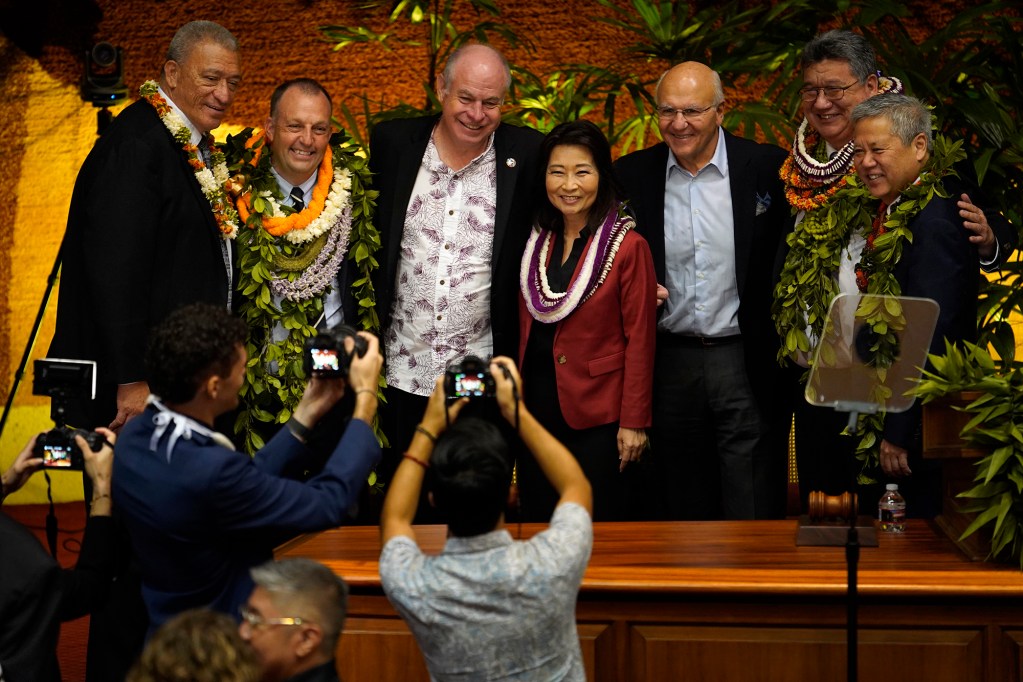
At a press conference following the State of the State, House Speaker Scott Saiki and Finance Committee Chair Kyle Yamashita said they would consider Green’s visitor fee. It could include the possibility of increasing the state’s transient accommodations tax, which currently is 10.25%, rather than charging a $25 fee.
“I think in concept we kind of are in agreement that there should be something that people pay into” when they are impacting the state, said Yamashita, who represents part of Maui. “And it should come from people from outside the state.”
Saiki cautioned that any increase to the TAT would need to be justified. He also pointed out that the Legislature approved funding last year for an app that would be used to inventory visitor use of state parks, trails and beaches.
The app, which is being developed under the jurisdiction of the Department of Land and Natural Resources, “could then be segued into assessing some kind of a use fee on visitors,” he said.
Still, the speaker said there is broad agreement to work together in the state’s best interest.
“As I said before, the House’s position is to work cooperatively with the governor,” said Saiki. “We’re at a place in time now where we need to solve problems in our state, and we need to find solutions that are to be workable.”
TAT Hike A Tough Sell?
The governor’s deadline to submit his legislative proposals was Monday, but no specific bill had been posted online as of late afternoon.
Unlike House leadership, the Senate leaders did not meet with the local media following the State of the State. There was no response to an inquiry to the Senate about the visitor fee proposal.
Green is well aware that any hike in visitor expenses could be a tough sell to a travel destination that is already on the higher end in terms of cost.
The governor briefly went off script from his prepared remarks to joke to tourism officials Jerry Gibson and Mufi Hannemann to not have “a heart attack” over the TAT hike. Both were in the House chamber audience, and the line got a laugh.
After the address, Hannemann, who’s CEO of the Hawaii Tourism and Lodging Association — and who was named chair late last year of the Hawaii Tourism Authority — said he previously discussed the climate impact fee with the governor and that Green “knows his position.”

The HLTA is open to a site-specific fee akin to the so-called “Hanauma Bay model,” in which tourists are charged to help maintain the places they visit. However, the group would not support any increase to the TAT, which Hannemann said is already too expensive. When an individual county levies its own 3% TAT, which the state authorized each to do, the total grows to 13.25%.
“This is not the time to add to the TAT as we’re struggling to come back from Maui,” he said. “To add to that, at this particular point in time, is something that we could not support.”
In his address, Green said that the impact fee could help fund more fire breaks.
“Imagine how helpful that program would have been to address the disaster on Maui, had we had it?” he said. “We need to do a little better this year.”
In the past two years, the fee looked like it might pass but then died at the last moment during the pivotal conference sessions. Last year, it failed amid a chaotic, “cattle call” rush to approve bills in the final hours before the session ended.
Climate-impact fee advocates have previously expressed concerns that the site-specific fee model would allow for some parts of Hawaii’s environment to be cared for but not all of it.
Further, the $68 million revenue projection that Green gave Monday would fall far short of the $360 million that a 2019 study from the non-governmental organization Conservation International estimated was needed to make up for visitor impacts to Hawaii’s natural resources.
The Care for Aina Now coalition, formerly known as the Hawaii Green Fee coalition, lobbied last year for state officials to create the measure. On Monday, the group said in a statement that “we recognize there are different mechanisms to provide these funds, and we believe that we must be open to different options to support this environmental and economic priority for Hawaii.”
‘Tax Amnesty’
The governor’s speech was in many ways more of a recap of the past year than a road map to the one ahead. It is old news by now, for example, that the administration negotiated a new four-year contract with the Hawaii State Teachers Association almost a year ago.
What’s new, however, is a proposal to provide “tax amnesty” to any owner of a short-term rental “who chooses to sell it to help us with our housing crisis,” said Green.
“A sale of this kind — to an ‘owner-occupier’ local family, or to someone who turns the home into a long-term rental for a local family — will be exempted from capital gains tax, conveyance tax and general excise tax,” he said.
If approved by the Legislature, the “House Hawaii’s Ohana” plan, as it is called, would start as early as this fall and last for two years.
The proposal underscores one of the toughest tasks for the administration: convincing owners of profitable short-term rentals to convert them to long-term units or to sell them to the government in order to have them converted into permanent housing.

“Right now, 52% of all short-term rentals in Hawaii are owned by non-state residents, and 27% of short-term rental owners own 20 or more units,” said Green, adding that those statistics are unacceptable for a state that simply must house its own people.
The most immediate concern is getting displaced Lahaina survivors into housing, something that Green has said several times may prompt him to declare a moratorium on short-term rentals.
“There are 27,000 short-term rental units on Maui alone, and — if we can dedicate just 10% of these homes to displaced Lahaina families — we can house them all,” he said.
At the same time, however, the governor said there had been progress in housing the survivors — more than 1,360 of them by the latest count. Should that figure reach 3,000 by March 1, a moratorium would not be necessary. The state’s offer is to cover the fair market value of each rental for two years and provide a property tax exemption for 18 months to those who participate.
“This is the right thing to do — and I urge you to join us,” said Green, who plugged the email address mauihousing2024@fema.dhs.gov to apply for the offer.
Taxpayer Relief Promised
The governor said that phase one of his Green Affordability Plan, approved by the Legislature last year, provided $104 million in direct income tax relief to Hawaii’s ALICE families, or Asset Limited, Income Constrained, Employed. ALICE families struggle to meet basic expenses.
Phase one doubled the earned income tax credit and food tax credit. On Monday, Green said the next phase will include a child and dependent tax credit totaling over $115 million annually.
Enacting more tax credits will depend on the health of the state’s revenue picture. Hawaii enjoyed a $500 million bump in tax revenue over the next two fiscal years, thanks to the state Council on Revenues readjusting its economic projection upward from 1.3% growth to 4% growth.
Still, Yamashita, the House Finance chair, said while there is more money than expected, the revenue picture could change.
“That’s still going to be something that we got to look into a little more deeply,” he said. “There is more (money) than we thought, but there are a lot of money needs throughout the whole state.”
Green acknowledged that budget forecasts can change quickly, and dramatically. It was just last June that he was forced to make 22 budget cuts through line item vetoes in order to save over $1 billion across the next two fiscal years.
Green said his administration was being cautious in its fiscal approach, noting that there is $1.5 billion in the Rainy Day Fund should conditions change. His supplemental budget for fiscal year 2025, meanwhile, is focused heavily on $373 million in requests for essential infrastructure and housing, not ambitious and expensive new programs.
Still, the governor indicated, the future looks bright.
“Today I am here to report that — although we have faced great challenges and suffered even greater loss over the past year — we have come together as one ohana to recover and to heal,” he said in his speech. “I am here to report that the state of Hawaii is strong.”


