

Feds Are Confident Honolulu Rail Is Finally Moving In The Right Direction
DOT Secretary Pete Buttigieg rode the new Skyline transit system and visited several other federally funded infrastructure projects on Oahu and Maui.
The nation’s top transit leader expressed strong support Thursday for Honolulu’s long-struggling Skyline rail line and even took a ride along the partially opened system, part of his daylong tour of transit, harbor and airport infrastructure projects across Oahu.
But U.S. Transportation Secretary Pete Buttigieg said it remains unclear whether the rail, which has seen its costs more than double since 2012 to about $10 billion, would ever get more federal dollars on top of the $1.55 billion that his agency has already committed to getting it done.
Still, the fact that federal officials are now poised to release some of those committed rail dollars for the first time in a decade signals a strong vote of confidence that Oahu’s transit project is heading in the right direction, he said Thursday in an interview.

“The capital investment grants program that is funding this work has very high standards, and so any time money is moving, that reflects our confidence that those standards have been met,” Buttigieg said. “In this case, that meant a lot of work having to go back and work through some significant issues.”
The Federal Transit Administration, which Buttigieg oversees, is satisfied those concerns have been addressed, he added.
His ride across the elevated rail route’s 11-mile western half came 20 days after city and federal officials signed a new agreement pledging to get rail just past South Street, more than a mile short of its originally planned destination of Ala Moana Center.
The signing will unlock some $744 million in Federal Transit capital grants money that’s been withheld from Skyline since 2014. It’s not clear when the city will actually receive the first $125 million share of that long-awaited cash.
But he couldn’t say whether more federal funds would be forthcoming beyond what’s already been committed.
Buttigieg said his first-hand experience aboard Skyline Thursday will help him better grasp “the complexities and the virtues” of the project when discussing it back in Washington. But he gave no timeline for when more funds might be released.
“While I can’t get to every project … I’m very glad I was able to get to this one because it is important in a way that is not just meaningful here in Hawaii but on our radar all the way in Washington, D.C.,” he said.
“We’re always seeking to support more growth in transit,” he said of the Biden administration.
Moving Hawaii’s Coastal Highways Inland Will Be A Heavy Lift
Buttigieg visited sites on Maui Wednesday, including the destruction in Lahaina from the Aug. 8 wildfire.
He toured a coastal stretch of Honoapiilani Highway south of the seaside town that’s slated to be relocated inland with the help of some $51 million to ensure that people there might have a safer and more reliable evacuation route.
On Thursday, Buttigieg acknowledged that Hawaii contains many more stretches of coastal roads that need similar attention due to the growing impacts of climate change and sea level rise, including Kamehameha Highway on Oahu’s Windward side.
He said the Federal Infrastructure Investment and Jobs Act passed under President Joe Biden offers unprecedented funding to confront climate change nationwide.
Still, state officials have previously estimated that Hawaii’s roads alone will need around $15 billion to deal with the rising seas around the islands.
“We’re going to look for as many resources as we can to help with this,” Buttigieg said Thursday. “The other reality is that even with this historic level of funding … in terms of need we’re going to see more requests than we could fund in a given year.”
A Port That’s Too Big To Fail
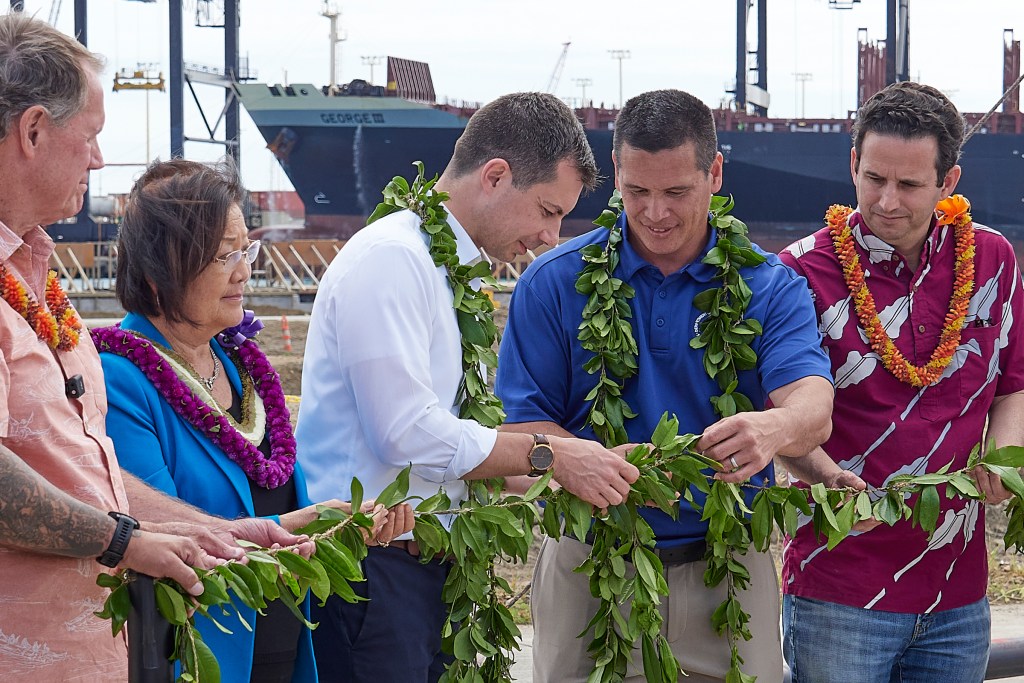
Buttigieg also visited the site of the future Kapalama Container Terminal, a project that’s been in the works for at least three decades to expand port operations at Honolulu Harbor. The project received a $40 million DOT grant to make it more sustainable and resilient.
About 90% of all goods that come into Hawaii flow through the harbor, making it one of the most critical infrastructure sites in the remote island state. The new terminal will also provide the transportation and logistics company Pasha Hawaii a new space to operate across from Sand Island and separate from Matson.
With the two companies working next to each other “it’s been a tight squeeze,” Sen. Mazie Hirono said Thursday at a groundbreaking ceremony for the new terminal. “It can be unsafe – we know that.”
The $40 million DOT grant will help fund new zero-emission gantry cranes at the future terminal, plus a solar-powered microgrid that can keep the terminal running during heavy storms and other adverse conditions, Buttigieg said.
The new terminal will also reduce the need for some 50,000 annual truck rides across the lone bridge that connects Sand Island to the other side of the harbor, according to Randy Grune, the managing director at Hawaii Stevedores.
Buttigieg acknowledged Thursday that the port needs further upgrades to reduce its growing vulnerabilities to climate change.
“This port cannot fail,” he said at the ceremony. “It gets me thinking about the broader picture and uniqueness of the transportation infrastructure in this place, where the very same geographic blessings that make this land what it is often mean that there is no other option when a piece of critical infrastructure fails.”
Civil Beat’s coverage of climate change is supported by the Environmental Funders Group of the Hawaii Community Foundation, Marisla Fund of the Hawaii Community Foundation and the Frost Family Foundation.

