

Kaneshiro Bribery Trial Delayed By New Judge
Meanwhile, defendant Sheri Tanaka is trying to sever herself from the case for reasons that are being kept secret.
The pay-to-play corruption case against Honolulu’s former prosecuting attorney will be delayed following the sudden appointment of a new judge who is grappling with a flurry of legal motions, including some that are hidden from public view.
The trial against former Honolulu prosecutor Keith Kaneshiro, his campaign donor Dennis Mitsunaga, lawyer Sheri Tanaka and Mitsunaga’s business associates was scheduled to begin on Feb. 27. But last month, Hawaii Judge Michael Seabright abruptly recused himself without explanation.
Timothy Burgess, a former chief judge of the U.S. District Court in Alaska, was appointed to take over. In a trial conference on Tuesday, Burgess said he would push the trial to March 12.

“That will give me time to make sure I’m up to speed and address some of the outstanding issues that still need to be addressed,” he said from the bench.
Prosecutors say Mitsunaga, his associates and his firm’s former attorney, Tanaka, conspired to funnel campaign donations to Kaneshiro so that the prosecutor would pursue a criminal case against Mitsunaga’s former employee, Laurel Mau. All the defendants have pleaded not guilty.
Burgess has a lot of material to get through. In recent weeks, attorneys on both sides have filed numerous motions “in limine,” which ask the court to either include or exclude certain evidence.
The defense doesn’t want the jury to hear mention of Katherine Kealoha, the disgraced Honolulu prosecutor. Kealoha was the one-time boss of one of the witnesses in the case, but defense attorneys argue she has no relevance to the charges at hand. Prosecutors, referring to Kealoha in their response as “she who must not be named,” said such a restriction would be unwarranted.

The government is pushing to include evidence of campaign donations made by Mitsunaga and his associates to various politicians over the years, not just Kaneshiro. They seek to show it was Mitsunaga’s pattern and practice to influence powerful people with so-called “bundled” political donations.
Seabright did not rule on any of those motions before he withdrew from the case. Since his departure, attorneys on both sides have filed several sealed motions, legal filings shielded from public view.
On Feb. 5, Tanaka’s attorney filed sealed motions to continue the trial and to sever his client from the other defendants. Heavily redacted versions of both requests were posted to the public docket.
“Ms. Tanaka has never before requested a continuance in this case and does not make this request lightly, as she had been eager to proceed to trial and respond to the government’s charges,” the motion states before several pages of blacked-out text.
The filing cites a “very unique fact pattern” that supposedly warrants a delay. The facts, however, are redacted.
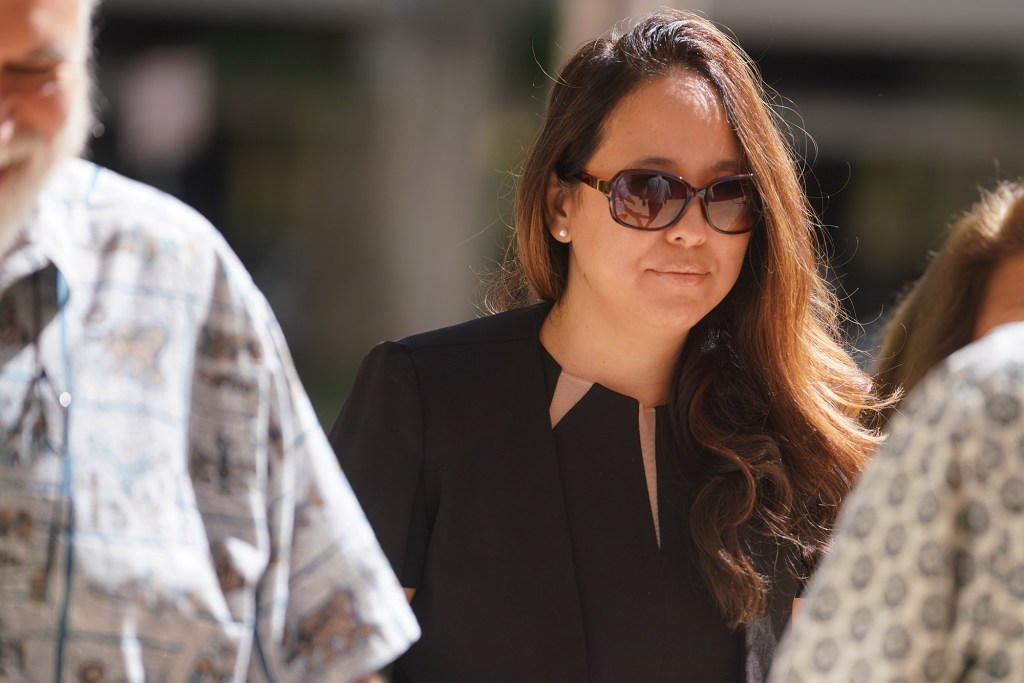
“These circumstances were totally unforeseeable by Ms. Tanaka’s counsel, and no amount of diligence could have prepared them for it,” the motion states.
“There is no indication in the record that Ms. Tanaka’s counsel has been anything less than diligent throughout the Kaneshiro Case. Rather, the need for a continuance stems from unforeseeable circumstances outside counsel’s control or foresight.”
Without a trial delay, Tanaka would suffer “extreme prejudice,” the filing states. The reasons for that are redacted.
In asking to separate Tanaka from her co-defendants, her attorney’s arguments are, again, hidden.
“She respectfully submits that severing her trial is required under the circumstances and existing case law,” an unredacted portion of the filing states.
The motion to sever includes a document called “Exhibit 1” that is entirely blacked out.
On Tuesday morning at the courthouse, most of the defendants sat silently in the courtroom for nearly an hour as their attorneys met with Burgess in his chambers. Tanaka waited in the hallway.
When the public session was called to order, Burgess expressed an interest in delaying the trial, but the judge gave no indication he was delaying due to Tanaka’s request or ruling on her motion. He made no mention of her motion to sever. He said motions in limine would be discussed at a separate hearing on Feb. 26.
About 20 minutes later, Burgess closed the courtroom to discuss the sealed motions. The public was kept out of the courtroom for roughly 45 minutes. He reconvened the public session just before noon to discuss details about jury selection. He told attorneys he has a lot of “catching up to do.”
“I look forward to reading your brief, concise and insightful filings,” he said.

