Kauai Fire Deals $20 Million Blow To Affordable Housing
The controversial project was nearing completion when it burned down over the weekend.
A charred husk of a building is all that remains of an oceanfront affordable housing complex that was under construction when it went up in flames shortly before 1 a.m. Sunday near Kauai’s Port Allen Harbor.
The Kauai Fire Department, which extinguished the fire at 12:20 p.m., is partnering with police to investigate the cause of the blaze. Arson has not been ruled out.
The fire destroyed about two dozen two- and three-bedroom apartments, a multimillion-dollar loss to taxpayers who helped fund the government-subsidized project and a blow to the island’s sputtering efforts to house a rural workforce that’s being squeezed out by astronomical rents and home sale prices.

“When you begin to have progress on the most challenging issue that we face on Kauai — affordable housing — and then an accident like this happens, it’s one of those where you just throw your hands up like, ‘What’s going on?’” said Kauai County Councilman Addison Bulosan, who is vice chairman of the Housing and Intergovernmental Relations Committee.
“That thing was three or four months out from being finished and it was a big win for improving our affordable housing inventory,” he added. “It’s almost like we’re destined for doom.”
Kauai Housing Director Adam Roversi had one thought when he woke up Sunday to the news that half of the Kai Olino affordable housing project site had burned down in the middle of the night: arson.
The building was wired but the electricity hadn’t been switched on yet, casting doubt on the likelihood of an electrical fire. And there had been strong opposition to the apartments from nearby homeowners who feared the subsidized housing project would block their Hanapepe Bay views and lower their property values.
“The idea that it was intentionally set, that’s only my gut,” Roversi said. “I’m no fire expert, but there just aren’t too many other options really.”
The fire, if treated as arson, may never be solved. Hawaii’s county fire and police departments rarely find enough evidence to implicate culprits in the roughly 400 arson cases identified each year.

It will cost $20 million to reconstruct the second of two buildings in the 48-unit Kai Olino complex, a two-phase project by the Oahu-based affordable housing developer Ahe Group. Before the fire, the project had been on track for local families to move in this spring.
Another building on the project site is nearly complete, with flooring in place and kitchen appliances installed, and does not appear to have been affected by the fire. But it’s unclear whether the fire will push back future tenants’ move-in date.
A planned third building, part of the project’s second phase of construction, was expected to break ground this week.
Makani Maeva, president and CEO of Ahe Group, did not return requests for comment.
Roversi said it’s his understanding that the project is well-insured and that the developer is committed to rebuilding.
“I would call this a setback,” Roversi said. “It’s another 24 or so families that no longer have a safe and affordable place to live in a relatively short period of time.”
There’s roughly 250 affordable units under construction on Kauai for occupancy within the next six to nine months, according to Roversi. In the next one-to-two years, he said the county expects to see approximately 540 new affordable units come online.
But Kauai will need roughly 2,500 additional housing units by 2030, according to a housing demand study by the Hawaii Department of Business, Economic Development & Tourism.
The shortage has led to surging rents, a rise in homelessness, an outmigration of Kauai residents to places with ample, more affordable housing opportunities and, for many of those who stay, a persistent anxiety.
From Luxury To Budget
The site of the Kai Olino project on a waterfront bluff on Okupu Road in Eleele was originally slated for luxury condos.
Alexander & Baldwin, the south Kauai property’s original owner, announced plans in August 2005 to develop the lot into a 75-unit multistory condominium. The developer went so far as to build out water and sewage lines and secure a building permit before nixing the project on the heels of the 2008 economic downturn.
The property sat dormant for years until it was purchased in 2022 by Ahe Group, which used A&B’s original condo plans, only with modifications to make the units affordable.

With ocean views designed into the layout of the apartment kitchens and living rooms, the Kai Olino workforce housing project — which includes four units reserved for families experiencing homelessness — is poised to retain some of the grandeur of the abandoned luxury development envisioned by A&B.
“If they were for sale on the market they would be $1.5 million to $2 million condos, and local families who make $50,000 a year are going to be able to live there,” Roversi said.
It’s funded primarily through low-income housing tax credits and state financing. Kauai County also provided a half-million dollar grant, as well as fast-track permitting, waivers and deductions from permitting fees and project-based Section 8 vouchers, Roversi said.
Next door to the Kai Olino project is a neighborhood of single-family homes built by A&B in 2007 as part of the affordable housing requirement for its luxury condo project that never materialized.
Those homes have aged out of the county’s affordability rules, which were once less stringent, and can now be bought and sold at market rates.

Despite the two developments’ similar origin stories, some owners of homes skirting the Ahe Group project site have been among the most vocal adversaries of the Kai Olino apartments.
“It was ironic,” Roversi said, “because as Ahe Group was beginning to publicize that they were going to do this affordable housing project on the site, the folks in that subdivision were kind of up in arms that affordable housing was being built across the street from their homes when their houses were part of an affordable housing subdivision built by A&B.”
Some of the homeowners had been looking forward to the luxury condos because they thought they would increase their property values, Roversi said, and they were against the affordable development for the negative effect they thought it would have on their home values.
The county housing director said there were other complaints too: The multistory apartments would block the ocean view. The project would increase traffic. An influx of lower-income families would bring down the neighborhood’s appeal and character.
‘Not In My Backyard’
On Kauai, where the median home price is $1 million, an increasing number of people do not have a house to sleep in at night.
That’s according to the most recent annual point-in-time count, which was published last spring and found a 10% uptick in homelessness on Kauai in January 2023 from the same time the previous year. Volunteers located 488 homeless people across the island on a single night who agreed to participate in the federally mandated survey.
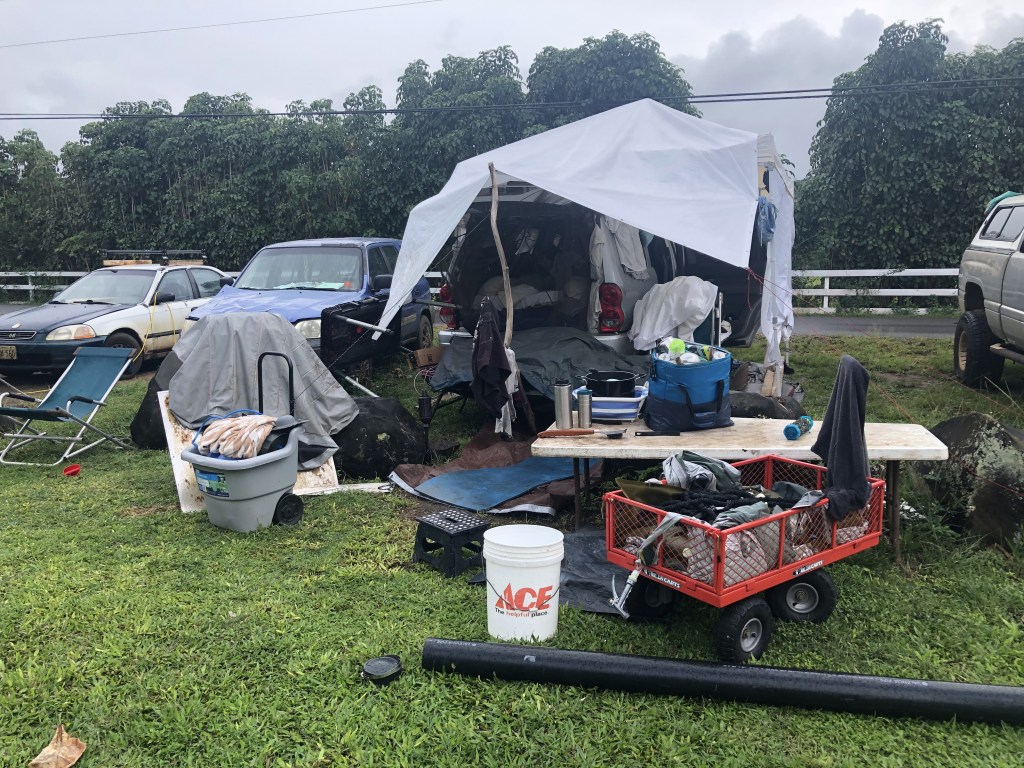
While the survey does not offer a precise count of the island’s homeless population, it’s an important bellwether of the island’s difficult housing economy used by nonprofit agencies and government policymakers working to tackle the issue.
Affordable housing projects are both badly needed on the island and notoriously controversial, threatened by NIMBYism from residents who don’t want them built down the street from where they live.
Roversi said this “not in my backyard” sentiment has been known to hinder Kauai housing projects. He explained how during Covid the county had plans to build a 12-unit tiny home project in Waimea, but virtually every citizen who was questioned did not want it. So the county abandoned it in the face of overwhelming opposition.
While Roversi views the fire at Kai Olino as another setback, he said his broader concern is that the fire, if it’s determined by authorities to have been intentionally set, may make developers think twice about pursuing affordable projects on Kauai.
“It sullies our reputation slightly, perhaps, as being a great place to do this necessary kind of work,” he said.