Property Cleanup In Lahaina Has Become A Frustrating Waiting Game For This Fire Victim
Officials have made it almost impossible for property owners to clean up their own lots and the federal program is going slowly.
At the start of the year, Mario Siatris signed up to have the U.S. Army Corps of Engineers clear his fire-ravaged property on Mela Street of toxic debris.
It was not a simple decision.
His business partner who he had shared the house with before the Aug. 8 fire, U‘i Kahue-Cabanting, had wanted to rally together a crew of their friends and family to help haul away the health-hazardous debris, a critical precursor to the reconstruction of Mario’s destroyed plantation home.
Mario, a commercial landscaper, has access to tools and small machinery. And Mario’s son had recently completed a free training course on hazardous waste cleanup specifically tailored to the Lahaina wildfire recovery effort.
With Mario’s homeowner’s insurance coverage, U‘i figured they could pay themselves to discard the ash and twisted metal remains of their lives. Surely they’d be able to get the work done faster than the federal government.

But doing the work themselves would require them to adhere to the same stringent specialized hazmat protocol as the Corps, with one frustrating caveat: They would not be permitted to dump the waste in the Olowalu landfill, opened early this year as a temporary disposal site. Instead, they would need to wait for Maui County to select a site and build a permanent burial ground for the Lahaina wildfire’s toxic remains.
They also wouldn’t be able to get paid to clear the property. After researching Mario’s insurance policy, U‘i learned the policy would only pay out to a business entity.
The kicker, though, was the sometimes aggressive community pressure Mario felt to join the government-sponsored cleanup. After the county put out messaging saying the Corps would first clean up neighborhoods where all of the property owners had opted in, neighbors started urging neighbors to send in their application for the government program, which bears no cost to the property owner.
“It’s almost like shaming your neighbors,” U‘i says on a recent Saturday afternoon over pizza and drinks at a sports bar near Lahaina. “And people were doing that on social media, so now you’ve got neighbor-on-neighbor. And Mario, he doesn’t like confrontation.”
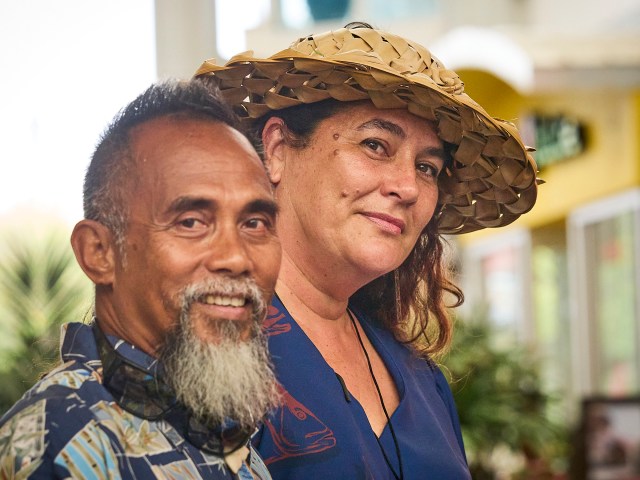
Six weeks have passed since Mario handed in his paperwork to join the government cleanup and his right-of-entry forms still haven’t been approved by the county. About half of roughly 1,800 applications submitted so far are stuck in this limbo.
Officials say the approval process is in some cases being held up by omissions in the application paperwork or ongoing negotiations between the government and the applicant’s homeowner’s insurance company.
“I have no idea what the hold up is,” Mario says, sipping from a bottle of Heineken. “I have no idea what I still need to do to get approved. We have no idea. Nobody knows nothing.”
This week the Corps completed debris removal on 100 residential properties. Mario is desperate to know when they’ll start on his.
In the meantime, there’s little he can do but wait — a frustrating position, but one that he’s growing familiar with as he navigates the bureaucracy of federal disaster recovery on the heels of the deadliest wildfire in modern American history.
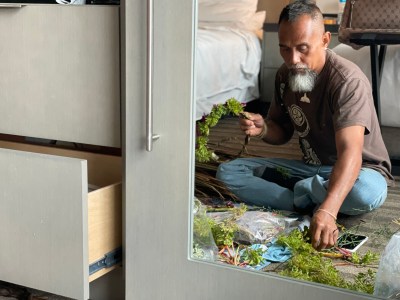
Mario is sometimes so overwhelmed by his circumstances that he finds himself zoning out in front of the television at his FEMA-funded condo with little awareness of how much time has passed.
Living and working at the same resort complex is taking its toll on his mental health, he says. With so many obstacles between him and the seemingly far-off date when the government will allow him to move back home again, he wonders how he’ll make it.
“I’m deteriorating there,” Mario says of his home for the last six months at the same resort where he works as the property landscape manager.
“You go to work the same place you go home, there’s no separation,” he says. “It’s not that I’m not grateful, but it’s consuming. Mentally I’m kind of drained. After work I just go home and watch TV. I never used to be like that, man.”
Even after the Corps removes the fire debris from his property, Mario won’t be permitted to live on his land until Lahaina’s fire-damaged water and sewer systems have been rehabilitated. Government leaders haven’t announced a timeline for this work, either — another point of discouragement for Mario and U‘i, and others like them who want to move back onto their property as soon as possible.
“That’s why Mario’s on this rollercoaster,” U‘i explains. “It’s like damned if you do, damned if you don’t. Either way, you’re going to wait. And we haven’t been given any kind of time frame.”
Mario has money sitting in the bank to at least begin to pay for the reconstruction of his century-old plantation home. But in his eyes, it’s shrinking with each day that passes and inflation takes its toll. He worries the value of his savings is dwindling faster than his wages can counterbalance it.
“What if the money I have isn’t enough by the time I finally get to build?” he wonders.
U‘i copes differently. She’s rarely idle, filling her days with volunteer work, family obligations or computer research about types of trailers she and Mario might want to live in.
Recently, she picked up the 8 p.m. to 4 a.m. graveyard shift as a volunteer greeter at The Wall That Heals, a traveling replica of the Vietnam Veterans Memorial that was stationed for a week at the War Memorial Stadium in Kahului. She accompanied her husband Ronald, a disabled veteran, to Honolulu for a series of doctor’s visits. She helped the Maui Business Brainstormers plan a 200-plate dinner during National Entrepreneurship Week.
And she continues to teach coconut weaving to tourists at the Westin. She’s been angling for a pay increase from the resort that funds her classes to help keep up with inflation and account for the added expense of supermarket flowers she now buys instead of the plumeria blooms that her burned-down orchard once provided. But the resort has cut back on its Hawaiian cultural programming as West Maui tourism sputters back to life. She figures the timing’s not quite right for contract renegotiations.
All the while she’s kept her cell phone ringer on high, waiting for news that her daughter’s going into labor.
In the weeks leading to the Feb. 19 due date, U‘i says her daughter displayed signs of preeclampsia. But those worrisome symptoms have since dwindled.
“She’s stressed out,” U‘i says. “But I don’t know anyone who’s not stressed out on Maui right now.”
Civil Beat’s coverage of Maui County is supported in part by grants from the Nuestro Futuro Foundation.