

Kamehameha Highway Just Got $5M To Guard Against Rising Seas. It Will Need Much More
There are tough decisions ahead when it comes to planning for the future of the critical road connecting Windward communities.
The effort to protect Oahu’s Kamehameha Highway against coastal erosion got a $5 million boost in federal funding last week, with half of those dollars targeted at building a new shoreline barrier in Kaaawa with stones weighing at least half a ton each.
But state transportation leaders estimate it will cost $125 million to install all the barriers needed to protect that road from Kaaawa to Hauula for the next 25 years against the rising seas and pounding surf.
That generation worth of protection also aims to buy time for state leaders and the Windward communities who rely on Kamehameha Highway to decide what to ultimately do about that critical coastal road, as sea level rise is projected to eventually overwhelm it, according to state Transportation Director Ed Sniffen.
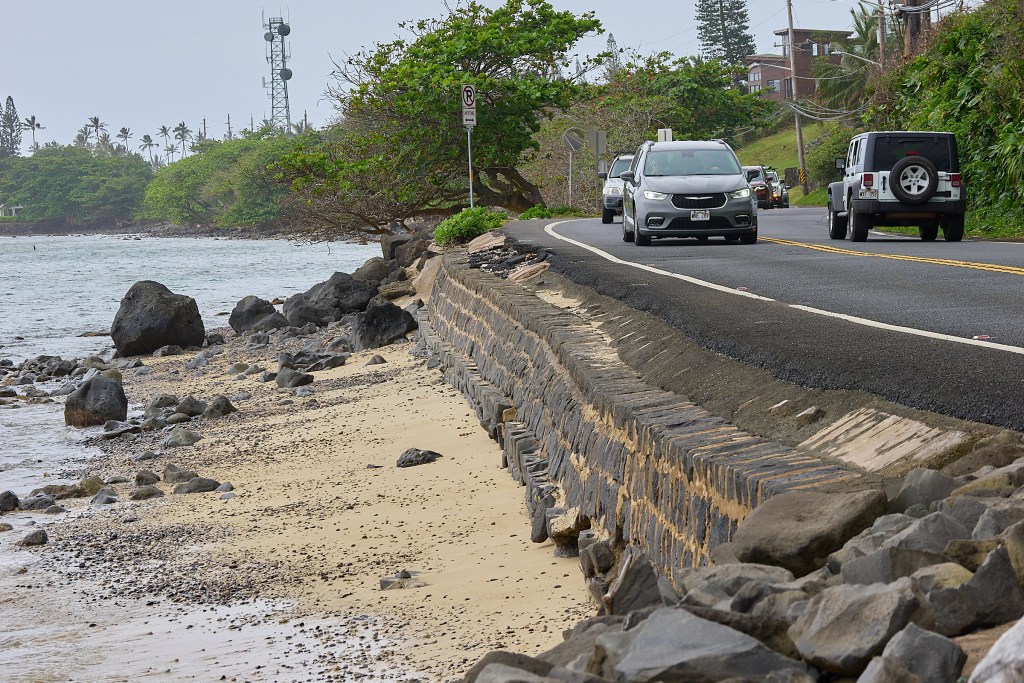
Scientists have projected at least 3 feet of sea level rise by 2100 or sooner, and Sniffen said the Windward coastal area that includes Kaaawa is expected to be fully inundated by then.
It would cost the state as much as $2 billion to relocate that 10-mile stretch of Kamehameha Highway running through central, Windward Oahu farther inland, Sniffen said.
State leaders will need to weigh whether that move makes sense, he said, adding that the discussions on what should be done need to start now.
“How do we plan now for what we’re seeing as eventualities in your community?” Sniffen said.
Hauula community advocate Dotty Kelly-Paddock said that many residents in the Koolauloa region of the Windward side are worried about what they see as DOT’s patchwork approach to address the highway woes, and that they consider it imperative that the road be preserved in the long term.
“We want a more comprehensive, data-based study by a group to plan how to best address the sea level rise and strong erosion that is undermining the entire stretch of Kamehameha Highway in Koolauloa,” Kelly-Paddock said.
The communities there want DOT along with Hawaiian Electric Co. and the Board of Water Supply, whose utility lines run along the highway, “to plan together and involve community reps in the process.”
“We want a voice,” Kelly-Paddock said.
DOT is still finalizing what types of barriers, or revetments, it will eventually use to protect the three most vulnerable miles of highway between Kaaawa and Hauula, Sniffen said. The agency is considering the barriers composed of stones weighing between half a ton and 1 ton, as well as hybrid barriers made from stone and concrete.
Those methods will require approvals from the state Department of Land and Natural Resources, including its Office of Conservation and Coastal Lands.

The state DOT expects to release its draft environmental assessment for the mid-term project next month, and Sniffen said his agency still expects to have all of those barriers finished by 2029.
Then, the tough discussions about what to do next, as the seas grow higher and fiercer, needs to happen, he said. Sniffen has previously suggested the area may be best accessed by ferry toward the end of this century.
“I don’t want to sound like I’m dictating what’s going to happen, but we have to put all of the potentials on the table,” he said Friday.
State leaders have estimated in 2018 that it would cost some $15 billion to address all of Hawaii’s highways vulnerable to sea level rise.
At a town hall meeting in Hauula this past September to discuss Kamehameha Highway, “the whole room stood up and said we’re not going any place” in the long term, Kelly-Paddock said.
“We need to be here. We need a road.”
In announcing the U.S. Department of Transportation’s decision to award two grants to Hawaii worth $5.2 million last week, U.S. Sen. Brian Schatz said the money would help protect and strengthen Kamehameha Highway.
“Thousands of people on Oahu rely on Kamehameha Highway every day to get to where they need to go, whether that’s school or work,” he said in a statement. “But rockfalls and erosion can cause disruptive traffic delays and can be dangerous.”
The two grants will be used to protect Kamehameha Highway by installing a coastal barrier to prevent erosion in Kaaawa and to replace an existing fence to protect the highway from rockfalls in Pupukea, according to a news release from Schatz.
Civil Beat’s coverage of climate change is supported by The Healy Foundation, Marisla Fund of the Hawaii Community Foundation and the Frost Family Foundation.

