

Kauai Wildfire Shows How Other Hawaii Power Safety Shutoffs Might Work
It’s a learning experience for the utilities and the communities they serve as emergency plans are developed.
JPʻs Pizza on Kaumualii Highway had just received its latest, weekly inventory of cheeses, specialty pepperoni and other ingredients from Honolulu last week when a brush fire broke out on Kauai, threatening to engulf Kaumakani, where the restaurant sits, and nearby Hanapepe.
The July 15 blaze eventually prompted Kauai Island Utility Cooperative to shut off the transmission lines that power those two communities, plus other towns located on the arid West Side, when it jumped the highway.
The shutoff caused JPʻs to lose its entire $2,000 inventory and close for a week, according to owner Chad Machado. But he supported the move to de-energize the lines there, especially after watching the fire come within a few hundred yards of his restaurant.

“We were so close. The fire was right behind us,” Machado said Wednesday.
He and others doused the building with a hose up until they had to evacuate the area. “We left coughing” amid overwhelming smoke and ash, Machado said. JPʻs survived and will stay in business, he added.
The shutoff by KIUC, which was requested by the Kauai Police Department, gave energy users across the state a glimpse of what the so-called “public safety power shutoffs” might look like.
Hawaiian Electric Co., which supplies power to much of the rest of the state outside Kauai, unveiled its new plan this summer to preemptively shut off power circuits and transmission lines in the hotter, drier areas to try and reduce the risk of sparking a wildfire when the weather turns especially dry and windy.
Some 48,000 customers fall within those potential HECO shutoff areas on Oahu, Maui, Molokai and Hawaii island. So far, none have occurred there. The goal is to help prevent another wildfire similar to the one that destroyed most of Lahaina.
On Kauai, the July 15-16 shutoff lasted about 12 hours and impacted roughly 1,100 of the co-opʻs members on the West Side, according to KIUC.
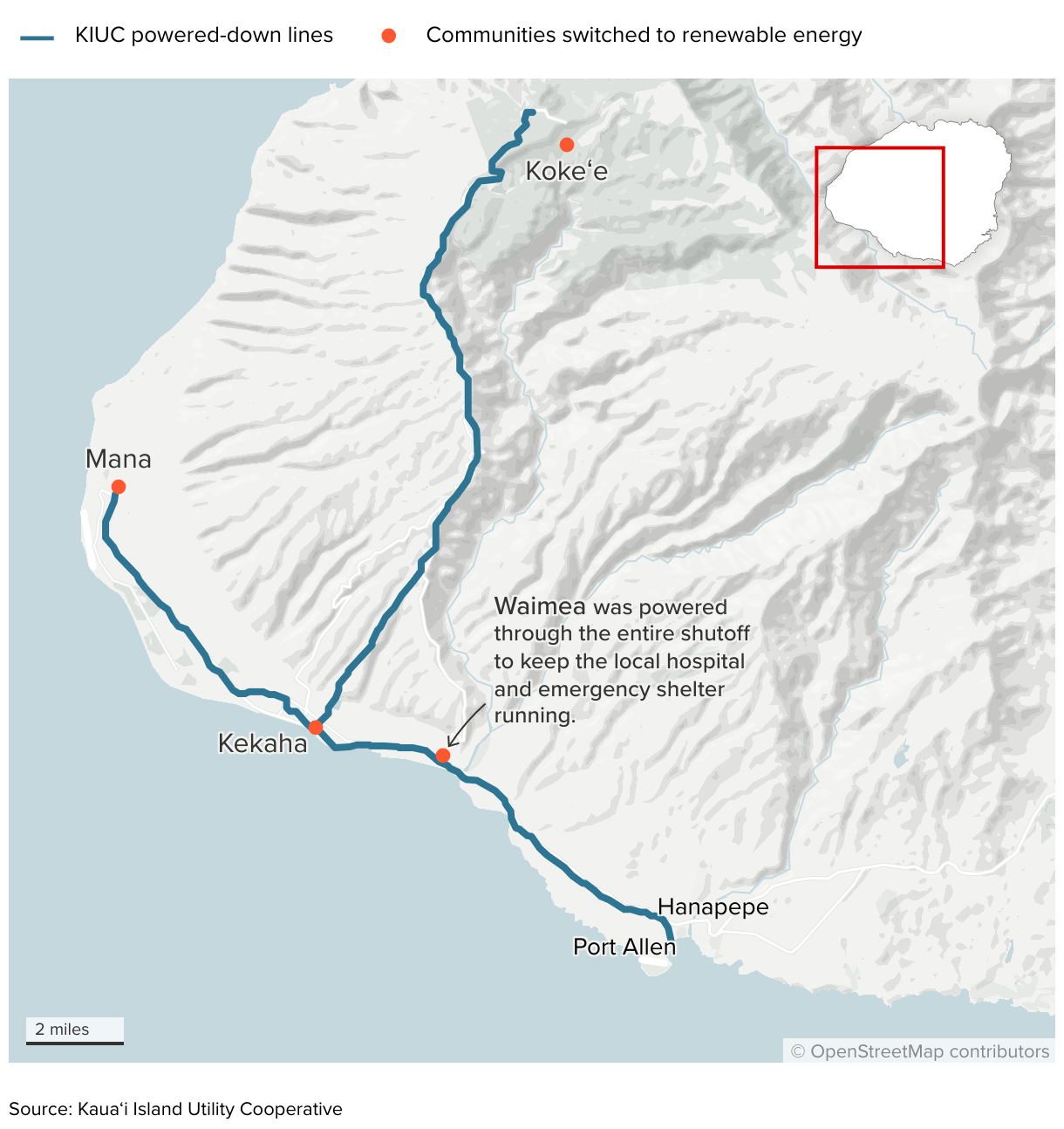
Unlike the preventative steps laid out in the HECO plan, the Kauai transmission lines were de-energized after a wildfire had already started. There had been no advance, red-flag warnings indicating an elevated threat that day, and the fireʻs cause remains under investigation.
“When poles and lines are in the potential path of the fire, you don’t want poles to be damaged and falling while they’re energized,” KIUC spokesperson Beth Amaro said Monday. “We were concerned about the condition of poles and the proximity of the fire to the poles.”
KIUC de-energized the lines that power Hanapepe, Kaumakani and nearby Pakala at around 3:15 p.m. as a brush fire approached those communities, affecting 378 of its members, according to a statement from the utility.
Those transmission lines also power the communities of Kekaha, Mana, Waimea and Kokee, situated farther up the islandʻs west side, according to Amaro. Initially, all of those areas kept the power on via two separate, renewable energy sources: a solar and battery facility at the Pacific Missile Range Facility and a hydro-electric plant on land owned by Gay & Robinson, Amaro said.
However, all of those communities except Waimea lost power around 6:30 p.m. when all the renewable energy was diverted to Waimea. That ensured the hospital and emergency shelter there could stay energized, Amaro said.
Power was restored to the entire area around 3 a.m. on July 17, after KIUC crews replaced four damaged transmission line poles, the utility stated.
Because the shutoff occurred within minutes of the police departmentʻs request, KIUC was not able to warn 99 co-op members signed up in those communities for emergency notifications that the power would be cut, Amaro said.
Those signed up for those notifications include seniors and power users who depend on special medical equipment. “We’ll try to give notice wherever we can but it doesn’t necessarily solve” every situation, she said.
Amaro said that KIUC did not receive reports of anyone on the emergency notification list experiencing problems due to the shutoff.
Clyde Nada, who owns Aloha Sweet Delights bakery next to JP’s Pizza, said he did not hear of any such issues in the nearby residential community.
KIUC does not have an official PSPS plan similar to HECOʻs. However, the Kauai utility did conduct power safety shutoffs last September in Kokee and Poipu during a red-flag warning.
“Following the August wildfires we had to come up with some internal protocols” to handle red flag conditions, Amaro said Monday. KIUC also finalized in May a broader plan to deal with wildfires across the Garden Island, she added.

