

Climate Advocates Want Tourists To Rent Electric Vehicles. Maui Shows Why That’s Hard
Transitioning rental car fleets to EVs could help the state meet its ambitious energy goals, but “range anxiety” leaves customers concerned about making it around the island.
Maui gained several new electric vehicle chargers this year, but the island still lacks sufficient infrastructure to rent EVs in large numbers to visitors, longtime local rental and EV industry officials say.
The slow pace of EV charger installation on the Valley Isle reflects the broader challenges Hawaii has faced in the past decade trying to add those stations and spur more EV use, largely due to cost and permitting issues.
Most of the major national companies that rent cars and trucks at the Kahului Airport did not respond to questions last week about how many vehicles in their fleet are electric-powered and what share of their total Maui fleet those clean-energy vehicles represent.

Mike Wilmering, a spokesperson for Enterprise Mobility, which owns Enterprise Rent-A-Car, Alamo and National, said the makeup of those brands’ fleets reflect the market on Maui, but he didn’t provide specifics.
“Our local fleet is balanced to customer demand and we are accommodating customer requests,” he said in an email.
Hertz, Avis and Budget — the other major rental brands at the airport — did not respond to requests for comment.
However, Shaun Stenshol, co-owner of Kahului-based Eco Rental Car, said that demand for EV rentals remains low on Maui because charging facilities are spread too thin to persuade visitors to choose that option.
The island doesn’t have enough of the faster and more powerful Level 3 chargers, he said. That contributes to customers’ feelings of so-called “range anxiety” — fears that they won’t be able to take long drives across the island without running out of power, Stenshol added.
If you live on Maui and can charge at home, that’s no problem, Stenshol said. But if you’re a visitor staying somewhere that lacks a place to charge a rental EV battery that’s a major obstacle, he added.
Faster Charging Options Needed
The publicly crowdsourced online charger map Plugshare, which helps EV users see what charging options are available before they drive, currently lists seven such fast-charging stations on Maui, most in Kahului.
However, at least two of those stations, at Queen Kaahumanu and Haiku shopping centers, were shown to be out of service or offline earlier this month.
There’s only one less powerful Level 2 charging station in all of East Maui listed on Plugshare, located at the Travaasa boutique hotel in Hana.
“Why don’t we have more? It’s supposed to be a priority of the state and based on what’s happening it’s not a priority,” Stenshol said.
Hawaii has a statewide goal of zero emissions for all transportation sectors by 2045, which includes vehicles, aviation and boats, according to the Department of Energy.
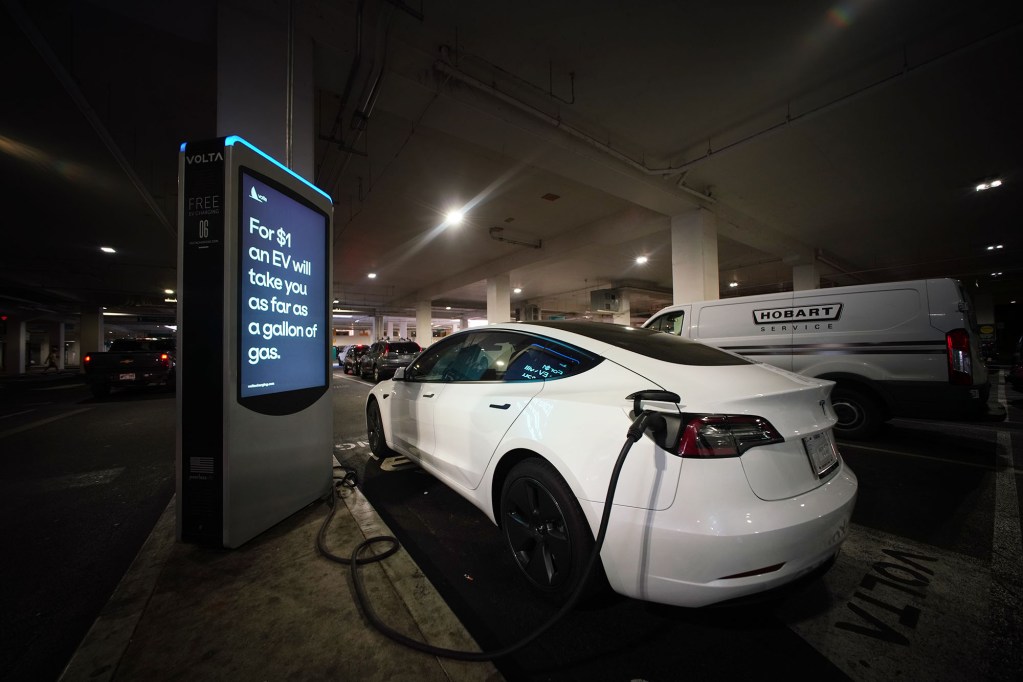
Meanwhile, a bill introduced this month by Tamara Paltin, who represents West Maui on the County Council, aims to require more Level 2 charging stations be included in public parking lots. Specifically, it would require those lots to install two such stations for every 50 parking spaces by 2025 and eight such stations per 50 spaces by 2031.
The bill largely mirrors a law that’s already in place on the Big Island, according to Rob Weltman, president of the Maui Nui EV Association, which is part of the larger nonprofit Electric Auto Association. Paltin had previously introduced the bill in 2023, but it was put aside after the Lahaina wildfire in August of that year, he added.
The council last week referred that bill to the Disaster, Resilience, International Affairs and Planning Committee, which Paltin chairs.
Weltman said that Maui desperately needs more public charging infrastructure — not just for visitors but for many residents as well. “One of the things I hear all the time is, ‘Please get some public charging because I can’t charge at home,'” Weltman said.
He said he knows of some local EV users who canceled their leases early because the island doesn’t have sufficient Level 2 or Level 3 chargers. “It’s the topmost issue for people who want to go EV but can’t,” Weltman said.
Weltman added, however, that he’d like to see the language in Paltin’s bill removed that would require existing parking lots to install Level 2 chargers in order to increase the measure’s chances of passing.
Eco Rental Car aims to provide Maui visitors with environmentally friendly options to rent vehicles, but its 20-car fleet currently only has two electric cars, Stenshol said. The rest are hybrid electric-gas cars.
He added that their customers often request a hybrid in advance so they won’t have to deal with the limited charging infrastructure.
“People don’t come here to be hassled, they come here to relax,” Stenshol said. “They need it to be easy. We need to accommodate the visitors.”
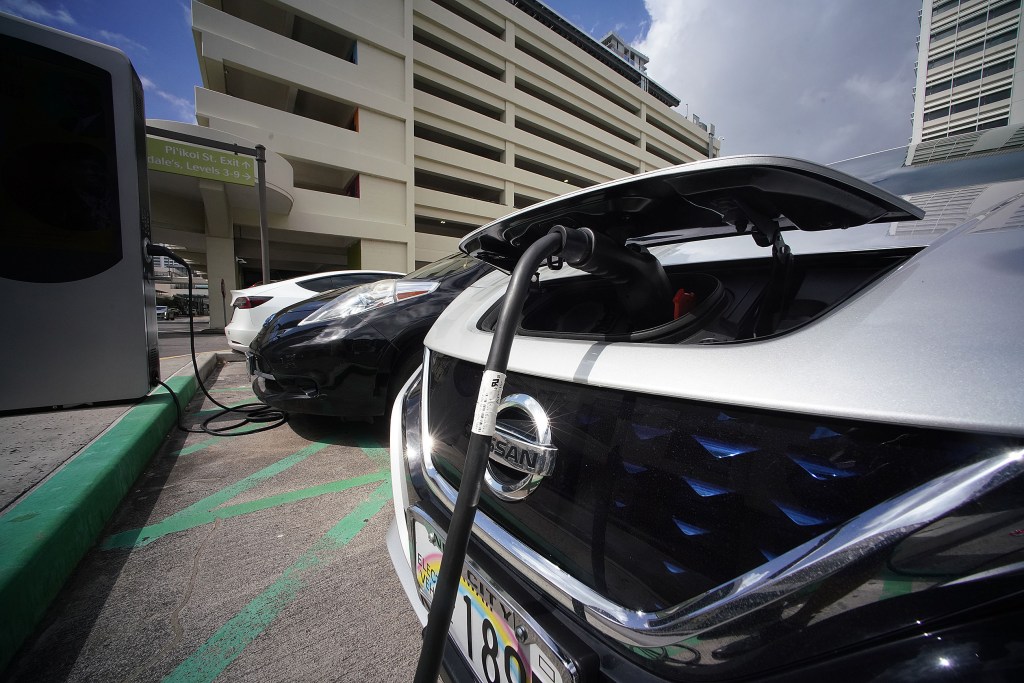
The island’s airport has 91 Level 2 stations to accommodate EV rentals, and one Level 3 station, according to the state Department of Transportation. Level 2 chargers typically take several hours to charge an EV battery, while a Level 3 can take less than an hour, according to the U.S. Department of Transportation.
In February, DOT opened a $3 million Level 3 charging station with four chargers, mostly covered by federal National Electric Vehicle Infrastructure funding that was included in the 2021 Bipartisan Infrastructure Law.
A second NEVI-funded charging station for Maui is expected to start construction later this year in Kapalua, according to DOT spokesman Russell Pang. It’s among nine additional NEVI stations planned across the state, including ones in Mililani on Oahu and in Princeville on Kauai, Pang said.
Plugshare shows no Level 3 chargers on Kauai. On Monday, state and federal transportation officials broke ground on another NEVI-funded charger at Aloha Tower in Honolulu that’s expected to be ready in November.
The state was strongly criticized by local clean-energy advocates last year when its $377 million rental car center at the Daniel K. Inouye International Airport opened on Oahu with just one charging station. It now has seven Level 2 charging stations and 18 more in the works, Pang said.
In July, there were 1.08 million passenger vehicles registered across Hawaii. Only 33,000 of them were EVs, according to the most recent data available from the Department of Business, Economic Development and Tourism.
“An electric car — what could be greener than that?” Stenshol said. “It should be a priority everywhere. We have to take some really big steps here to mitigate the climate crisis — because it’s coming.”
Civil Beat’s coverage of Maui County is supported in part by a grant from the Nuestro Futuro Foundation.
Civil Beat’s coverage of environmental issues on Maui is supported by grants from the Center for Disaster Philanthropy and the Hawaii Wildfires Recovery Fund, the Knight Foundation and the Doris Duke Foundation.
Civil Beat’s coverage of climate change is supported by The Healy Foundation, Marisla Fund of the Hawaii Community Foundation and the Frost Family Foundation.

