

Free Speech Group Blasts UH For Censoring Law School Presentation
An instructor’s PowerPoint slide about a theoretical crime led to an anonymous complaint.
For a decade University of Hawaiʻi law instructor Ken Lawson used a simple PowerPoint to teach first-year law students about the legal consequences of a fatal shooting.
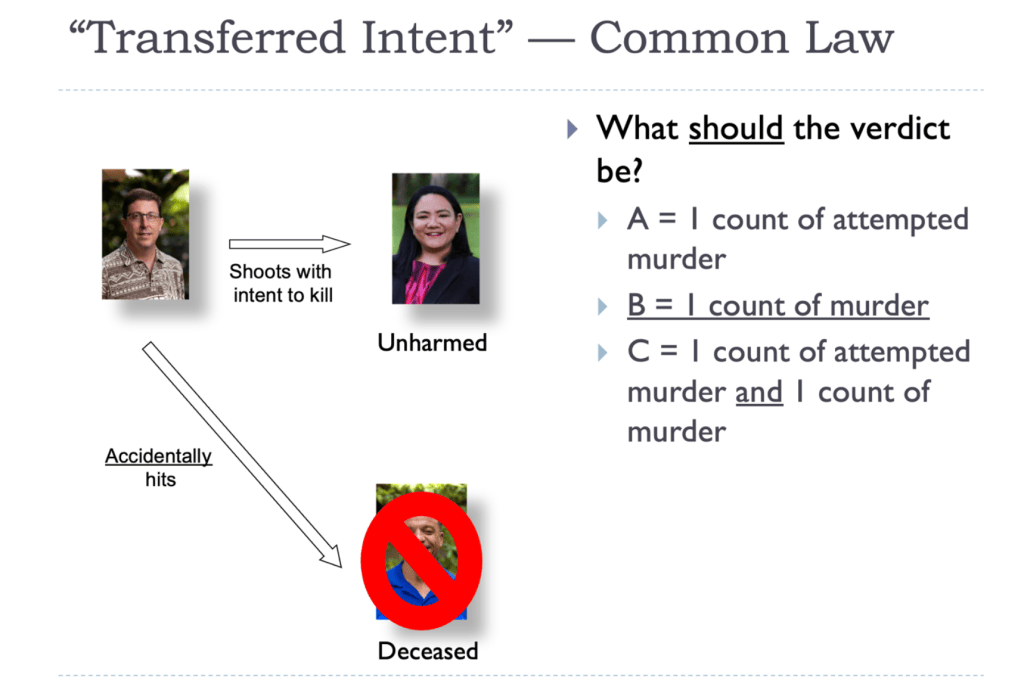
Instead of using a generic diagram, Lawson used pictures of real colleagues at UH’s William S. Richardson School of Law to depict the hypothetical crime. The most recent version, which Lawson used in a class last fall, displayed photos of two deans, with Lawson as the accidental victim.
That PowerPoint slide prompted a cascade of objections. An anonymous whistleblower objected to the depiction of violence. UH then deleted the deans’ photos from recorded class material without Lawson’s permission, even though he had violated no law or university policy. Lawson also was barred from using photos of faculty or students in lecture slides going forward.
Now a national free speech organization is pressuring UH to reverse its censorship of Lawson’s class materials.
Lawson in turn has accused UH administrators of editing his PowerPoint in retaliation for suing the university after he was disciplined for speaking out about a Black History Month event.
UH officials declined interview requests, citing Lawson’s pending lawsuit.
“UH Mānoa remains steadfast in its commitment to fostering a safe and respectful environment for all members of its community, including students and employees,” said a written statement from UH spokesperson Dan Meisenzahl. “As this is an ongoing personnel dispute and the subject of multiple litigation cases brought by Mr. Lawson, it would be inappropriate for the university to comment at this time.”
Lawson declined to be interviewed for this story, too, but he met last year with Law School Dean Camille Nelson and UH Interim Vice Provost for Student Success Kapā Oliveira. Civil Beat obtained a recording of the meeting, where each party expressed their concerns.
In the meeting, Nelson said she believed the anonymous whistleblower was a student. Oliveira said students were “on edge” at the outset of the academic year after a Mānoa man killed his wife, three children and himself with a knife last fall. The administrators also cited students’ concerns about school shootings on the mainland and the discovery of a dead body with gunshot wounds near the Mānoa campus.
“We’ve had more mental health incidents, I would say, in the first couple of weeks, than we did all of last year. So it’s on the rise,” Oliveira said. “And so I think students are just on like this heightened alert.”
Shielding Students, Or ‘Shying Away’?
The Foundation for Individual Rights and Expression, a nonpartisan group that monitors colleges, has stepped in to support Lawson, writing a Jan. 22 letter to UH that accuses the law school of interfering with Lawson’s academic freedom while protecting law students from realities of the profession.
Law “students will inevitably encounter difficult topics like sexual assault, homicide, physical assault, domestic violence, and may be faced in school and in their careers with descriptions of personal injuries far more graphic than those in Lawson’s hypothetical,” the foundation wrote to UH.
“Those concerned that law schools are shying away from teaching some areas of law to avoid controversy just got more reasons to worry,” the foundation said in an article posted on its website.
Lawson’s controversial lesson focused on the legal concept of transferred intent, which involves a basic principle: crimes generally require both a criminal act and criminal intent. Transferred intent arises when a person intends to, for example, shoot one person but accidentally kills a second person instead. The shooter still can be charged with murder, even without intending to kill the victim.
During their meeting, Lawson told Nelson and Oliveira that he’s used colleagues in his hypothetical scenario since 2015 because it’s easier for students to understand the concept if they know the people involved. Over the years, he’s placed a variety of deans and directors in the roles of shooters, victims and intended targets.
Fast forward to 2023, and Lawson’s slide showed Associate Dean Nick Mirkay shooting at Interim Associate Dean Trisha Nakamura — who both still hold those positions — but accidentally killing Lawson. That’s what prompted the anonymous complaint.
Lawsuit Over Black History Month Event
Mirkay plays a role in Lawson’s ongoing lawsuit, too, which the student whistleblower cited as a cause of worry that prompted the complaint.
The lawsuit dates to a February 2023 faculty meeting at which Lawson criticized the law school diversity, equity and inclusion committee for not including any Black speakers in a Black History Month event about the U.S. civil rights movement. Lawson, who is Black, called the DEI committee’s decision an example of “nice racism.” With the support of the law school’s Black Law Student Association, Lawson called for a boycott of the event.
Later, after faculty said they felt threatened by Lawson’s behavior at the faculty meeting, the university launched an investigation during which Lawson was banned from the law school. A question in the investigation was whether Lawson, who is known for having an animated personality, crossed a line during the faculty meeting and afterward.
That investigation found that Lawson had violated UH’s workplace non-violence and non-discrimination policy. Lawson’s lawsuit, filed in Honolulu federal court, challenges those policies, alleging the law school used them to prohibit him “from expressing certain viewpoints, no matter how civilly he might engage with them.”
A federal judge in Hawaiʻi denied Lawson’s request for a court order to prevent UH from sanctioning him. Lawson has appealed to the 9th U.S. Circuit Court of Appeals.
Among those named in the suit is Mirkay. Lawson told Nelson and Oliveira during their meeting that he created and started using the current PowerPoint slide before he sued Mirkay.
But the whistleblower complaint, which was quoted in a letter Nelson sent to Lawson summarizing their meeting, noted that students knew Lawson had sued Mirkay. Sudents found the slide depicting Mirkay as a shooter “really creepy,” according to the letter.
In that letter, Nelson said Lawson could’ve used other hypothetical scenarios to describe transferred intent “without having the scenario be too close to home” for students concerned about violence near their campus.

A ‘Bizarre’ Scenario
Randy Roth, a retired UH law school professor familiar with the situation, calls it “bizarre.”
He said the law school has in the past shown bias against Lawson, who is co-director of the Hawaiʻi Innocence Project. For instance, Roth faulted the school for not commending Lawson for his high-profile role last year helping to exonerate two men wrongly convicted of an infamous 1991 murder.
“Rather than walk down the hall and ask Ken about a facially questionable anonymous complaint, the dean summoned him to her office for a formal meeting that included a vice-provost and a warning that he could refuse to answer her questions only if he thought his answers would incriminate himself in a crime,” Roth said in an email.
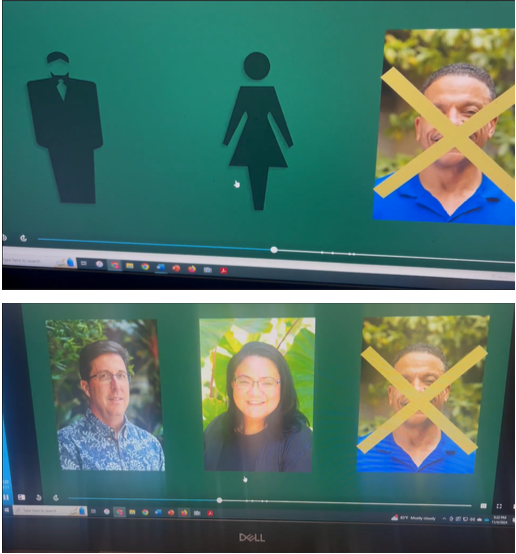
Roth said Lawson’s hypothetical shooting slide hadn’t violated any university policy. Still, UH changed Lawson’s material without his consent. The new image replaces photos of Mirkay and Nakamura with illustrations of a man and a woman but leaves the photo of Lawson as the victim.
The Foundation for Individual Rights and Expression says the change raises questions about whether the university really was trying to avoid triggering students.
“If the inclusion of the deans is ‘disturbing and harmful’ to students in Lawson’s class, why would the idea of their professor being shot not be equally or more ‘disturbing’?” the foundation wrote in its letter to UH.
Lawson told Nelson and Oliveira that he was initially willing to change the image but not after Nelson threatened him that the school would remove it if he didn’t comply.
“I won’t take kindly to threats,” Lawson told Nelson during their meeting.
Forcing UH faculty to change teaching materials that violate no law or policy based on anonymous complaints sets a bad precedent, Lawson told them.
“I’m not just fighting for me,” Lawson said. “I’m already out there, right? So, I mean, I might as well just go for broke. I’m going to stand up not just for myself, but other faculty members.”

