

Invasive Species In Hawaiʻi: Lawmakers Float New Plan As Urgency Mounts
Draft legislation proposes consolidating programs under a renamed Department of Agriculture and Biosecurity, but critics say the agency already has a spotty track record on invasive species.
A plan to tighten Hawaiʻi’s defenses against destructive invasive species would put a single person in charge of biosecurity at the harbor, airport and interisland hubs, according to draft legislation obtained by Civil Beat.
The proposal also calls for programs to be consolidated under a renamed Department of Agriculture and Biosecurity, reflecting increasing urgency in a state nicknamed the invasive species capital of the world. But the consolidation plan is a head-scratcher for some advocates, given the current department’s spotty track record for controlling invasive species.
“There’s far more to invasive species than just the agricultural sector,” said Franny Kinslow Brewer of Big Island Invasive Species Committee. “Just putting it all into one department — I don’t think that’s reflective of the nature of invasive species.”

Recent public outcry over the spread of coconut rhinoceros beetles, which kill palm trees, and a surge in stinging little fire ants caught lawmakers’ attention, resulting in a $10 million boost in funding for the department’s invasive species programs. That came years after invasive species groups said almost $30 million a year was needed to stem the tide of pests.
Sen. Donovan Dela Cruz, the powerful chair of the Senate Ways and Means Committee, expressed his frustration on Monday during a briefing with the Department of Land and Natural Resources and Hawaiʻi Invasive Species Council.
“I don’t think the current structure is working — it’s obviously not,” Dela Cruz said. “The current way of biosecurity is not working. Either you come up with something or we will.”
The 64-page draft proposal has not yet been filed and doesn’t have sponsors attached but suggests lawmakers have themselves come up with a potential fix, betting the agriculture department’s performance will improve with more personnel, programs and funding.
Most notably, the draft suggests moving the Hawaiʻi Invasive Species Council — created in 2003 to fill gaps in the department’s work on invasive species — into the new agriculture-biosecurity department. The council coordinates the 2017-2027 Hawaiʻi Interagency Biosecurity Plan.
Dela Cruz called the results of that interagency plan laughable at Monday’s briefing.
“Eight years of implementing and it’s getting worse,” he said. “The overall state strategy isn’t necessarily working. We might be winning some battles but we’re not winning the war.”
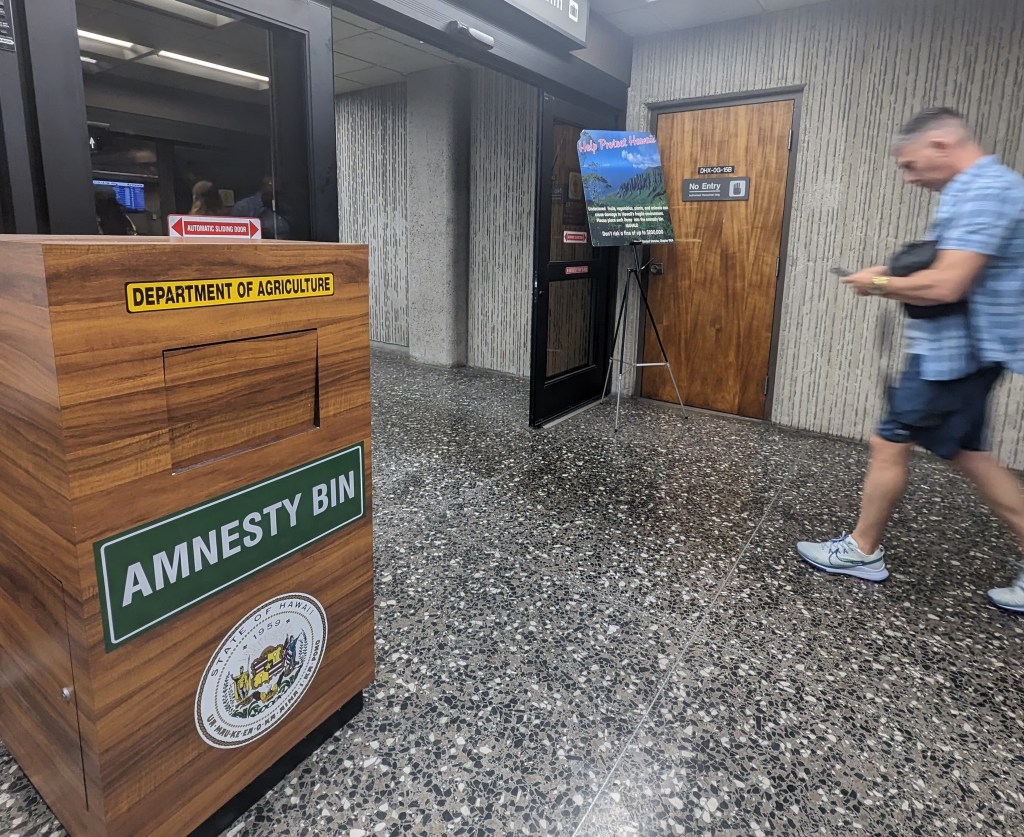
Critics of the draft consolidation proposal are concerned that moving the invasive species council into the agriculture department will narrow the state’s biosecurity scope, as invasive species impact community health, native species and the economy. Invasive grasses, for example, were partially blamed for stoking Hawaiʻi’s growing wildfire problem.
The invasive species committee is one of five across Hawaiʻi, all of which rely on funding from the council to mitigate pests’ impacts, such as a program to avoid cases of deadly rat lungworm infections, caused by a parasite on raw vegetables.
Those committees also fight invasive marine species, such as algae, all of which would be new to the agriculture department.
“It has to be an interagency approach. If anything I think biosecurity should be elevated to its own department and straddle all the agencies,” Kinslow Brewer said.
State agriculture director Sharon Hurd said in an interview that she is not opposed to the renaming of her department, or the increased responsibility as long as it comes with adequate funding.
Her department was criticized by lawmakers and others after it refused to name nurseries that were knowingly selling pest-infested products, including a landscaping company whose plants may have been to blame for temporarily shutting down Punahou Carnival’s plant sale.
“I think I share concerns with a number of folks, given the ag department’s failure to recognize the importance of biosecurity as illustrated by all of the issues with bad actor nurseries,” Sierra Club Hawaiʻi Chapter Director Wayne Tanaka said.
The department also is struggling to attract and keep staff, including in key leadership positions, often blaming the vacancies on a lack of state funding. The Plant Industry Division, which oversees the agency’s biosecurity work, has not had a permanent leader since the beginning of 2023.
The draft proposal was partly inspired by a recent trip by five legislators and representatives from four state departments to New Zealand, another island nation recognized worldwide for its biosecurity program.
The plan is yet to be introduced in the Legislature and is likely to face scrutiny from both House and Senate lawmakers. But Hawaiʻi Farm Bureau director Brian Miyamoto says it is proof that the legislature is prioritizing biosecurity.
“I don’t think anyone would disagree with me when I say things have been getting worse,” Miyamoto said. “We believe that (the Department of Agriculture) should be the tip of the spear.”
“Hawai‘i Grown” is funded in part by grants from the Stupski Foundation, Ulupono Fund at the Hawai‘i Community Foundation and the Frost Family Foundation.

