

Critic Of High Costs Of Tiny House Villages Quits Top Homelessness Post
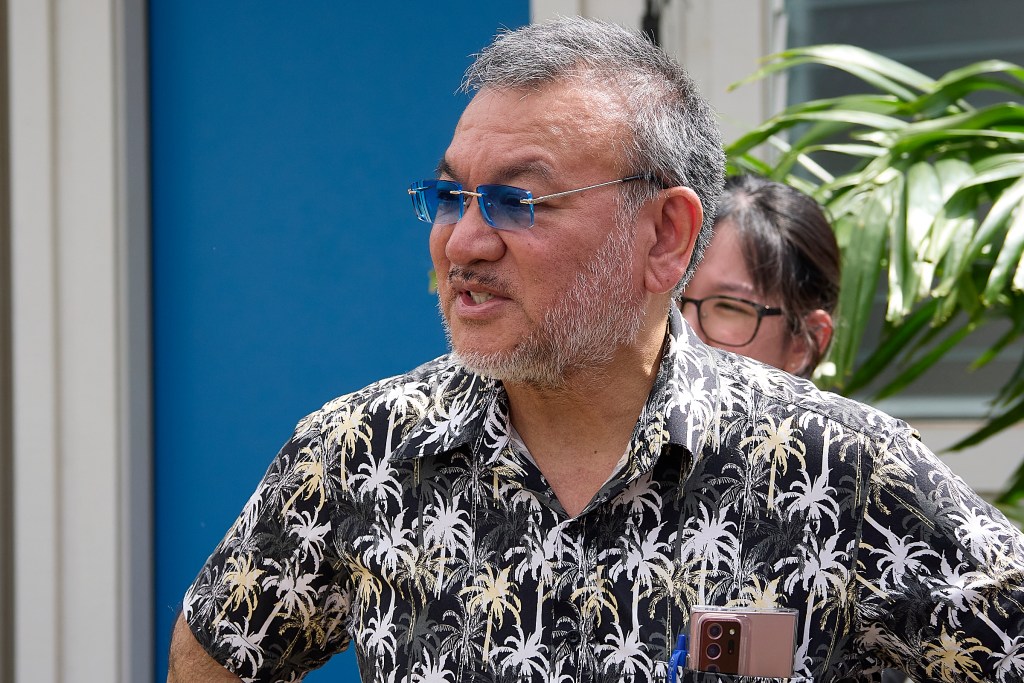
Former homeless director John Mizuno will become a special advisor in Gov. Josh Green’s administration.
The head of Hawaiʻi’s homelessness program, who publicly criticized excessive operating costs of some state-funded tiny home villages, has stepped down as the director of the Statewide Office on Homelessness and Housing Solutions.
John Mizuno, a longtime legislator, was the chief driver of Gov. Josh Green’s kauhale initiative for more than a year, bringing more than a dozen tiny home villages online in the past 15 months.
But Mizuno earlier this month drew attention to the high operating costs of kauhale that opened in urban areas before being connected to electric and sewage systems. In one instance, a village of 20 shed-sized shelters paid $21,000 in one month for electricity provided by diesel generators. Overall monthly costs at the village located on Middle Street in Honolulu topped $8,600 per month per person, an independent evaluation found.
Green at the time defended the off-grid kauhale, saying it was much less expensive and far more humane to house people in the villages than allowing them to live on the street. The governor also noted that only two of the 18 kauhale currently open are off-grid.
He said opening villages off the grid is “merely a bridge to the larger goal of providing housing to get our homeless neighbors off the street, into stability and embraced with wrap-around services.”
On Tuesday, Green announced that Mizuno would be replaced by Jun Yang, who most recently worked as the homeless coordinator for the state Department of Transportation. Yang also has served as executive director of the Honolulu Mayor’s Office of Housing.
A news release from Green’s office said Mizuno will assume a new role in the administration. Mizuno did not respond to a request for comment.
“I am extremely excited with the new role of Special Advisor on homelessness as this new role will allow me to be more hands-on, working directly with homeless families and individuals along with working to reunite the homeless with their families,” Mizuno said in the news release. “I look forward to my new role.”
Green declined an interview request.
The abrupt change in leadership comes at a critical time for the governor’s kauhale program.
Green ran for governor on a promise to address Hawaiʻi’s housing crisis, and soon after taking office he declared a state emergency on homelessness in 2023. Green’s Kauhale Initiative is a central component of his homelessness plan, designed to help the state’s most vulnerable residents. The endeavor calls for creating “affordable spaces for housing and healing our people, through intentional ‘kauhale’ design and operation.”
Green hopes Hawaiʻi can increase the number of kauhale — which typically have about 40 homes — to 30 by 2026, he said in his State of the State speech in January.
The state’s 2024 point-in-time count tallied 6,389 people experiencing homelessness in Hawaiʻi, with 4,494 on Oʻahu, according to a House bill introduced this session to support the kauhale initiative.
Bill Would Require At Least Two Bids
Under Green’s emergency proclamation, Hawaiʻi waived competitive bidding to build the kauhale and has gone with a sole-source development contractor, HomeAid Hawaiʻi.
Green requested $50 million from the Legislature for the kauhale program this session, but it’s unclear whether lawmakers will be able to provide that much, said Rep. Luke Evslin, chair of the House Committee on Housing. He noted that the Trump administration’s cuts to federal programs have created uncertainty for state budgets.
“Things are in flux given the state of the federal government,” he said.
As a result, the $50 million request in Green’s original bill has been blanked out, a common practice as proposals work their way through the legislative process. But lawmakers have made substantive amendments to strengthen accountability to the kauhale program. For example, the measure now requires at least two bidders for any kauhale estimated to cost the state over $1 million.
Evslin said the housing committee added that requirement based on testimony by Mizuno. He acknowledged that requiring at least two bids could slow down a project if only one bidder steps up, but the requirement would ensure the state got a good deal.
“It’s reasonable that we can expect to get at least two bids for a project,” Evslin said.
Yang marks Green’s third homeless coordinator in three years, following James Koshiba, who served until January 2024, when Mizuno took over.

