Few Property Sales, High Prices in Lahaina As Victims Try To Recoup Losses
Sales have increased in recent months, but real estate agents say sellers of burned-down homes have no other choice.
Nearly a year and a half after a wildfire destroyed more than a thousand homes in Lahaina, sales of burned properties have increased as some people decide they can’t bear the emotional toll of rebuilding or simply don’t have the money to do so.
But the number of sales is small compared to how many homes were destroyed, real estate agents said. Some people who have put their burned lots on the market have set prices well above what the land alone was assessed for a few years ago.
Many property owners believe that if they must sell, they’re not going to “just give it away,” said Tyler Coons, a real estate agent who has lived and worked in Lahaina for decades. “Everybody’s still very emotionally tied to their property and doesn’t want to take less than they could possibly get.”
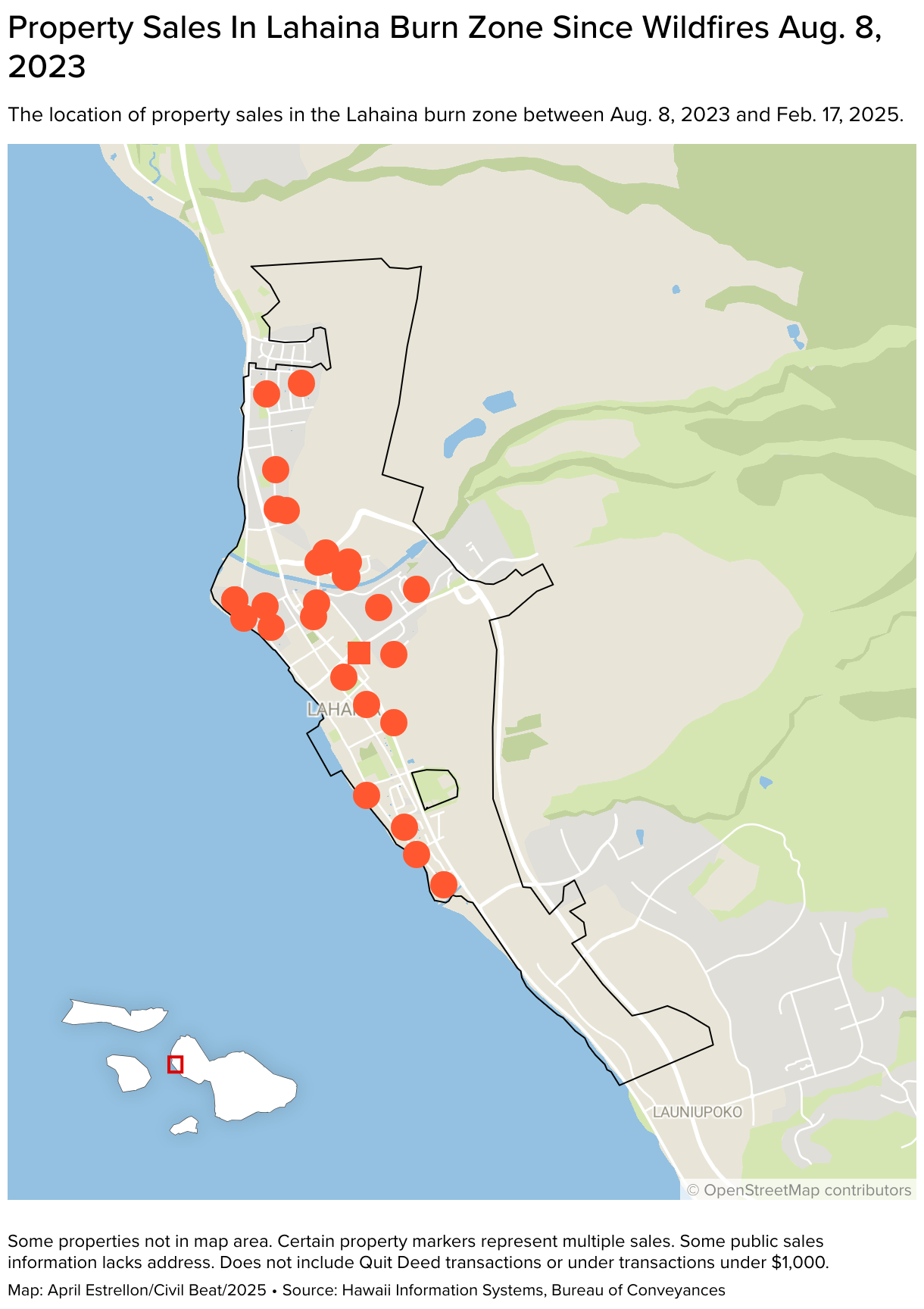
There have been more property sales in Lahaina overall in the past seven months than there were in the year after the fire, according to real estate records. About two dozen properties that burned down have been sold since the fire; of those, 19 sales have occurred in the past seven months. Many appear to be transactions between family members, friends or neighbors. (Those figures do not include deed transfers for little or no money, which are often used to shift ownership among relatives.)

Real estate agents said few people have put their properties on the market. As of last week there were only a handful of burned lots for sale in Lahaina.
Even before the fire, residential properties in historic Lahaina were rarely put on the market, real estate agents said. Extended families often shared homes, and properties were passed down to younger generations over the years.
And when people have listed vacant lots, they’ve often asked for more money than the land alone was valued at before the fire, according to Coons and county tax records. One lot is listed for $800,000; in 2023, the land alone was assessed at $325,200, according to county tax records. Another plot of land listed for $599,000 had an assessed value of $339,500 in 2023. A third was assessed at $482,500 in 2023; it’s listed for $625,000.
Prices Based On What Sellers Need to Recover
Susan DeLoria, a real estate agent in Lahaina, said sellers are setting prices after taking into account all that they’ve been through and what they would need to be financially secure in the future.
“It’s truly a reflection of, ’This is what we had, this is what we’ve been paid out from our insurance, and this is what we need going forward,’” she said.
Most potential buyers haven’t been willing to pay what sellers want, Coons said. Between the elevated asking prices, the high cost of construction and uncertainty about when and how Lahaina will be rebuilt, land in the burn zone is not a good investment, he said.
“I don’t see any smart person saying, ‘I want to own a home in the burn zone today for maximum dollar,” Coons said. “It doesn’t make any sense because of the high cost of building. … The only way that could happen that could maybe make sense is if you were literally building the home yourself. Literally.”
“I think as those (housing) programs start to run out, then people are going to be put in a bind of whether they can afford to hold on to an asset that’s not livable for the next, potentially multiple years.”
Justin Tyndall, University of Hawaii Economic Research Organization
Justin Tyndall, an assistant professor of economics with the University of Hawaii Economic Research Organization, said the fact that so few people have sold their land may be a sign that many of those who lost their homes have been able to find temporary housing through federal and state programs. So far, they’ve been able to get by while hanging onto their land.
“But I think as those programs start to run out, then people are going to be put in a bind of whether they can afford to hold on to an asset that’s not livable for the next, potentially multiple years,” he said.
‘Heartbreaking’ Decision To Sell
Don and Andrea LaCaze said they decided to sell their property after they took stock of their finances.
They had been in Lahaina since the mid-2000s, in a three-bedroom, two-story house that was nestled in a lush yard full of fruit trees. Over time, they paid off the mortgage with income from renting out a portion of the house.

The morning after the fire, Don LaCaze, 69, returned to find the neighborhood leveled and the street littered with dead cats, dogs and birds. “I just broke down crying because it was so devastating. Everything we had in the world was in that house,” he said. “Our whole retirement was just that. That was it.”
At first they hoped to rebuild, but their insurance payout wouldn’t come close to covering the cost. They struggled to find temporary housing that would allow their dogs, Bear and Luke. After a few months, they gave their chicken Molly to a friend in Kula and moved in with Don LaCaze’s sister in California. They’ve since settled near family in North Carolina.
Deciding to sell the land where their home once stood was “heartbreaking,” said Andrea LaCaze, 59, but it’s necessary in order to recoup even a fraction of what they lost.
In the fall, they put the property up for sale, asking $680,000 for the lot. In 2023, the lot alone had an assessed value of $401,400, according to county tax records.
“I know we priced it a little high, but we know people are going to want to cut us down,” Don LaCaze said. “It gives people wiggle room.”
A few buyers have put in offers, but the couple said they have been so low they didn’t even consider them.
The LaCazes said they are trying to deal with the psychological scars left by the fire, find jobs and adjust to their new life on the mainland.
Andrea LaCaze said she’ll be sad when they eventually sell the property, but also relieved.
“Because it’s finally over and maybe we will be able to move forward,” she said. “It’s a lost dream.”