

Sea Anemones Invade Kāne‘ohe Bay, Likely From Home Aquariums
A new invasive species threatens Kāneʻohe Bay’s fragile coral ecosystem, sending state officials scrambling for a solution.
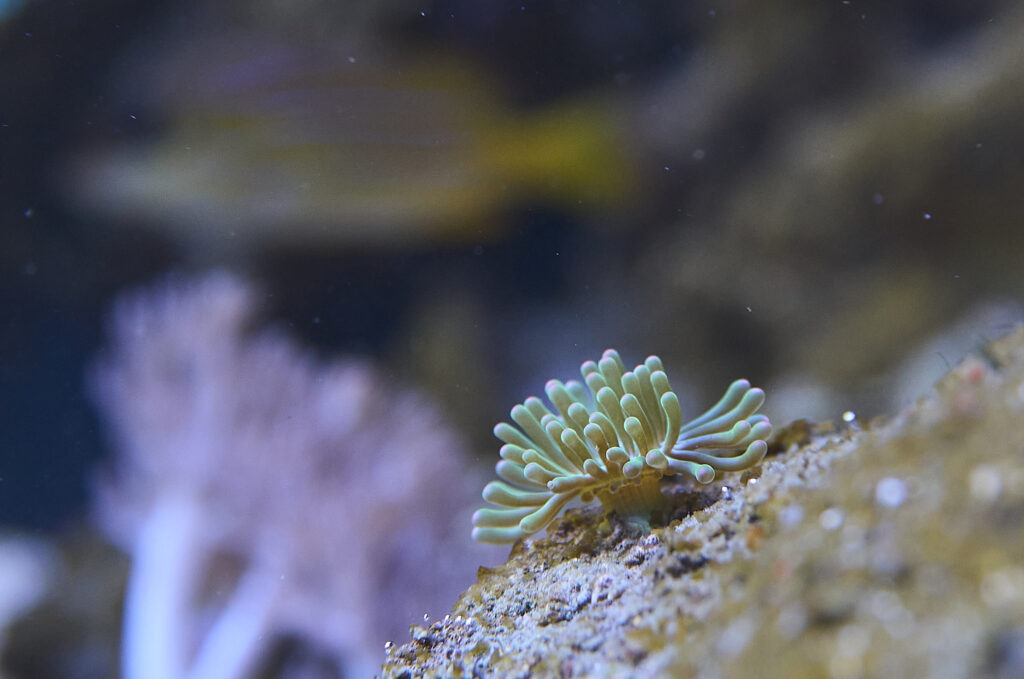
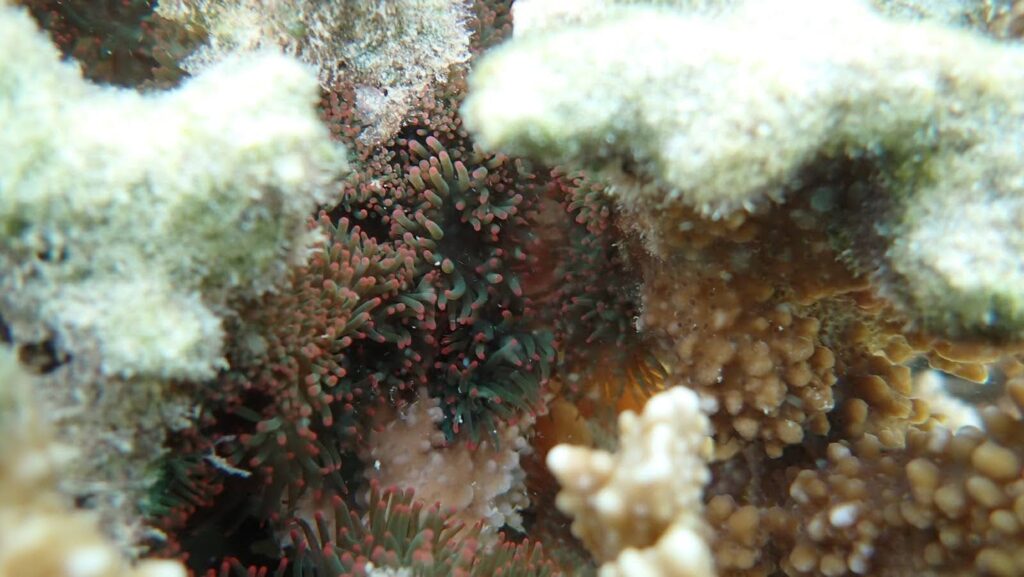
For most home aquarium enthusiasts, the majano anemone is an invasive pest to avoid getting in their tanks at all costs.
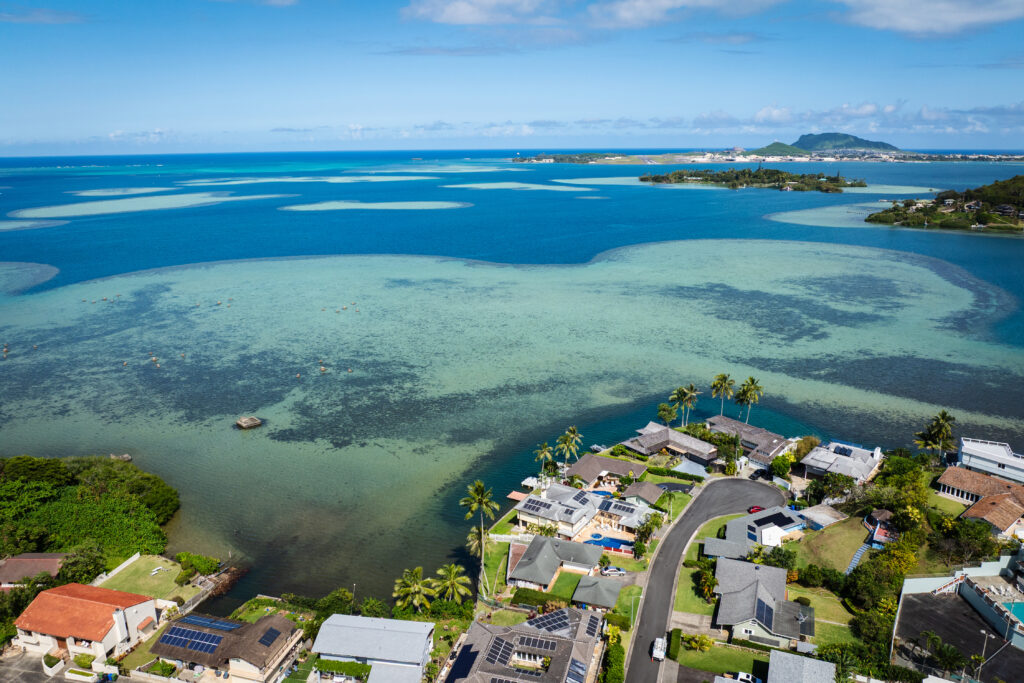
Now, the worrisome critters are loose in Oʻahu’s Kāneʻohe Bay.
They likely got there, experts say, as part of illegal coral plantings meant to cash in on the nation’s growing aquarium-hobby fix.
So far, they’ve managed to cover a 950-square-yard swath of reef in just a few years. If left unchecked, researchers say, the majano could soon overrun much of the bay’s fragile, imperiled coral ecosystem.
“It would be the worst thing ever if majano were to spread to another reef because it makes it that much harder to manage it,” said Hiʻilei Kawelo, executive director of the nonprofit Paepae o Heʻeia, which stewards the Heʻeia fishpond in Kāneʻohe Bay.
“At a certain point, if it spreads too far, then it becomes unmanageable.”
State conservation officials have a plan to eradicate the majano before they overtake those Windward waters and beyond, and legislation is moving forward to devote some $200,000 toward that effort.
The earliest that workers might start is late this summer, aquatic invasive species biologist Jesse Boord said, and that’s in a best-case scenario where the funding’s awarded and the permitting process goes smoothly.
The situation, Boord added, is “incredibly urgent.” Every passing day, he said, is another chance for the majano to spread to a new reef and, ultimately, to areas outside Kāne‘ohe Bay. The pest has separately arrived in part of Pearl Harbor, through a different infestation than Kāne‘ohe.
Aquarium hobbyists try to avoid the majano because they can rapidly overtake their entire tank, and as invasive species they pose similar threats in the wild. The individual creatures, researchers say, are capable of detaching from one location and moving to another. They can swiftly overwhelm and smother the native coral.
Oʻahu’s growing majano problem, Kawelo and other local biologists say, shows just how hard it can be to contain invasive species once they take hold in the water, compared to those found on land.
But here in Hawaiʻi, often referred to as the invasive species capital of the world, the state aims to stamp out the Kāneʻohe Bay outbreak by covering the infestation with tarps and pumping the covered area with chlorine.
The plan was developed, officials and community members say, over a series of meetings held with Coconut Island-based researchers at the University of Hawaiʻi’s Hawaiʻi Institute of Marine Biology, as well as community groups and other public officials.
If deployed, the plan would kill various coral and other native species along with the majano. Boord, who’s with the state Division of Aquatic Resources, said the cost of doing nothing would be far greater.
The anemone has the potential to take over Kāneʻohe Bay, Boord said, so “you kind of have to sacrifice this very small bit to save it.”
From Local Reefs To Aquariums Abroad
The same qualities that make anemones such as the majano amazing, says Waikīkī Aquarium curator Tony McEwan, are also what make it so difficult to get rid of them.
“If you break it off and squash it,” McEwan said, “every little cell can grow into another animal.”
They’re hermaphroditic, so they reproduce and spread on their own. And when threatened, they shoot spores that spew more anemones into the environment.
However, the majano are native to the Indian Ocean and have no natural predators in Hawaiʻi. The critters’ Kāne‘ohe Bay footprint, Boord said, could expand by around 10% to 20% by year’s end.
They also find a home in home aquariums, and interest in that hobby has skyrocketed recently in the U.S., invasive species officials say. That’s had profound consequences for Hawaiʻi.
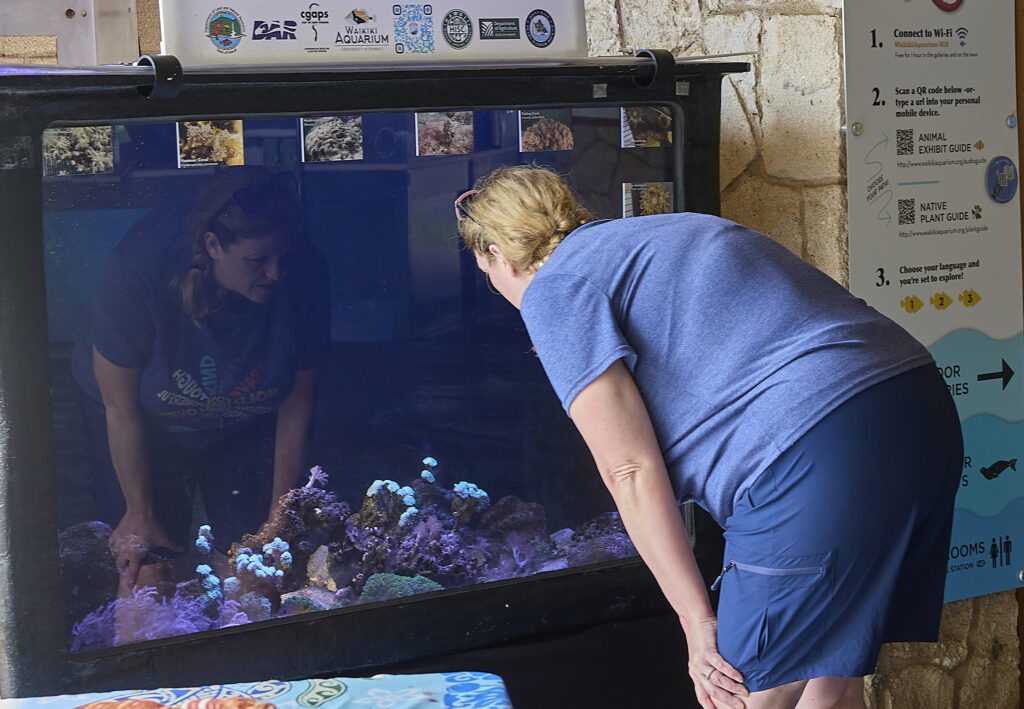
The U.S. aquarium industry was valued at $2.2 billion last year, and, according to Hawaiʻi invasive species expert Christy Martin, the nation has become the world’s largest consumer of marine aquarium species.
Martin is the program manager for Hawaiʻi’s Coordinating Group on Alien Pest Species, which helps keep local agencies on the same page as they fight those species. She said much of the aquariums’ popularity grew during the Covid pandemic when people were stuck at home.
The popularity of home aquariums has also apparently driven a demand for black-market coral, used as decorations in the tanks. In reefs across Hawaiʻi, Puerto Rico and other tropical regions, people illegally plant invasive coral, which they can then harvest and sell to hobbyists, federal officials say.
Martin described the practice as fragging, where fragments of illegal coral are broken off from those secret spots and re-sold typically in online chat boards and private groups. Sometimes, the invasive coral that’s planted can contain undesired hitchhikers, such as anemones.
That becomes an invasive species problem when aquarium hobbyists also simply release their tanks’ contents into the ocean. In 2023, a species of invasive pulse coral was found across 80 acres in Pearl Harbor, according to a report by the U.S. Invasive Species Advisory Committee, even though it’s illegal to possess that coral in Hawaiʻi. The report said that coral was likely released from a home aquarium.
Effective methods to detect and respond to those marine invasive species set loose in nearshore waters, the committee added, are “critically lacking.”
U.S. Customs officials often catch illegal coral shipments, Martin says, but she believes those interceptions are just the “tip of the iceberg” of what’s being trafficked from Hawaiʻi via fragging.
“How are we supposed to monitor all reefs everywhere?” she said.
A ‘Funny-Looking’ Coral
In 2020, Kawelo’s father, who has spent his life fishing in Kāneʻohe Bay, noticed a beautiful yet unusual coral he had never seen there before. He alerted Kawelo and her sister, both of whom are biologists.
“It was kind of like in passing,” Kawelo recalled of her father’s alert. “‘Oh yeah, I forgot to tell you — there’s this really funny-looking coral out on the reef.’”
“For somebody who’s 80 years old (and) looking in the water his whole life, if something stands out, it was pretty easy for him to identify that it’s not normal,” Kawelo said. The family took photos of the coral and sent them to nearby University of Hawaiʻi researchers.
Eventually, state and federal officials found three species of invasive Montipora coral. The invasive coral colonies, Martin said, were situated in an area that doesn’t get a lot of visitors. It has fairly shallow waters with exposure to sunlight that’s ideal for growing.
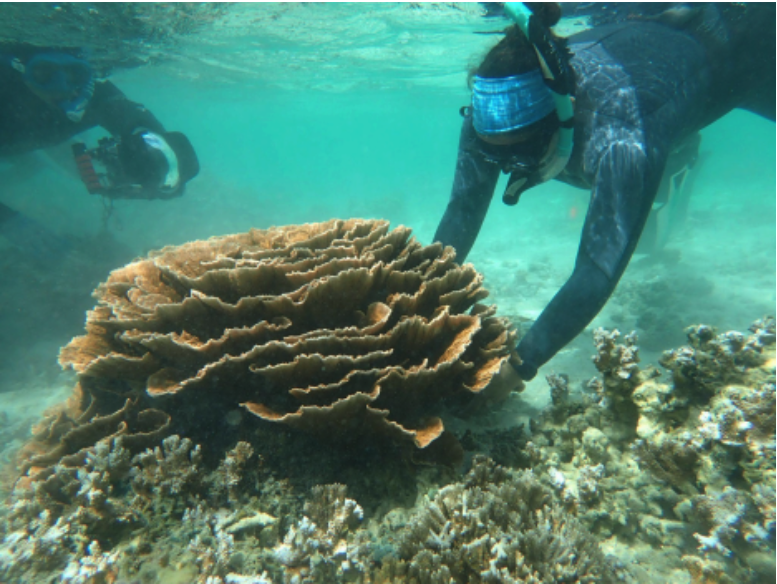
The state Aquatic Resources division won’t divulge the specific spot because they don’t want to tip off others looking to plant coral in the bay, but invasive species biologist Boord said the corals were obviously deliberately planted there.
Small majano anemone were found in the branches of the invasive Montipora, Martin said — a sure sign that the coral must have come from an aquarium.
The state uprooted the corals and majano, then monitored the removal site over the following days, weeks and months.
Then, this past October, the majano were found there again.
The affected area is very rugged and layered, Boord said. “There’s a lot of holes, lots of pukas, lots of branching corals, rock, algae — all that.”
“Some of these anemones can go unseen very easily,” he added. “It’s definitely likely that happened in our first removal.”
Now, the state is in a race against time to stop the pesky majano from spawning further.
‘Nuking’ The Tank
Aquarium hobbyists typically use custom wands and scrapers to meticulously scrape off each individual majano anemone in their tanks at home. Even then, many have to “basically nuke” their tanks and eliminate everything inside them, Boord said, to get rid of the pests.
To do it on a larger scale is even more difficult.
“You can’t scrape them off,” wildlife disease specialist Thierry Work says. “If you scrape them off, you just create more more organisms because all those little pieces become new animals.”
Work, a Honolulu-based project leader with the National Wildlife Health Center, has pioneered various control techniques for invasive species, including methods that douse those organisms with hot water. Ultimately, he agrees that chlorination is among the most effective treatments available.
“One of the big problems with invasive species is everyone throws up their hands, right? They go, ‘Well, the cat’s out of the bag. We can’t do anything. It’s a marine environment. Everything’s connected,'” Work said. “We were just trying to break that paradigm.”
Kāneʻohe isn’t the only area on Oʻahu affected by majano, either. It’s been found in Pearl Harbor in an area that Martin said is not far from Navy housing and a publicly accessible waterfront area.
The majano likely got there via an illegal aquarium-dump, Navy Region Hawaiʻi Conservation Manager Nicole Olmstead said in an email. The Navy doesn’t know the extent of the impact there, Olmstead said, but it has awarded a contract to try to eradicate the anemone from an area around Ford Island.
Martin said the military will have to spend significant money and devote year-round work to get the job done.
In the meantime, the state is hoping the anemone doesn’t hitch a ride to yet another part of the island.
The state needs reach out more to fishers and other people who use the bay about the majano situation, Kawelo said, because they are “the eyes and ears of the resource — of the ‘āina (land) and kai (sea), and it makes all the sense in the world” to partner with them to monitor for any new appearances.
“To their credit,” Kawelo added, DAR is “making every effort to do that.”
But fishers and others using the bay could also risk cross-contaminating other parts of the island with the wily anemone, which means DAR hopes people will steer clear of the contamination area.
“Ideally it would be quarantined but that’s not necessarily something that we can do, just go put this barrier up,” Boord said.
Civil Beat’s coverage of climate change is supported by The Healy Foundation, Marisla Fund of the Hawaiʻi Community Foundation and the Frost Family Foundation.
CORRECTION: In a caption, a previous version of this story misstated how the invasive species likely spread in Kāneʻohe Bay in 2020. In fact, the anemone spread by itself.


