

Ravenous Beetles Go Urban, Preying On Honolulu’s Iconic Coconut Palms
Fallout from the scarab beetles’ invasion into urban Honolulu remains unknown, but the damage so far is “pretty bad,” according to one expert.
UPDATE: This story has been updated to include a response from the city of Honolulu.
Urban Honolulu has been hit by tree-killing coconut rhinoceros beetles, renewing concerns about what would remain of the tropical cityscape if the ravenous pests chew their way through the coastline.
The city previously was thought to be immune to the beetles’ effects despite widespread destruction statewide, including on Oʻahu’s North Shore. University of Hawaiʻi Agrosecurity Laboratory chief Mike Melzer called the recent damage a “wake-up call” for the city and its major landowners.
Following a tip to Civil Beat, Melzer and his laboratory’s Coconut Rhinoceros Beetle Response team last week found old and new wounds on freshly planted and established palms in and around the Victoria Place condominium complex near Ala Moana Beach Park. The location poses a threat to Waikīkī Beach, less than two miles away and within the beetles’ daily range of flight.
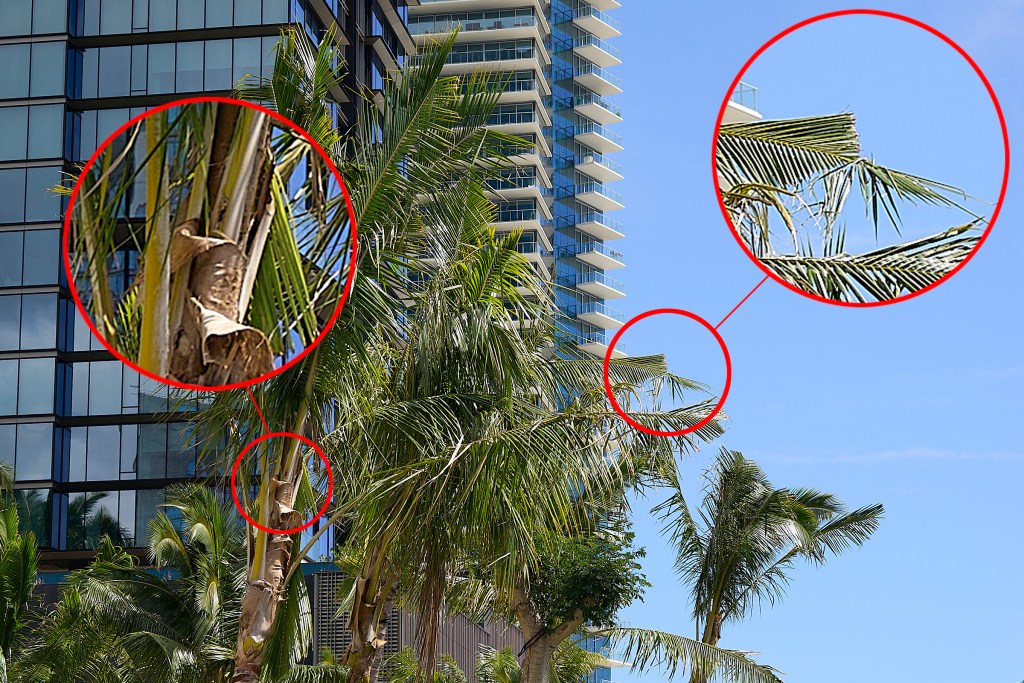
Officials have long dreaded the idea of the beetle breaching the urban core for fear the palm-studded cityscape would be irreversibly transformed, potentially affecting tourism.
The state and counties have invested millions of dollars to control the pest, though invasive species specialists have suggested it was too little, too late, especially to contend with a pest dealing catastrophic damage to palm populations across the Pacific.
Christy Martin, program manager for Hawaiʻi’s Coordinating Group on Alien Pest Species, said the destructive beetles were bound to reach Honolulu sooner or later.
“In my mind it was going to be inevitable,” she said. “There was nothing keeping them from going after those trees except that they hadn’t been carried there to start a large enough population yet.”
The beetle was first officially detected on Oʻahu in late 2013 at Joint Base Pearl Harbor-Hickam but was contained on the island for almost a decade. Two years ago, however, invasive species experts declared eradication on Oʻahu impossible and in October, Honolulu City and County started felling 80 dead and dying trees on the North Shore because they were a risk to public safety.
“We’re a little bit in uncharted territory here.”
Keith Weiser, CRB Response Deputy Incident Commander
Yet Honolulu has not been a major concern for infestations because the urban landscape generally lacks the rotting logs, compost and green waste preferred by breeding beetles. Still, the city’s palm-lined streets and beaches provide plenty of fodder that Melzer thinks the city and landowners should be quick to protect.
“Now we know it is a threat,” Melzer said. “Some of the palms … they’re pretty bad.”
The city could not be reached on Monday, as staff observed Presidents’ Day. On Tuesday, Honolulu Parks Department spokesman Nate Serota said that although the damaged trees are not on city land and not under its jurisdiction, their proximity to Ala Moana Beach Park is particularly concerning. It is among the most popular parks in the state and hosts hundreds of vulnerable trees, he added in an email.
The city has responded to the island-wide infestations by prohibiting new palms from being planted along roadways and discouraging new landscaping projects from including the trees, among other things. But Serota said “one of the unfortunate truths” about CRB is that “while jurisdiction matters to us, the beetles don’t care.”
Previous Detections, New Construction
The Ward Village damage follows four beetle detections in the vicinity of Ward Village and Kakaʻako since September, caught in traps monitored by Melzer’s team.
The team had had “almost no finds east of the airport for many years,” Deputy Incident Commander Keith Weiser said, following successful eradication efforts around Kalihi, Sand Island and Joint Base Pearl Harbor-Hickam in 2014.
Development in Ward Village could be partly to blame for the detections and damage, as landscaping there continues. Palms have been planted near the footbridge over Ala Moana Boulevard, which is still under construction.
Beetles could have hitchhiked to the area on the trees from nurseries around Oʻahu. The palms show signs of both new and old damage.
“Some of the catches that we have could be coming out of those trees,” Weiser said. “It’s a little bit unclear how serious the problem is going to get in town… but the damage has been moderate so far. We’re a little bit in uncharted territory here.”

Weiser is “moderately worried” about the detections and surrounding trees. He added that without treatment, the trees may recover “or they might establish a new breeding site in Ala Moana Beach Park and we’d see new damage.”
Both Weiser and Melzer recommend landowners or the city apply a fly spray-like pyrethroid pesticide to the palms’ crowns to get rid of the problem early. The treatments, Weiser said, would pose minimal public health risk.
‘They’re Almost Like Termites’ Now
The UH CRB Response team will not be responding to the potential infestation on Oʻahu due to federal funding restrictions, which limits the team to eradication work on Kauaʻi, Maui and the Big Island.
“We get 60 calls a day of people asking for help and we just can’t do that,” Melzer said. “We have to be a bit more judicious about where we do our work. I hate saying it but it’s become a reality.”
Whether or not the state Department of Agriculture is responsible for dealing with such damage is unclear, since the damaged trees are on private land.
Last year, the state invested $10 million in programs to better control invasive pests, including $1.2 million for the coconut rhinoceros beetles — money lawmakers have said the state agriculture department has failed to spend properly or effectively.
Landowners “understand that when they plant these palms, there’s always going to be ongoing costs.”
Kakaʻako-Ward Rep. Kim Coco Iwamoto
The beetle problem is so bad now across Hawaiʻi that “they’re almost like termites,” shifting the burden of the response to landowners, Melzer said. Of the recent Ala Moana sighting, Kakaʻako-Ward Rep. Kim Coco Iwamoto said the landowners should step up.
“They understand that when they plant these palms, there’s always going to be ongoing costs,” she added.
Lawmakers, including Iwamoto, this year introduced a set of bills — Senate Bill 686 and House Bill 643 — that would inject at least $625,000 into the the CRB Response team’s research and response to beetles statewide, including by adding staff.

More attention and funding is needed, according to Christy Martin, the invasive species expert and advocate. She believes there is sufficient habitat for the beetles in town, whether they bed down in Ala Moana or head to the greener outskirts of the urban core.
“Eventually we’re going to see these beetles move into those last remaining habitats, those last remaining trees,” she said. “We haven’t seen the end of their spread yet.”
“Hawai‘i Grown” is funded in part by grants from the Stupski Foundation, Ulupono Fund at the Hawai‘i Community Foundation and the Frost Family Foundation.

