Costco ‘Pineapple Wars’ Pit Kauaʻi Business Owners Against Each Other
On the Garden Isle, an essential ingredient to the Mai Tai, lūʻaus and many local dishes is in short supply, driving businesses to buy out Costco’s weekly supply in minutes.
Twice a week Malia Stewart lines up early outside the Līhuʻe Costco and scrambles to score as many crates of pineapple as she can when the doors roll open at 10 a.m. She described the morning ritual as a competitive sport where her opponents are smoothie shop owners and entrepreneurs with roadside fruit stands.
The store sometimes sells out of the iconic tropical fruit in minutes.
“It’s pineapple wars,” said Stewart, who helps her dad run Uncle Mikey’s Dried Fruit.

The amount of fruit farmed at Dole Food Company Hawaiʻi, the state’s most prolific pineapple producer, dropped in recent years after the company shrunk its footprint and decided to phase out its export business. On Kauaʻi, this has left business owners like Stewart, who depend on the fruit’s sweet, yellow flesh, in a bind.
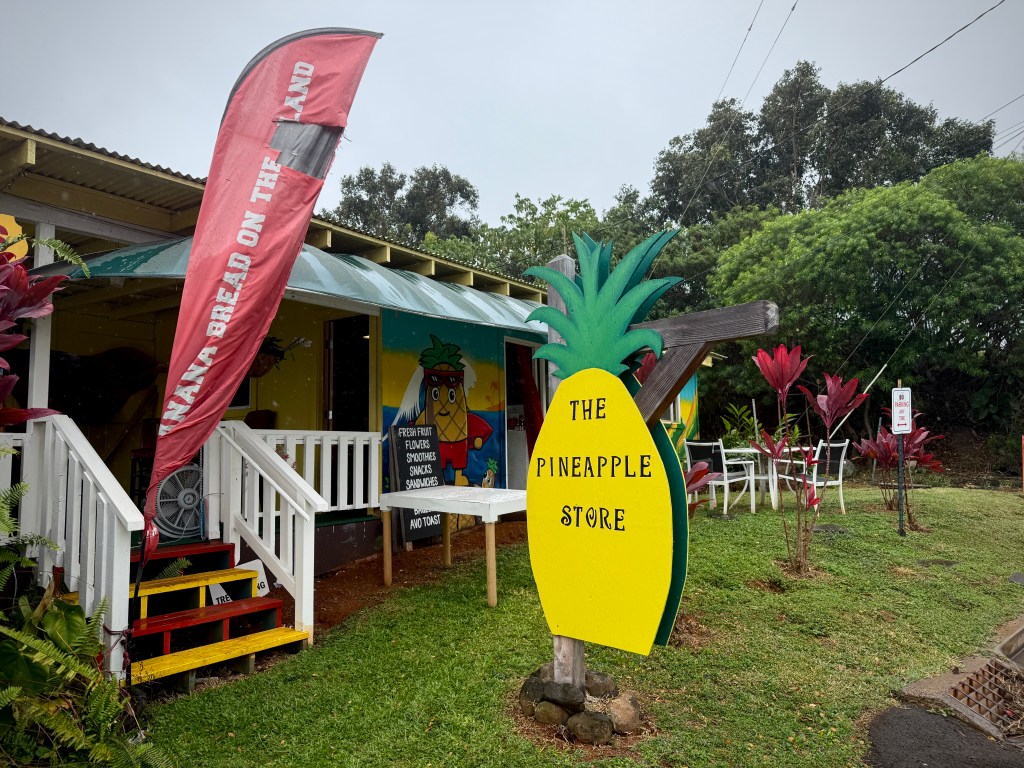
“We’re The Pineapple Store and we don’t have any pineapples,” The Pineapple Store owner Christian Marston said. “It’s embarrassing.”
Both souvenir and pantry staple, pineapple bridges the real Hawai‘i and the one that’s airbrushed for tourism. Pineapple is an essential Mai Tai ingredient. At a lūʻau it’s often as ubiquitous as the pig. And at The Pineapple Store, it is the singular reason why customers come in.
“We’re The Pineapple Store and we don’t have any pineapples. It’s embarrassing.”
Christian Marston, The Pineapple Store owner
Since the early 1990s, the sunny yellow roadside shanty two miles north of Kauaʻi’s Līhuʻe Airport has steered traffic to a tourist honeypot that unapologetically sells pineapple-themed dish towels, earrings, refrigerator magnets and — the star attraction — fresh, whole pineapple that ships to the mainland in pairs for $141.
The shop’s all-in business model worked for more than three decades. But recently its single-minded focus has hit a bit of a snag: The store has run out of the fruit more than once in the last year, forcing the manager to refund orders.

There are still plenty of pineapples, Dole Hawaiʻi General Manager Dan Nellis said, but not enough of the large-sized fruit favored by the big box retailers that function as a wholesaler for small island businesses.
“We really spoiled the local market in the old days because we grew way more fruit than we needed and we could say, ‘Don’t send any of the big fruit to the mainland,’” Nellis said. “Yes, we made our plantation smaller, but there isn’t a shortage of pineapple. It’s the size distribution that isn’t always the right fit.”
Esaki’s Produce owner Earl Kashiwagi said he typically imports 2,000 cases of Dole Hawaiʻi pineapple a week to Kauaʻi. Half of them go to Costco. But in recent months he has scrambled to come up with 300 or 400 cases for Costco’s standard 1,000-case order.
“We can’t tell a big hotel that we ain’t got pineapple. On Kauaʻi, that’s like saying we don’t have drinking water.”
Earl Kashiwagi, Esaki Produce owner
Dole Hawaiʻi harvests pineapple weekly and some weeks the large fruit that makes its way on the barge to Kauaʻi is more plentiful than others. When supply is short, Kashiwagi said he ensures all his customers — Walmart, Target, Foodland, Safeway, hotels and a slew of small businesses — get some of the harvest, even when that means everyone comes up short.
“We can’t tell a big hotel that we ain’t got pineapple,” Kashiwagi said. “On Kauaʻi, that’s like saying we don’t have drinking water.”
Hawaiʻi Just Can’t Compete
Pineapple is a summertime fruit. Unlike the state’s smaller growers, Dole Hawaiʻi uses a plant hormone that induces flowering to encourage a year-round harvest in storied fields that date to the company’s 1901 origins.
Dole Hawaiʻi historically planted a crop far in excess of local demand, sending roughly half its harvest to the U.S. mainland. But the company can no longer compete against the low-wage-paying Central American producers that dominate the produce aisles of mainland supermarkets.
Output from Dole’s fields on Oʻahu varies week to week. So does fruit size. Costco, Walmart and other major retailers only want five-pound fruit, Nellis said. Sometimes there’s enough, sometimes there isn’t.
A handful of local business owners interviewed for this story did not want their names published because they don’t want to advertise that they sometimes source pineapple from a big box retailer instead of directly from local farmers. Others said they worried that Esaki’s Produce would not be happy to learn they were buying their pineapple from Costco.
Costco sells pineapple by the case for $3.99 per fruit. Each case has five or six fruit. Esaki’s charges $1 per pound, except for when bad weather delays Dole Hawaiʻi harvest from making it onto the Kauaʻi-bound Young Brothers barge. When this happens, Esaki’s ships its pineapple to Kauaʻi by air cargo, hiking the price from $1 to $5 per pound. That can push the price of a five-pound pineapple to $25.
The price at Costco, however, never waivers, making it the economical choice for small and mid-size businesses that depend on pineapple.
“Esaki’s even told me to get it at Costco because it’s cheaper,” The Pineapple Store manager Kristin Bisarra said.
Hawaiʻi was once home to the world’s most productive pineapple plantation. When cheap labor in Asia usurped Hawaiian pineapple farming in the early 1990s, the endless rows of spiky fruit that carpeted many of the islands disappeared or shrunk. Today the state’s pineapple is primarily grown on Oʻahu and Maui.
A $48 Pineapple?
On Kauaʻi, a number of small farms produce the fruit in relatively low quantities.
Kauaʻi pineapple grower Patrick Abbott said local businesses in the juice and smoothie market have pleaded with him to develop an off-season crop of the fruit. He briefly experimented with growing winter pineapples but ultimately gave it up. Forcing the pineapple to flower early, he said, reduces the sugar content and alters the flavor.
“The results were disappointing and, besides, we don’t like to chase the tourist market,” said Abbott, who produces an annual harvest of about 10,000 fruits ready to pick in June, July and August.
Abbott grows a unique variety of pineapple developed by the University of Hawaiʻi at Mānoa. It shares the fleshy, yellow fruit of the pineapple grown by Dole Hawaiʻi, but it tastes sweeter. And its less acidic than sugarloaf pineapple, which has white flesh and tends to fetch a much higher price than yellow pineapple.
Private chef Leo Antunez said he recently paid $48 at a Kīlauea grocery store for a single sugarloaf pineapple. He made the purchase for a high-end client, he said — who didn’t blink.
“Hawai‘i Grown” is funded in part by grants from the Stupski Foundation, Ulupono Fund at the Hawai‘i Community Foundation and the Frost Family Foundation.