Kaua‘i Helicopter Company Wants New Flight Rules Amid Public Opposition
Blue Hawaiian has petitioned federal regulators for a rule change but community members, worried about safety and noise, say they need more time to study the proposal.
A cloud of confusion and a deficit of public awareness around a Kauaʻi helicopter tour operator’s petition for a flight rules waiver from the Federal Aviation Administration has brought community members out in opposition.
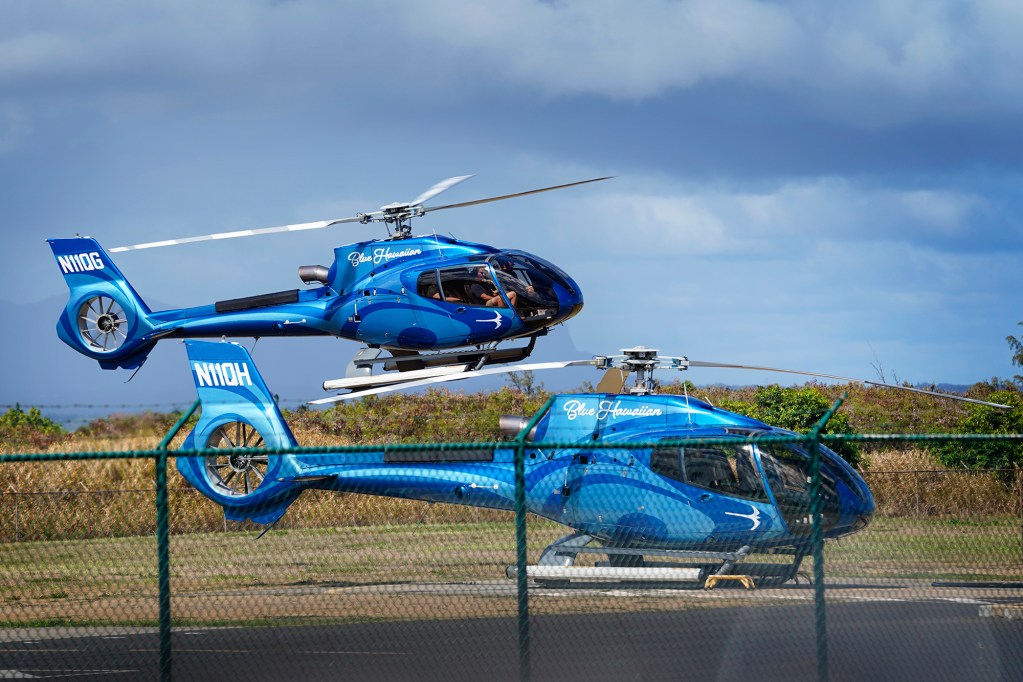
Blue Hawaiian Helicopters is seeking federal approval to fly at lower altitudes during its tours over certain parts of Kauaʻi — but higher than what’s currently allowed for flying in bad weather.
On Kauaʻi, where a helicopter is among the best ways to see hidden waterfalls and other remote jewels of the island’s 5 million-year-old topography, aerial sightseeing can be a lucrative business. But after a string of fatal crashes in the last five years, it’s also an industry caught in the grip of simmering controversy.
As regulators and the state’s air tour operators lock horns over how best to improve safety, residents have become increasingly testy about helicopters churning up noise in neighborhoods and pristine wilderness areas. Noise and safety concerns about air sightseeing tours are decades in the making, fueling the opposition.
The sightseeing tour company’s appeal for an exemption to FAA flight rules has inspired a petition drive by island residents seeking to block the air tour company’s move to fly at lower altitudes. There are more than 130 public comments in opposition to the petition. The deadline to submit public comment is Tuesday.
Eric Hamp, the tour company’s director of operations, said Blue Hawaiian’s request to regulators is largely misunderstood.
“Unfortunately,” he said, “it’s been misconstrued because it just looks like we want to go lower, when, in reality, what we’re asking for is to fly higher than what is already allowed.”
In Hawai‘i, FAA regulations require air tour operators to fly at least 1,500 feet above the landscape. The agency allows for more flexibility, however, to avoid flying into bad weather. Pilots can descend to altitudes as low as 500 feet to dodge sudden clouds or fog in accordance with the Hawai‘i Air Tour Common Procedures Manual, which spells out the policies to which air tour operators in the state must adhere to fly lower.

The Federal Aviation Administration is in the process of replacing the manual with a new regulatory process for determining when and how flight tours can deviate below 1,500 feet in altitude.
If approved, Blue Hawaiian’s petition would only allow its pilots to descend to 700 feet in altitude in certain areas where current rules allow pilots to drop down to 500 feet, according to Hamp. These more conservative rules, he said, would boost safety for air tour passengers and pilots and reduce the public impact of helicopter noise — a subject of routine complaints.
“The idea is to stay away from the clouds,” Hamp said. “If you’re flying along and you know you can go down to 500 feet in a certain area, which we currently can now, when you hit clouds you’re going to make your decision to turn around later than you would if you know you can only go down to 700 feet.”
FAA spokesman Ian Gregor declined to comment on the pending petition. The National Transportation Safety Board did not respond to a request for comment.
Hanalei resident Carl Imparato, a member of the community group Stop Disrespectful Air Tourism! said he’s asking Kauaʻi residents to oppose Blue Hawaiian’s proposal on the grounds that the company rushed to seek regulatory approval without first discussing its plans with the public.
The group is concerned that Blue Hawaiian’s proposal would allow the company’s helicopters to fly at lower altitudes in certain parts of the North Shore but he said he’s not certain because he only found out about the proposal last week.
“If you said I had to make a decision right now on whether this looks good or bad, my answer is it looks bad,” Imparato said. “But I’m putting a caveat on that because I think, in fairness, there’s a need for a lot of discussion before anyone in the public can really say that what Blue Hawaiian is proposing is a terrible thing or before one can conclude that what they’re proposing is actually harmless or an improvement.”
Last week Imparato said Blue Hawaiian executives engaged in hourslong discussions with him and other community advocates about what the company is proposing, but he said it’s too little too late. There are still unanswered questions about how Blue Hawaiian’s proposal might impact copter noise in neighborhoods, Imparato said, and there isn’t enough time for the community to draw any conclusions before the public comment deadline ends Tuesday. He said he wants Blue Hawaiian to withdraw or delay its request to federal regulators to allow more time for community vetting.
Hamp says Blue Hawaiian routinely considers public impact when making flight decisions.
“It’s such a heated thing, noise and helicopters, and I get that there’s mistrust over the years,” Hamp said. “And obviously we’re a business. But when we make decisions we really focus on two things: What’s going to be the public impact and how does is affect the safety of our passengers and our pilots. The revenue stuff comes afterwards. If everyone’s safe and the public’s happy, or relatively happy, the revenue is going to be there.”
STOPDAT! formed in 2008 to lobby Kauaʻi helicopter operators to improve their compliance with a voluntary “fly neighborly” agreement forged in the late 1980s in which several tour operators pledged to change their flight paths to help reduce copter noise in neighborhoods. The group is working to find a way to make the agreement enforceable, Imparato said.
“Noise is the elephant in the room,” Imparato said. “They want to couch everything on safety but Blue Hawaiian knows that the changes they’re proposing are going to have an impact on noise, positive or negative, and there hasn’t been any community discussion about it.”