

Speedier Reviews, Quicker Honolulu Building Permits? Not So Fast
The county says it’s doing its job faster, but that’s not yet translating to faster permits for property owners.
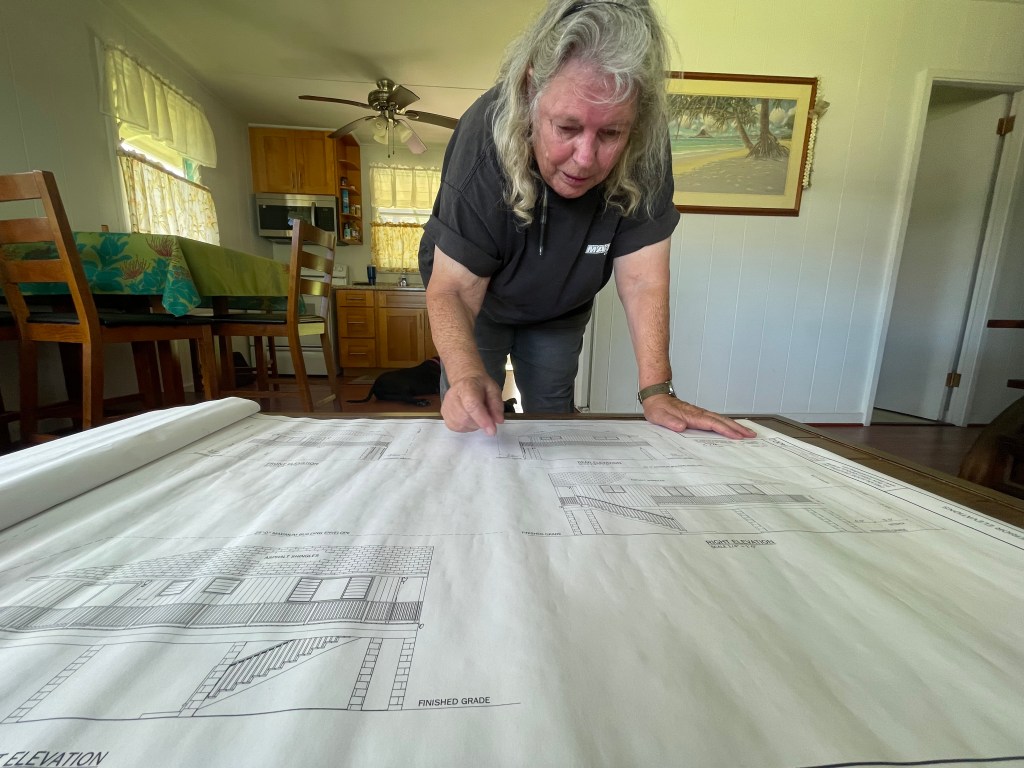
Teresa Parsons was tired of waiting for her building permit.
It had been 400 days of delays, reviews and more delays. Her Kāneʻohe homebuilding plans seemed to be in a slow-motion ping pong match between Honolulu’s permitting department and her architect.
Fed up, Parsons asked the county for a copy of her project routing slip to see where the chokepoints were. What she saw shocked her.
For 208 business days, the slip showed, her plans were with her own architect. The discovery gave her more sympathy for a department she’d sharply criticized.
“I’m not saying DPP is without blame,” she said. “But the 400 days wasn’t all their fault.”

Parsons’ story highlights an aspect of Honolulu’s battle to speed up permitting times that doesn’t often receive attention: the role of the applicants themselves. As the Honolulu Department of Planning and Permitting, or DPP, speeds up its processes, it says delays are more and more often the fault of those applying.
“It’s shifting from us to them,” DPP Director Dawn Takeuchi Apuna said.
With increased training, staffing and updated operating procedures, DPP is responding to building applications faster, city data shows. Code review time – which, at its peak, took six months or longer – came down to an average of nine days for residential plans and two months for commercial jobs, according to data shared with the Honolulu City Council late last year.
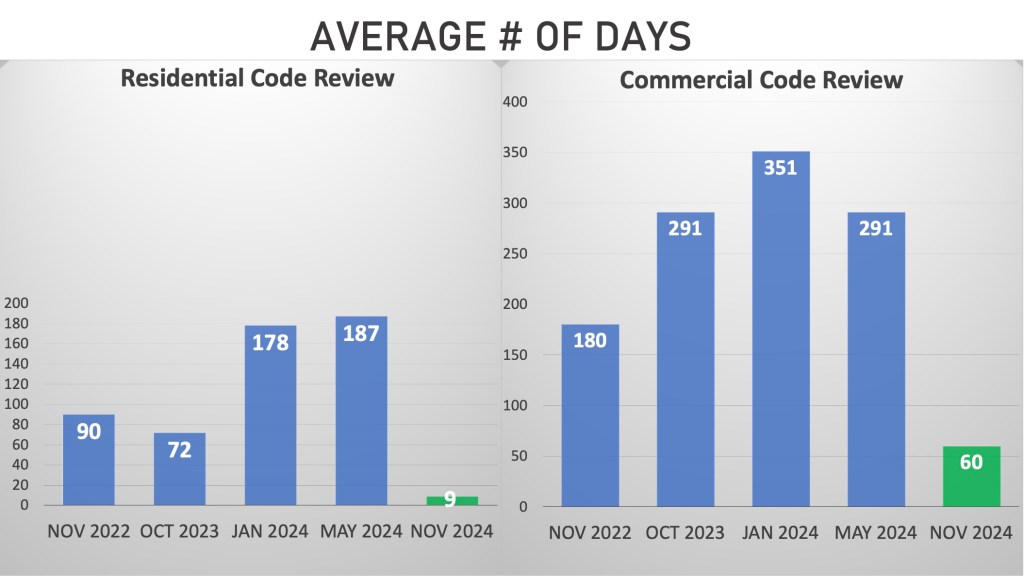
However, that drastic reduction in one phase of the process hasn’t decreased overall permitting time.
In fact, median – or middle of the pack – time for permitting both residential and commercial projects in 2024 was the worst it’s ever been, according to a Civil Beat analysis of city data.
The median residential applicant who picked up a permit in Honolulu last year waited around 288 days, or almost nine and half months. The median commercial applicant waited more than 10 months. Half of last year’s permit applicants waited longer. Data for 2025 is not yet publicly available.
With the permit office responding to building drawings with comments and questions faster than permit applicants are accustomed to, the applicants – often draftsmen or architects – may be struggling to keep up, according to Takeuchi Apuna.
“It’s kind of shocking that it has gotten so fast,” the director said of her department. “It’s definitely affecting their workload and the number that they have in their queue.”
Jim Kane, Parsons’ architect, begged to differ.
“That aggravates me to no end,” he said when Civil Beat shared the director’s comments.
The applicants do have “some culpability,” he acknowledged. In Parsons’ case, Kane said there was indeed a miscommunication about a document he needed from his client that held up the job for months.
“But on almost every case, probably 75% of the time, it’s waiting for them,” Kane said of DPP.
To be sure, DPP still has its issues. The office is working to fill much-needed code review and engineering positions. And as the department improved its speed in code review, delays migrated to other parts of the permitting process, such as stormwater review, Takeuchi Apuna acknowledged.
“We’re not trying to make people’s lives harder,” she said. “We are doing everything we can to fix it.”
A Game Of ‘Hot Potato’?
As DPP gets faster at providing applicants with comments and questions, the agency is doing more rounds of feedback for each permit, according to a DPP analysis done in response to Civil Beat’s inquiries.
The permit director said ideally there should be no more than one or two cycles of reviews per permit.
But residential applicants who waited two years or more underwent an average of four or five review cycles throughout most of last year, DPP said. And the average for that group had creeped up to six cycles by January of this year.
The bottom line: DPP may take an average of nine days to do one round of review, but five or more rounds can amount to weeks or months of wait time for the property owner.
Whose fault this is, it’s hard to say.
Could DPP reviewers be sending applicants insuffient feedback in the interest of speeding up the department’s statistics? It’s possible, Takeuchi Apuna acknowledged, but she doesn’t think that’s the issue.
“They might not catch everything, but their intention is to do a full review,” she said. “We don’t want to do the hot potato. We want to do what is correct.”

The more likely culprit, according to Takeuchi Apuna, is that applicants frequently send plans back to DPP without having addressed the county’s concerns. She believes they do this so they can tell their client the application is with DPP.
“It’s the easiest thing for all of these design professionals to say,” she said. “And so we’ve taken the hit regardless of what’s actually happening with an application.”
Applicants, on the other hand, have complained for years that DPP reviewers provide nonsensical comments on their building plans that take time to clarify — or even reverse.
Kane, who has worked in the islands since the 1980s, said he often finds himself having to educate entry-level code reviewers, who are not required to have an education or background in architecture or engineering.
With all the back and forth, property owners are often left to wait and wonder what’s going on.
Kailua resident Angie Chinen, who is trying to build a second home on her property for her daughter, has had her own painful permitting journey, which has been a financial drain.
She took out a home equity line of credit to finance the project, which required her to buy flood and hurricane insurance for her home. She finally got her permit last month after more than two years of waiting. In that time, she paid nearly $10,000 for insurance she doesn’t feel she needs, all before she’d even touched the line of credit.
Chinen has many gripes about DPP, including what she considers excessive delays in its so-called prescreen queue, quibbling about her kitchen design and confusion over a park dedication fee.
But, like Parsons, she was also disappointed when she looked at her project’s routing slip. It showed her draftsperson held onto plans for some long stretches, including one period of almost four months. And along the way, some drafts of her plans contained mistakes, according to Chinen.
“I was pretty angry,” Chinen said.
Chinen’s draftsperson declined to comment for this story.
More Help Is On The Way, Director Says
The permitting system has gotten somewhat better, in Kane’s opinion. The agency’s website is more informative than it used to be, technological upgrades have made plans easier to track, and increased staff training appears to be paying off in more uniform feedback.
“I do give them kudos on that,” he said.
Additional improvements are coming soon, Takeuchi Apuna said.
The department plans to launch two new technological programs this summer. CivCheck, an artificial intelligence software company, will start checking plans, she said, and will hopefully handle what would otherwise be the first two review cycles.
And a program called Clariti is set to replace DPP’s decades-old software, POSSE.
In the meantime, the city’s upgraded version of its permitting program ePlans allows applicants – including property owners – to see for themselves where an application is. Takeuchi Apuna encourages owners to check that and hold their design professionals accountable.

It’s a message that has irked some designers.
“They didn’t like that we finally lifted the cover,” Takeuchi Apuna said, “and now you can actually see what’s happening.”
Parsons was thankful for the opportunity to see the details on her permit.
“When I found out where it was sitting, and it wasn’t all DPP’s fault, I got engaged with it,” she said, “and the next thing you know, I have permits.”
Homeowners should know that they can be included on the city’s email correspondence with their design professionals too, she said. Applicants can move their own plans along by being proactive.
“Part of it still is DPP,” she said, “And part of it is not.”

