

Developer Accused Of Campaign Fraud Allowed to Travel While Out On Bail
The prosecutor said Timothy Lee’s wealth makes him a flight risk. Lee’s attorney suggested his client’s money is all the more reason he’ll stay put.
A wealthy Honolulu real estate executive accused of making fraudulent campaign contributions will be allowed to travel outside Hawaiʻi for business while out on bail and as his case plays out in court.
Timothy Lee, chief executive officer of JL Capital, was indicted in February with nine counts of making false name contributions to candidates in Honolulu’s 2020 mayoral election. After his arrest, Lee quickly regained his freedom by paying the $250,000 bail. But he had to surrender his passport.
On Thursday, Circuit Court Judge Clarissa Malinao granted a motion from Lee’s attorneys to return his passport and allow him to travel to the mainland and internationally for work. Lee won’t be allowed to take any trips for pleasure, though, and he will have to inform the court and prosecutors of his travel plans in advance, his attorney David Minkin told Civil Beat.
The Attorney General’s office opposed the motion, arguing Lee’s considerable wealth makes him a flight risk. Court documents lay out some of the details of that wealth.

Five years ago, Lee was making $200,000 a year and appears to have given himself a $100,000 bonus in 2020, Deputy Attorney General Thomas Michener wrote in a court filing. In 2021 and 2024 he purchased property, putting down at least $1 million in cash. And he once contemplated buying a specialty bicycle from Taiwan that cost nearly $10,000.
Michener said that means Lee could afford to travel to countries from which extradition would be difficult or impossible.
“Lee has substantial financial resources at his disposal, resources that could be employed by him to stay out of the United States indefinitely,” Michener wrote in the court filing.
Minkin said his client’s money shows something completely different: that he is “committed to building his life in Hawaiʻi.”
Lee is accused of funneling $13,000 to the campaigns of 2020 mayoral candidates Kym Pine and Keith Amemiya through employees of his firm, which developed the Sky Ala Moana high-rise and is building another luxury tower on Kapiʻolani Boulevard called Muse Honolulu.
“Lee has substantial financial resources at his disposal, resources that could be employed by him to stay out of the United States indefinitely.”
Thomas Michener, deputy attorney general
The CEO is accused of reimbursing employees who made donations to the candidates to hide the true source of the funds. Donors are limited to giving a maximum of $4,000 to mayoral candidates, and Lee had already maxed out, the prosecution said.
The Hawaiʻi Campaign Spending Commission investigated the case after learning about an employee who said Lee asked him to write checks to Pine and Amemiya. At a March 2022 hearing, Minkin pushed back on the idea that Lee asked employees to make donations but didn’t deny that his client reimbursed them.
“Mr. Lee is fully aware of the consequences and fully understands he cannot reimburse people months later for contributions made on their own behest,” Minkin told the commission at the time.
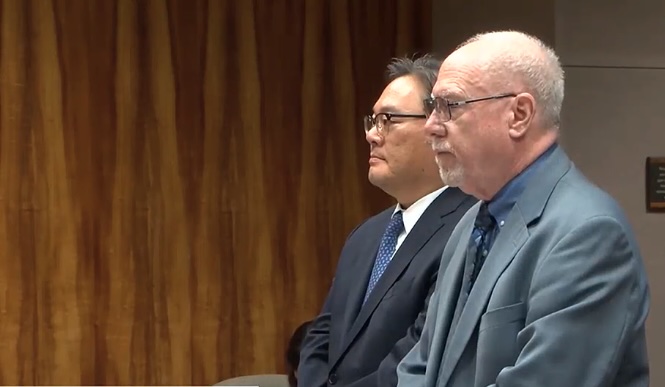
The commission voted to send the case to state prosecutors. Neither Pine nor Amemiya was accused of wrongdoing.
It is rare for a Hawaiʻi campaign finance violation to result in criminal charges. For years, cases the Campaign Spending Commission referred to prosecutors were resolved with fines or resulted in nothing at all.
However, public calls for a crackdown on corruption have grown louder following the bribery scandal involving former Senate majority leader J. Kalani English and former Hawaiʻi representative Ty Cullen. English and Cullen pleaded guilty in 2022 to taking cash and gifts from the late businessman Milton Choy, who was seeking to benefit his wastewater business.
Lee faces the potential of up to five years in prison for each of his nine counts. Making false name contributions is a C felony, the lowest level of severity.
Lee May Try To Flee, Prosecutor Says
JL Capital has active projects in California, Virginia, Korea and Japan, according to Lee’s motion.
Lee’s attorneys argued that his job requires him to visit those project locations and their motion stated that failing to do so would “irreparably harm his business and company.”
Lee’s attorneys promised that Lee would be present for all future court dates, would provide prosecutors with an itinerary of his travel before he left Hawaiʻi and would sign a waiver of extradition in which Lee preemptively agreed that another jurisdiction could transfer him back to Hawaiʻi if necessary.
According to the Attorney General’s office though, Lee can’t be trusted to travel because of his wealth.
Michener suggested that in addition to his own funds, Lee may have access to the resources of his company’s owner — Korean multimillionaire Lee Joon-ho — whose wealth is estimated by Forbes to be $690 million. Investigators found that the owner had entrusted Lee to oversee the renovation of his Diamond Head residence, according to Michener’s filing.
“Whether and to what extent Lee Joon-ho’s resources may be available to Defendant is unknown,” the filing states. “But, the Defendant was given the responsibility of overseeing the very personal matter of water at his wealthy employer’s home indicates a close relationship between the two, on that Defendant may be in a position to utilize.”
Minkin, Lee’s attorney, countered in a court filing that his client’s wealth is one reason he will continue showing up to court.
He has built a comfortable life in the islands over the course of 20 years and has two sons who attend ʻIolani School, Minkin noted. In other words, Minkin wrote, Lee has “established roots” in Hawaiʻi and isn’t going anywhere.
Even the same fact was interpreted differently by the two sides.
The AG’s office noted that Lee’s credit report shows he pays his debts on time and that he was able to post bail and get out of custody in under an hour — evidence of his financial means and ability to flee. Minkin said that’s proof of just the opposite.
“If Mr. Lee had any intention of relocating abroad, surely he would not be concerned about repaying his debts in a timely manner,” he wrote. “These nonsensical arguments should not be countenanced by this Court.”

