Hawaiʻi Legislature Adjourns — For Now
Before ending the regular session for the year, lawmakers stashed away money to shield Hawaiʻi from federal budget cuts.
The Legislature adjourned its 2025 session on Friday with a promise to return in the months ahead to aid programs facing federal funding cuts from the Trump administration.
To accomplish that, lawmakers have set aside a $200 million fund that can be tapped for resources should federal dollars run dry. Federal funds account for about 19% of the state’s $20 billion annual operating budget, or about $3.8 billion.
In addition, lawmakers have allocated $50 million to aid nonprofits that rely on federal funding.
Voting on hundreds of bills was completed Wednesday, leaving lawmakers just a handful of measures that required last-minute amendments to make technical fixes before they adjourned Friday.
House Majority Caucus Leader Chris Todd praised the work of the Legislature this year, ticking off a list of accomplishments he said were “each designed to make incremental improvements to life here in Hawaiʻi.”
“That doesn’t happen by accident,” he said. “It took deep collaboration, open-minded negotiation, and a belief that doing the right thing — not the easy thing — is still worth striving for.”
On Friday, the Legislature gave final approval to the so-called “green fee,” another measure that may help the state cope with fallout from the new federal administration.
That measure, Senate Bill 1396, would increase the state’s hotel room tax by .75%, and impose the tax on cruise ship passengers.
At a time when the Trump administration is rejecting climate change initiatives, the new fee is designed to provide a stream of local funding to help Hawaiʻi adapt to climate change or mitigate its effects.
Falling Back On Tourism
The green fee bill drew much debate in the Senate, with some senators worrying increasing the tax on tourists could discourage visitors from traveling to Hawaiʻi.
Sen. Angus McKelvey, who represents parts of Maui that rely most heavily on tourism, supported the bill’s passage but had concerns that the additional fee would hit his district, which has already been impacted by the Maui wildfires and a downturn in tourism.
The additional taxes would be “very impactful for areas already taking a hit,” McKelvey said.
Sen. Lorraine Inouye said that a last-minute addition to the measure that would tax cruise ships could negatively impact her Hilo district, where businesses rely on disembarking tourists who shop in town. She said she wanted to revisit the tax increase in the future to exempt U.S.-flagged cruise ships.
Sen. Tim Richards, also of the Big Island, echoed Inouye’s concerns.
“We’re hitting a ceiling here and would be discouraging tourism going forward,” he said.
But Sen. Glenn Wakai called arguments that increasing the tax would lead to a downturn in tourism a “total fallacy.”
He pointed to the 1% TAT increase passed in 2017 to help fund the rail project. The annual visitor count from that time rose from about 8 million to well over 10 million in 2019.
“The sky is not falling on tourism,” Wakai said.
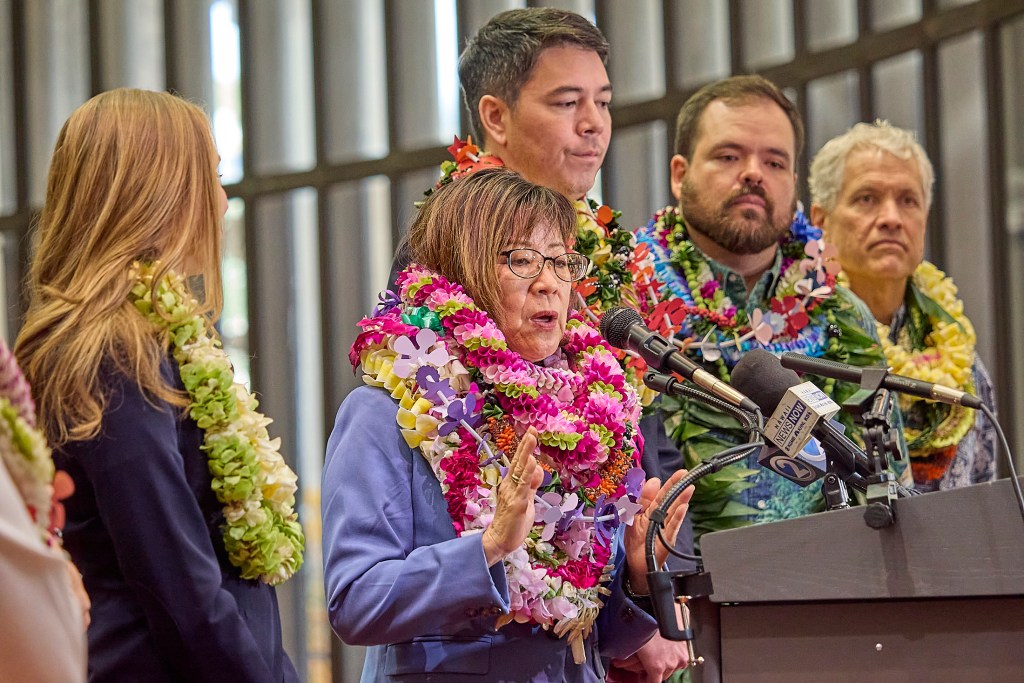
House Speaker Nadine Nakamura praised the green fee, describing the additional levy as a “modest change to the transient accommodations tax that will raise over $80 million a year.”
She said that money will be used “to mitigate the impacts of climate change on our natural and built environment and to address beach erosion and other impact on our visitor industry.”
“Those monies will be used to protect, manage and restore Hawaiʻi’s natural resources, including native forests, native plants and animals, aquatic resources, coastal lands and freshwater resources,” she said.
The new tax was a signature intitiative of Gov. Josh Green but was proposed and rejected at the Legislature three years in a row. It finally passed easily on Friday with a vote of 23-2 in the Senate, and 41-8 in the House.
Green praised the bill in a written statement Friday after the vote.
“This legislation, which I intend to sign, is the first of its kind in the nation and represents a generational commitment to protect our ‘āina,” he wrote. “Hawai‘i is truly setting a new standard to address the climate crisis, and I want to thank lawmakers for their unrelenting work these past two years in bringing this to fruition.”
The governor cited an estimate that the fee will raise an extra $100 million a year “to provide disaster mitigation for the Aloha State.” He has until July 9 to sign the bill into law.
Bracing For Impact
Disbursements from the new $200 million fund would be made through a series of appropriations bills that lawmakers may take up during special sessions that are anticipated to be needed later this year once the Trump administration puts any cuts in place. Those disbursements would require the approval of the Legislature.
Nakamura said that she is particularly concerned with cuts to Medicaid and Medicare programs, other social safety net programs and the University of Hawaiʻi.
“We know all across the board, there will be cuts made,” Nakamura said at a press conference. “We will need to respond.”
She said the Legislature would need to evaluate and prioritize which departments get access to the $200 million fund.
Nakamura has told House members to be prepared to be summoned back to the State Capitol for a special session later this year, suggesting that could happen in late August, late September or mid-November. The exact timing will depend on the actions of the Trump administration and Congress.
Also approved Friday was Senate Bill 97, which would impose a mandatory minimum 30-day jail sentence for anyone found guilty of “excessive speeding” for a third time in five years. Excessive speeding is defined as driving 80 mph or more, or driving 30 mph over the speed limit.
That stiff new penalty made some lawmakers uncomfortable. Rep. Kim Coco Iwamoto suggested the state should send out warning notices to all motorists who have already been found guilty of excessive speeding twice.
Rep. Elijah Pierick said he opposed the bill, remarking that “this is pretty strict.”
In their closing floor speeches several lawmakers took time to remember Republican Rep. Gene Ward, who became a fixture in the House during his decades-long tenure representing East Honolulu neighborhoods. Ward, 82, died during this year’s session.
“At the beginning of the session we committed to serving with aloha, a willingness to collaborate, and with mutual respect in resolving differing views, and I thank you for trying to honor that commitment,” Nakamura told her fellow House members. “I think Gene Ward would be very proud of that.”
Civil Beat’s reporting on the Hawaiʻi State Legislature is supported in part by the Donald and Astrid Monson Education Fund.