Hawaiʻi Has A New Ghost Gun Law. Will It Make A Difference?
Honolulu prosecutors pushed for a bill that would make ghost guns illegal. Now it faces its first test since becoming law.
Honolulu County prosecutors finally got the power last month they had long said they needed to prosecute people for having ghost guns.
But weeks later, in what could have been the first test, both police and prosecutors failed to fully use the newly enacted law which, among other things, adds these unserialized and untraceable firearms to Hawaiʻi’s list of prohibited weapons.
Shortly after midnight on May 13, Joseph Papa allegedly shot a ghost gun into the air outside a house on Kīnaʻu Street in Honolulu, according to police and court records. Police arrested him for reckless endangerment, criminal contempt and multiple weapons violations, including possession of unserialized firearm parts and carrying a firearm without a license.
One offense was notably missing from arrest records: possession of a prohibited weapon, in this case the ghost gun.
When prosecutors took up the case, Papa was charged with reckless endangerment and unlicensed carry of a firearm. If he’s convicted of that weapons violation, under the new law, he could still face an additional three years in prison because that firearm was a ghost gun. But he wasn’t charged with simply having an illegal firearm, or its parts.
Prosecutors did not respond to requests for comment, nor did Papa’s attorneys or Honolulu police.
Papa pleaded not guilty on Tuesday, and his next court hearing is in July. He is being held at the Oʻahu Community Correction Center.
Patching A Loophole
Since 2020, it has been illegal in Hawaiʻi to possess, manufacture or sell unserialized firearm parts with the intent of building an untraceable weapon, making this state one of only about a dozen to restrict ghost guns.
Lawmakers at the time wanted to stop people from obtaining parts that could easily be assembled into unregistered guns.
“Up until that point, there wasn’t a clear path to be able to prosecute those kinds of incidents,” Sen. Chris Lee, one of the lawmakers behind the original law, told Civil Beat in March.
Prosecutors in Hawaiʻi and Maui counties have used the 2020 statute to charge more than 50 people, according to court records reviewed by Civil Beat.
But their counterparts in the state’s most populous county, Honolulu, have found the law hard to enforce. The statute, they argued, only related to unserialized gun parts, not a fully assembled ghost gun. It required them to prove beyond a responsible doubt that someone intended to assemble an unregistered gun from those parts.
Meanwhile, the number of ghost guns recovered by police has been on the rise. Between April 2021 and January 2025, Honolulu police arrested 33 people for illegally having unserialized gun parts. None were charged under the unserialized parts statute, according to the previous Civil Beat story.
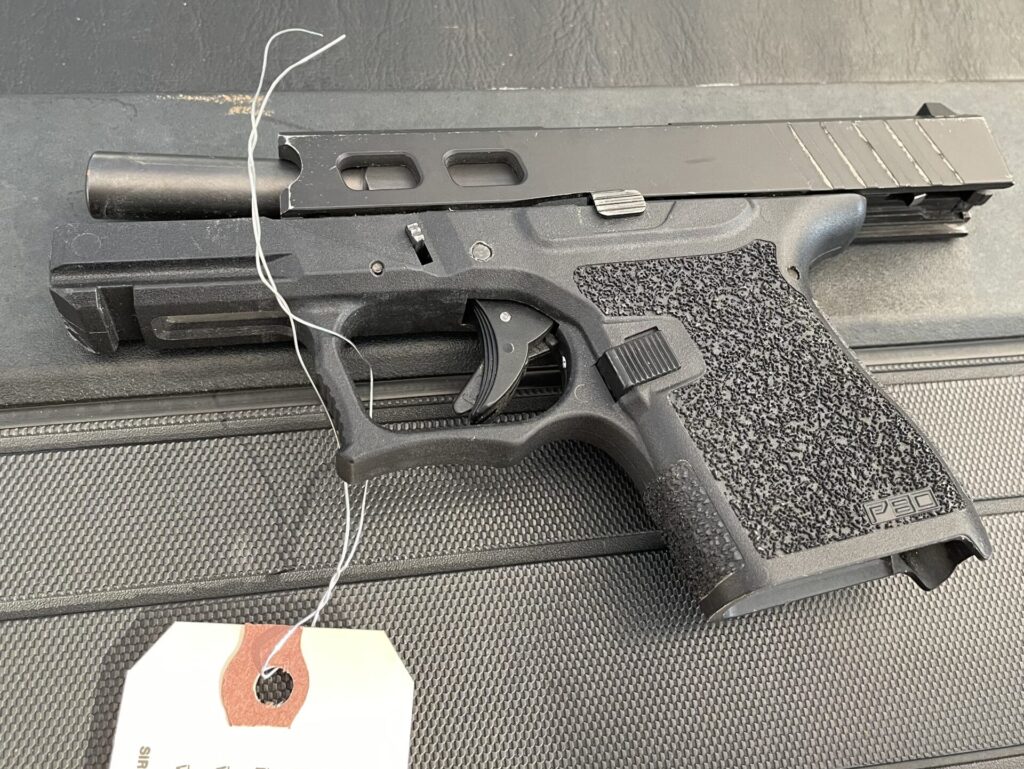
This year, prosecutors asked lawmakers to close that loophole, making it easier for them to charge people arrested with fully assembled ghost guns and increasing the penalties for having an untraceable weapon.
Honolulu Prosecutor Steve Alm said his office’s proposal, House Bill 392, would “change the definition” of a ghost gun to extend it to include whole weapons, rather than just parts. “Essentially, if it doesn’t have a serial number on it, it’s a ghost gun,” Alm told Civil Beat in April.
The bill made it outright illegal to have a ghost gun, a class C felony punishable by up to five years in prison. It also allowed for more prison time in cases where defendants were convicted for using a ghost gun to carry out a felony — anywhere from up to an additional three to 15 years, depending on the severity of the crime.
It was intended as a deterrent.
“Hopefully they’ll either get jail or prison time,” Alm said, “and if people start getting that regularly, then they might not be trying to acquire or carry around a ghost gun.”
Civil Beat’s community health coverage is supported by the Atherton Family Foundation.