

Red Hill Water Contamination: ‘Disappointing’ Payouts For Victims
Department of Justice attorneys succeeded in limiting the scope of the fuel leak case, and consequently, the damages.
Almost four years after leaks at the U.S. Navy’s Red Hill fuel storage complex contaminated Pearl Harbor’s drinking water, a federal judge has ordered the federal government to pay the first set of plaintiffs who sued for their injuries.
The awards range from $5,000 to $100,000 per person and total about $680,000 – much less than many were hoping for. Plaintiffs had asked the court for $225,000 to $1.25 million each.
The ruling on the 16 bellwether plaintiffs may serve as a model for the settlement of thousands of other cases.

Those who drank and bathed in the contaminated water testified at a trial last year that they suffered health problems including gastrointestinal and neurological impacts, some of which linger to this day. The awards likely won’t cover many victims’ out-of-pocket medical expenses.
“It’s disappointing,” said Army Maj. Mandy Feindt, whose husband was the lead plaintiff in the case.
“Our families have accrued so much debt, paying for things the government wouldn’t cover, just to get our families to safety or get the best care. People are living off credit cards and loans because of all the debt they’ve accrued.”
Two Spills Above An Aquifer
The case stems from a set of back-to-back fuel spills in 2021 at the Navy’s World War II-era fuel depot, which is located 100 feet above Oʻahu’s primary drinking water aquifer.
On May 6, 2021, some 20,000 gallons of fuel spewed from a pipeline and poured into the facility’s concrete tunnel. Most of the fuel was captured in a containment line intended to catch used firefighting foam in the event of a blaze.
That line sucked up the fuel and moved it to another part of the facility, where it sat for months. Some Red Hill officials knew fuel from the May leak was unaccounted for, according to the military’s subsequent investigation of the incident, but they did not tell regulators or the public.
In November, a Red Hill worker hit the pipeline with a cart, and fuel rained down for 34 hours. The location of that November spill was within a few hundred feet of the Red Hill well, which then delivered contaminated water to the residences, businesses and military operations around Pearl Harbor.
Thousands of people were sickened, with entire families reporting symptoms ranging from vomiting to rashes. In surveys since, former residents have reported ongoing health challenges.
The water contamination crisis occurred after years of leaks at Red Hill, most notably in 2014 when an estimated 27,000 gallons of fuel escaped one of the facility’s massive tanks.
Environmental advocates and the Honolulu Board of Water Supply had warned for years of the dangers of storing fuel in a leak-prone facility right above the island’s water supply. But Navy officials consistently assured the public it was safe. Even after people were sickened by the 2021 leaks, the military expressed its interest in keeping Red Hill operational, but later backed down amid public outrage.
The facility has since been defueled, and military officials have pledged to never again store hazardous material there. The Navy Closure Task Force-Red Hill declined to comment on the court ruling and referred questions to the Department of Justice, which did not respond.
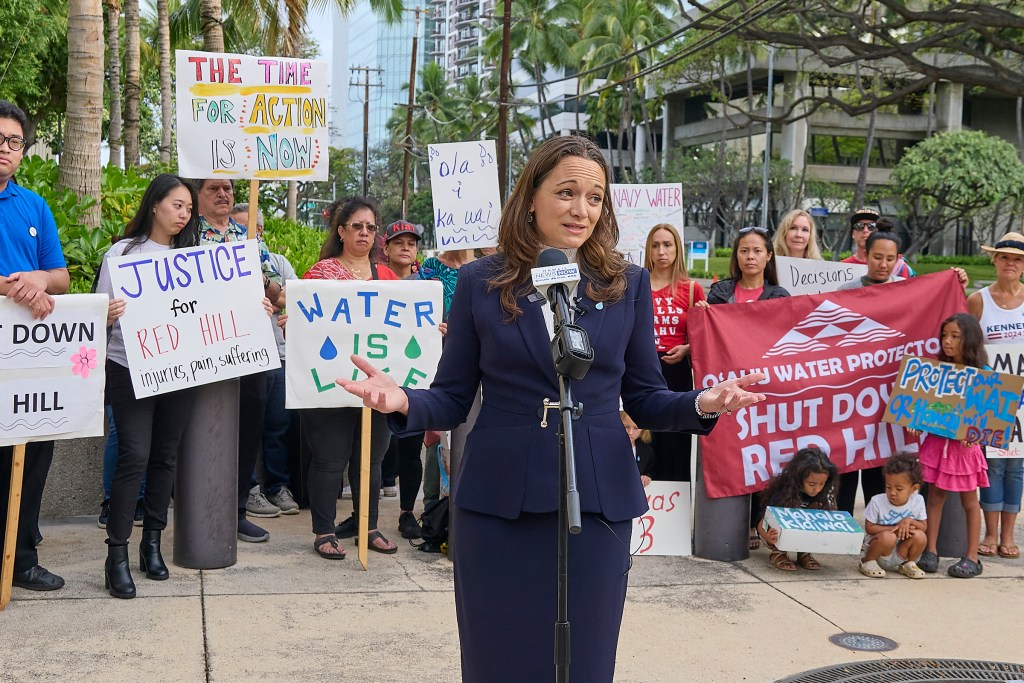
On Thursday, the plaintiffs’ attorney Kristina Baehr called the trial result a historic legal victory. The federal government had claimed there was insufficient evidence to prove anyone was harmed by the fuel-tainted water. The judge disagreed.
“The judge found everybody was harmed,” she said. “So the judge rejected their argument.”
Baehr declined to discuss the award amounts.
“We’re going to focus on the win,” she said. “I’m not going to focus on the amounts today.”
Amount Of Awards Varies
Feindt’s husband, Patrick — who was sickened after the leaks — will receive $37,500. He has undergone multiple surgeries.
Their daughter, who suffered rashes, breathing challenges and development regression, will get about $15,000. Their son, who experienced symptoms including coughing and wheezing, will get $5,000.
The plaintiffs’ awards will be reduced by attorneys’ fees, which can take up to a 25% bite out of the total, and related expenses.
U.S. District Court Judge Leslie Kobayashi’s ruling shows the monetary awards were limited by legal decisions made before the trial even began.
Early on in the case, the federal government admitted to negligence and causing a nuisance. Plaintiffs lauded this as a victory, but it was also strategically advantageous to the government.
As a result of the government’s admission, the events leading up to the catastrophic November 2021 fuel spill that poured thousands of gallons of fuel into the Red Hill well were deemed irrelevant.

The Hawaiʻi Department of Health has noted that groundwater samples showed possible evidence of fuel contamination after the May leak and before the November one occurred. And some residents have reported experiencing health issues in that period.
However, in court, those health issues were considered preexisting conditions because they began before November 2021.
Kobayashi also excluded partial testimony of one of the Red Hill families’ key expert witnesses.
Steven Bird, a doctor, would have testified about long-term adverse health impacts from jet fuel exposure, future medical care needs and plaintiffs’ fears of long-term health issues in the future. But Kobayashi found his testimony didn’t pass muster for trial.
In her ruling, Kobayashi said it is clear to the court that many of the plaintiffs have suffered greatly, and she is sympathetic to their plight. However, she wrote, they did not show by a preponderance of the evidence that the November fuel release was the “legal cause of each injury.”
“Where the Court has found that Plaintiffs have failed to demonstrate credible evidence, it is not concluding that the medical conditions or ailments do not exist,” the ruling states. “Rather, its findings reflect that correlation does not carry Plaintiffs’ legal burden of proving causation.”
Civil Beat’s community health coverage is supported by the Atherton Family Foundation, Swayne Family Fund of Hawai‘i Community Foundation, the Cooke Foundation and Papa Ola Lōkahi.

