

Drones Could Be Dispatched As First Responders To Crime Scenes In Hawaiʻi
State police want to use license plate readers and drones to fight crime on Hawaiian homelands. Futuristic law enforcement technology could also be deployed soon in Waikīkī.
A crime reported on Hawaiian homelands may someday trigger police to dispatch a flying drone with the quick press of a button.
That’s the pitch Hawaiʻi Department of Law Enforcement Director Mike Lambert made Tuesday to the Hawaiian Homes Commission as he underscored the utility of drones, artificial intelligence and other emerging technologies to help deter drug activity, burglary, squatting, illegal dumping and domestic abuse on homesteads.
The reality, Lambert told commissioners, is this: Law enforcement in Hawaiʻi is short-staffed. Placing a patrol officer in every neighborhood is unrealistic. That’s where technology can be used to fill in the gaps.
“If you come into the homesteads, the likelihood of getting busted is high,” Lambert said. “That’s the type of force field or bubble that I want to try to get out. … If you’re going to rip stuff off, don’t do it in there.”

The Safety Via Technology program Lambert made a case for Tuesday is focused on busting misconduct by outsiders. In addition to drones, license card readers would be deployed at major Hawaiian homelands access points. Part of their utility would depend on homestead residents voluntarily registering their license plate numbers.
A cornerstone of the program is remote-controlled, camera-equipped drones, which travel at a maximum speed of 45 mph. The drones can quickly reach the potential scene of a crime and provide real-time aerial footage of the scene before law enforcement arrives. The footage can also be used to track suspects, analyze traffic patterns and collect evidence.
The law enforcement agency is seeking authorization from the DHHL to mount and monitor license plate readers at homestead access points and identify rooftop drone launch points in remote areas where the drones can reach the scene of a crime faster than a police officer. The agency also wants the DHHL to adopt and participate in the Saferwatch mobile security app.
Some of the technology Lambert pitched to commissioners is already set to be used to increase enforcement in Waikīkī.
Approval Still Needed
The commission did not vote on whether to enter a partnership with the DLE to use its drone-powered security program, and there is no vote on the proposal currently scheduled.
But DLE has enough funds to cover the cost of running the program for several years, Lambert said, citing the agency’s start-up money. The law enforcement agency became fully operational in January 2024.
“We got you guys covered for at least three years … as long as you guys are interested in the technology,” Lambert said.
Lambert said a license plate database would help police more easily identify suspects, especially outsiders whose vehicles aren’t associated with the homesteads. The program isn’t designed to catch neighbors ripping each other off. Instead, it’s geared to track suspects in unregistered vehicles driving in and out of the homesteads.
The technology could help prevent a domestic abuse victim from being abused again by notifying the victim if the vehicle registered to the abuser nears his or her residence, he said.
Critics say robotic surveillance is intrusive but proponents argue it gives law enforcement an edge — especially in difficult-to-reach rural areas.
The Department of Hawaiian Home Lands has long complained that police responses to crimes on homelands are inconsistent, with some HPD officers reportedly hesitant to enforce laws on the lands due to jurisdictional issues.
On the Big Island, homesteader Luana Keakealani said people who trespass onto Hawaiian homelands to commit crimes is a well-entrenched problem.
“My one concern would be, and I would encourage the commission to consider, the privacy rights that are in our state with respect to personal space and aerial trespass … so that when we do deploy these tools that are supposed to be helpful to us that we’re not creating a situation of people feeling like they are being violated,” Keakealani said during public testimony.
Waiʻanae Coast Neighborhood Board member Johnnie-Mae Perry said drones and license plate readers could be particularly helpful on agricultural homesteads where farmers have long been targeted by thieves and vandals. The technology might also deter illegal dumping, which she said happens routinely on homestead land in Waiʻanae.
“I could see where it would be a big advantage on the island of Kauaʻi,” Dennis Neves, the commissioner from Kauaʻi, said. “We have a lot of people that are squatters taking over and dumping issues like that.”
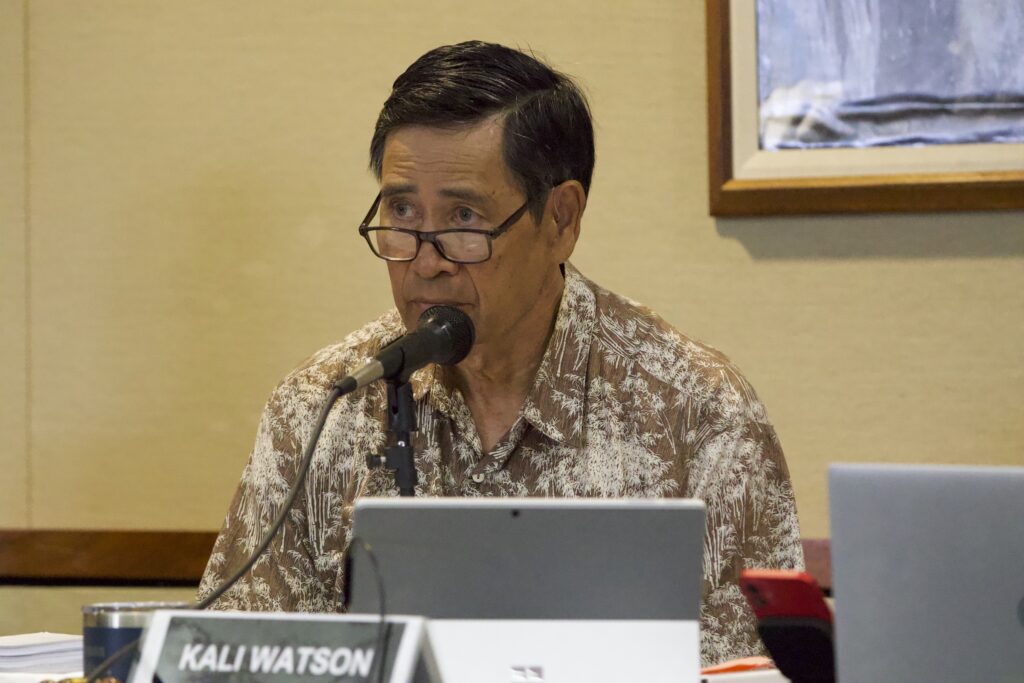
Chairman Kali Watson did not respond to requests for comment for this story.
DLE already owns 10 Skydio drones and is seeking Federal Aviation Authority approval to use them for police work.
It would take four to six weeks to set up license plate readers. Lambert said he wants to pilot the readers at a dozen homestead communities throughout the state, including three locations on Oʻahu and one or two locations on each neighbor island.
“This is not a future thing where I’m trying to sell something I don’t have, it’s just a matter of who wants it,” he said.

