Maui Wildfire Debris Is On The Move Again. What Happens Next?
Maui County officials are still discussing the future use of the Olowalu site where wildfire debris is being temporarily stored.
Thousands of times over the next few months, 50 dump trucks will be loaded with non-recyclable debris from the deadly 2023 Lahaina wildfire before making a roughly 19-mile journey from the temporary storage site in Olowalu to its permanent home in central Maui.
By the end of the year, approximately 400,000 tons — the equivalent of five football fields, five stories high — of ash and debris is expected to be removed from the coastal area that is uphill from an important reef system with the country’s largest population of manta rays.
The massive hauling operation, which is scheduled to begin Monday, has raised concerns about traffic, prompting warnings for drivers to plan for extra travel time and to keep a safe distance from the trucks making their way along the narrow Honoapi‘ilani Highway, up Kūihelani Highway just north of Māʻalaea and along a former cane haul road.
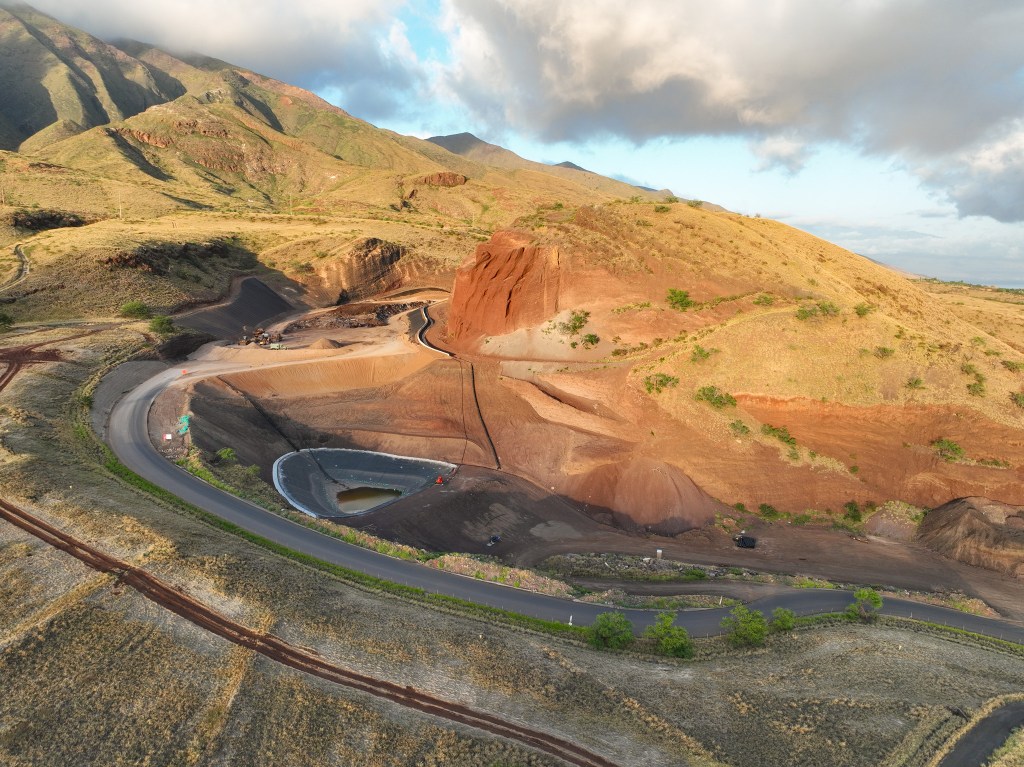
Local and federal officials also have offered assurances that numerous measures are in place to ensure the operation has minimal impact on the environment and public health. The debris, which officials say is considered nonhazardous, will be wrapped in industrial plastic sheeting and lightly wetted to tamp down dust.
The move closes another chapter in cleanup efforts on the Valley Isle after the 2023 wildfire that killed 102 people and leveled much of the historic town of Lahaina, including more than 2,200 homes and other buildings. It also raises new questions about what happens next at the Olowalu site, which was a controversial choice to be the temporary holding pit.
Traffic Woes And Environmental Concerns
Officials have said the trucks must run throughout the day if they are to meet a federally imposed deadline of Dec. 31. Olowalu’s proximity to Lahaina was a key reason for its selection as a temporary site.
Despite the distance, the final location for the debris near the county’s main landfill in Puʻunēnē was chosen because it’s considered to be a safe distance from the ocean, homes, schools and hospitals.
While steel and concrete from the burn zone can be recycled, the ash and other small particles that must be stored are contaminated by arsenic, lead and other toxins, according to the state Department of Health.
Once the waste has been cleared from Olowalu, the U.S. Army Corps of Engineers will turn its attention to restoring the state-owned land to the same condition it was in prior to receiving the waste last year.
The site was an out-of-use cinder quarry, but engineers will face the challenge of cleaning up potential environmental and health hazards and monitoring the area to detect problems that may arise in the future.

Workers will cut the heavy plastic liner on the bottom of the holding pit into sections so that it can be loaded onto trucks, hauled to the permanent disposal site and discarded with the rest of the debris, according to the official closure plan. They will also clean up any leachate — liquid that has passed through the debris — from a collection basin before removing the basin’s liner.
From there, soil will be collected and compared to samples taken before the land was covered in debris to determine what impact it may have had and if other actions are necessary to make the site safe, according to the state’s health department. Any soil that may have been contaminated will be removed and discarded at the permanent disposal site.
Signage, roads, drainage channels and other infrastructure will also be removed, and any areas that were disturbed by the disposal site’s operations “will be stabilized to a finished grade as similar as
possible to the original conditions at the site,” according to the closure plan.
The two groundwater monitoring wells installed at the site will be “decommissioned and abandoned” according to established Department of Health procedures, according to the plan, or as directed by the county’s Solid Waste Division.
Monitoring For Problems
Officials will then need to determine the long-term future of the Olowalu site, which is less than 400 meters from the coast. No definitive plans have been made for the property once it has been cleared, according to a statement provided by the county’s Department of Environmental Management last week.
The decision to temporarily store wildfire debris in Olowalu took months because of environmental concerns. The ocean below contains a massive reef system with hundreds of manta rays and the oldest coral found near the main Hawaiian islands.
Officials initially considered making it the permanent disposal site but reversed course after listening to the concerns of numerous community members, engineers and environmental experts.
While ash samples collected after the fire in Lahaina had elevated levels of arsenic, lead, copper and other hazardous substances, the debris stored at Olowalu is considered nonhazardous and nontoxic based on a test method created by the Environmental Protection Agency, Army Corps spokesman Cortland Henderson said in a statement.

The Corps is legally required to monitor potential environmental and health hazards at the temporary storage site and to regularly release the data collected from testing samples.
This monitoring will continue throughout the debris transfer process and until the site is cleared, Henderson said. Henderson noted the state health department also monitors local air quality using sensors on the island.
Some harmful substances have been detected in air, water and leachate samples collected from the temporary disposal site, but state officials determined the facility was “not releasing harmful substances into the environment at levels of health concern.”
The Future Of Olowalu’s Coast
The temporary disposal site was built along the coast of the Olowalu Valley, a once-vibrant farming community where Native Hawaiians grew a variety of crops.
The area was transformed following the arrival of European settlers, and it became a hub for water-intensive sugar production, said Tamara Farnsworth, the coastal resilience project manager at the Nature Conservancy, a nonprofit environmental advocacy organization.
“Just like anywhere in Hawaiʻi, there were major changes that occurred after Western contact and with the shift away from Native Hawaiian land management through the plantation era,” Farnsworth said.
Today, Olowalu is sparsely populated and the native shrubland that once dominated the area has been largely replaced by highly flammable invasive grasses. The changes on land have also put pressure on the nearby Olowalu Reef by allowing more sedimentation that damages the fragile marine ecosystem, Farnsworth said.
Farnsworth was among the environmental experts who previously expressed concern that storing wildfire debris in this area could place additional stress on the reef.
Now that the debris is being moved, she said, measures should be put in place to ensure any potential issues are identified and dealt with as quickly as possible.
The state also has plans — developed before the fires — to relocate a portion of the scenic Honoapi‘ilani Highway due to the threat of climate change.

In late May and early June, the Nature Conservancy co-hosted a series of events with the University of Hawaiʻi Community Design Center to collect feedback on ideas for how to sustainably use the coastal land in the aftermath of both changes.
Judith Stilgenbauer, director of the master of landscape architecture program at the University of Hawaiʻi Mānoa, said many people who attended the events said they would like to see the area’s native wetlands restored.
Efforts to preserve the valley’s biodiversity and restore the native ecosystems that previously provided natural protection for the reef have existed for years, but Stilgenbauer expressed reservations about pushing for the area to be totally restored to its natural state.
“There’s really nothing natural left in these landscapes. It’s all highly disturbed,” she said. “I think we have to be really careful about saying we want to restore it to what it used to be. It’s more of a 21st century adaptation of that.”
Civil Beat’s coverage of Maui County is supported in part by a grant from the Nuestro Futuro Foundation. Its coverage of environmental issues on Maui is supported by grants from the Center for Disaster Philanthropy and the Hawaiʻi Wildfires Recovery Fund, the Knight Foundation and the Doris Duke Foundation.
Update: This story has been updated to clarify which agencies are monitoring air quality on the island.