

State Demands Church Return Housing For Homeless Elderly — Or Buy Them
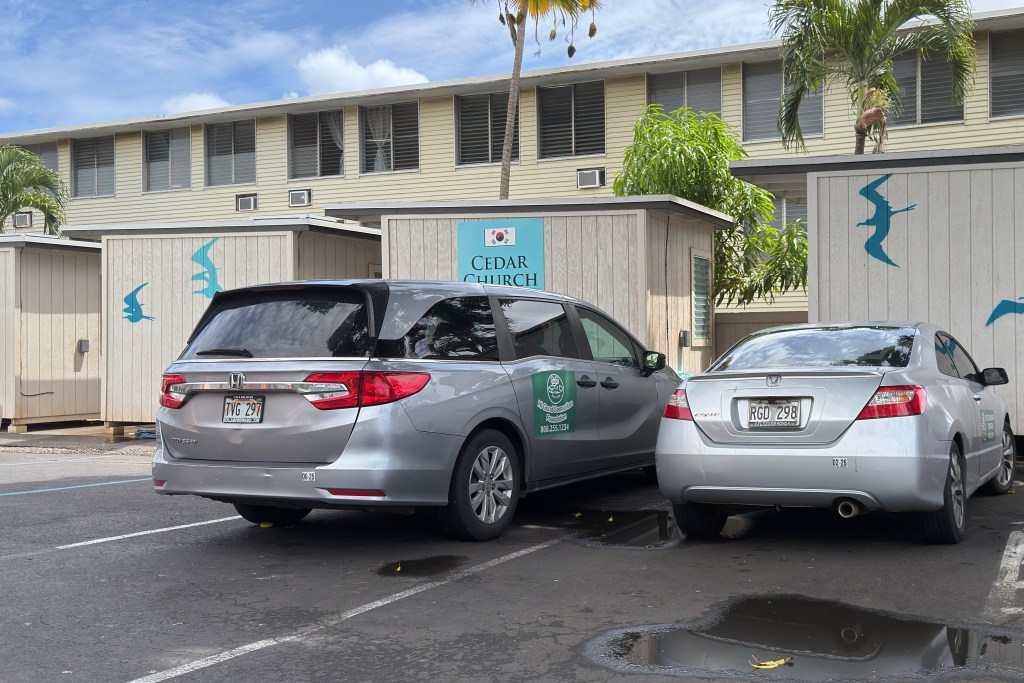
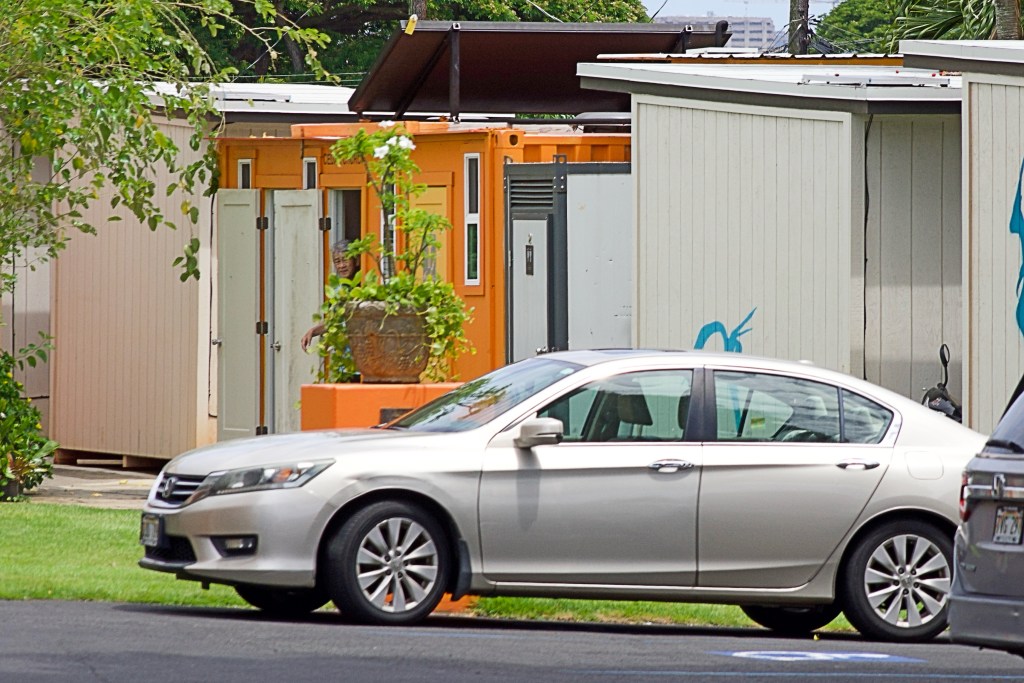
The 20 state-owned units were installed last year in the parking lot of the Hawaii Cedar Church in Kalihi. The kauhale currently shelters kūpuna and families.
The state’s Office on Homelessness and Housing Solutions is demanding that a Korean church either return or pay $20,000 apiece to buy 20 state-owned tiny housing units installed in their Honolulu parking lot.
The demands were outlined in a letter sent to the pastor of Hawaii Cedar Church by the governor’s homelessness coordinator, Jun Yang. In it, Yang said the Kalihi church was not authorized to use the units and must immediately stop.
The units are occupied by previously unhoused kūpuna and families. Installation of the units was completed in August during the tenure of Yang’s predecessor, John Mizuno, using donated contracting services.
Gov. Josh Green has made tiny homes a cornerstone of the state response to endemic homelessness and he set a target to build 30 kauhale villages as part of his pledge to cut the state’s homeless population in half by 2026. At the opening of another kauhale in December, Green talked about the need for “continued partnerships as we work together to make lasting progress.”
The Cedar Church kauhale was specifically named in a presentation Green and Honolulu Mayor Rick Blangiardi gave in May last year about Hawaiʻi’s response to homelessness as one of 17 projects then on track to open.
But Civil Beat has confirmed the state and church had no written agreement regarding the installation of the 20 units, and that appears to be where the church project has run afoul of Yang’s office.
Yang declined a request for an interview Friday and in an emailed statement said the letter was sent in anticipation of a management and performance audit of the state’s Kauhale Initiative required under a bill approved by legislators this session and sent to the governor for approval.
“As such, we are taking steps to ensure that state property is safeguarded, state contracting standards are met, and that tiny homes like those on the grounds of Cedar Church in Kalihi, are used in accordance with state standards for kauhale services,” he wrote.
Yang’s letter makes no mention of contracting standards, kauhale services or safeguarding state property in the letter — and only outlines conditions for the return or purchase of the units.
The correspondence took the church pastor the Rev. Duk Whan Kim by surprise, according to the church’s attorney, Ernie Martin. Attempts to reach Kim directly were unsuccessful.
Martin said Kim had worked closely with the state homelessness office on the project under Mizuno’s leadership and believed there was a mutual understanding about the units and their intended use on church property. Martin said he has contacted Yang’s office and is working to resolve the conflict.
The letter gave the church a May 27 deadline to respond or the state would “immediately arrange to remove the property,” but as of Monday the units were still in place and occupied.
Mizuno — who suddenly stepped down as the state’s homelessness coordinator in February and now works as a special advisor to the governor — did not respond to voicemail or texts requesting comment. Mizuno’s deputy director, Eric Ford, declined to be interviewed when reached by phone.
Rep. Lisa Marten, who chairs the House Committee on Human Services and Homelessness, said Monday she hopes the conflict can be resolved because she is impressed by the church’s commitment to helping homeless and vulnerable people after visiting the site, “but they could do more.”
Given the state’s move to more formal contracts with its kauhale partners, Marten said she wasn’t surprised the homelessness office was doing its due diligence.
The state has no data on residents and no say in who gets to access the services at the church, she said. But the additional documentation could eventually enable the congregation to access more state funding support — including money already budgeted — that could enable them to provide additional services, including medical.
Return Units Or Buy Them, State Says
The 20 units on the church property off Kamehameha IV Road were purchased by the state from HomeAid Hawaiʻi as part of its production of tiny homes for the Kauhale Initiative, CEO Kimo Carvalho confirmed.
Competitive bidding for the construction of the units was waived under an emergency housing proclamation issued by Green in September 2023, and HomeAid has been the sole-source supplier. HomeAid Hawaiʻi produced 1,079 of those units in 2024, according to its website. 273 of those units were designated for Oʻahu and Maui.
“The former homeless coordinator took 20 of those units to Cedar Church in July, and that’s the extent of HomeAid’s involvement,” Carvalho told Civil Beat.
But the nonprofit was not the sole-source contractor for installing all the kauhale sites, Carvalho said, adding that the grading of the church site and utility connections were completed using donated labor and materials from another company, Prometheus Construction.
Prometheus VP Cliff Tillotson declined to be interviewed for this story. Ford, Mizuno’s former deputy, now works for the company.
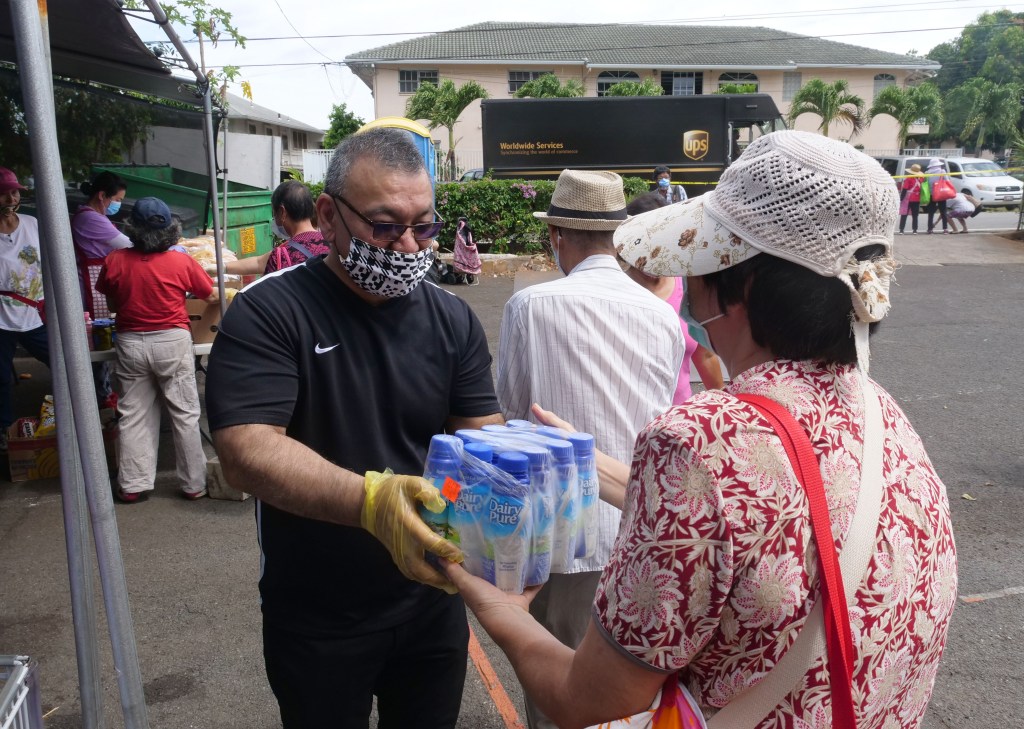
Hawaii Cedar Church is a Korean congregation and sits on a 30,000-square-foot parcel — including the parking lot where the kauhale are located — purchased for $1.34 million in December 2011, county property records show. The church hosts a food pantry, and has a history of providing food relief and emergency housing, previous reporting shows.
The church has also operated the Waiʻanae Cedar Farm, a 4-acre property where it placed small sheds to provide low-cost emergency housing, Hawaii News Now reported in 2021.
Mizuno and Kim — the pastor at Cedar Church — have a connection dating back more than a decade when Mizuno was state representative for Kalihi, before he resigned in December 2023 after Green tapped him to become the state’s homelessness coordinator.
Mizuno replaced James Koshiba who had been in the state role a year and had “set the stage” for the ambitious project, Green said. A dozen kauhale opened under Mizuno’s watch, and discussions for Cedar Church began around April of 2024.
Speaking to the Kalihi-Pālama Neighborhood Board in July, Mizuno said the Cedar Church project was “the first Kūpuna Kauhale for homeless kūpuna over 60 years old and those that may be coming out of the ER, medical respite patients, or medically discharged.”
In August, Mizuno posted a video walkthrough of the completed kauhale to Facebook, showing installed living spaces, amenities including shower units and laundry, and individual garden beds.
Six months later, Mizuno was publicly criticizing the costs of running some of the state-funded kauhale and he stepped down from the role in February, taking on a special adviser position in the same office. He was replaced by Yang, former homeless coordinator for the state Department of Transportation.
The church appears to have its fingers caught in the door now that the new state homelessness czar wants to tidy up the books.
A Star-Advertiser report on July 17, 2024, says HomeAid Hawaiʻi’s 100-square-foot homes cost $16,000 to produce. Carvalho is featured in the photo story, which shows housing units heading to Hawaii Cedar Church, according to the caption.
Yang’s letter, however, asks the church to pay $20,000 per unit if they move ahead with a plan to buy them. “If the HCC wished to purchase the units, payment shall be made to the state within 45 days of the date of this letter.”
As of Monday, it’s unclear whether the church is considering that option.
The cost of the housing units themselves, concerns about kauhale running costs and questions about the absence of receipts for the estimated $37 million in HomeAid Hawaiʻi contracts underpinned conference committee discussions on housing this legislative session.
Lawmakers ultimately voted to expand Green’s Kauhale Initiative, providing a $50 million funding base through 2026 and 2027.
The funding package also included provisions for quarterly reports on expenditures from Yang’s department, and the performance and management audit of the Kauhale Initiative — the one outlined in the state’s May 16 letter to Cedar Church.
Civil Beat’s community health coverage is supported in part by the Atherton Family Foundation.
Read the state’s letter in full:

